Your receptionist is juggling three patients at the counter, the queue outside is growing, and the file for the patient sitting in front of you is nowhere to be found. Sound familiar?
According to the Pakistan Medical Commission, there are over 220,000 registered doctors in the country — yet the vast majority of clinics still run on paper registers, handwritten prescriptions, and verbal patient recall. A 2023 WHO report on primary healthcare in South Asia found that poor medical record-keeping contributes to up to 30% of preventable clinical errors in outpatient settings.
The right clinic management software in Pakistan doesn’t just digitize your paperwork — it cuts your prescription time, eliminates the chaos of double bookings, and gives you a patient’s full medical history before you’ve finished washing your hands.
This guide breaks down what clinic software actually does in a Pakistani setting, what separates a tool built for your clinic from a generic international product, and which solution experienced doctors across Lahore, Karachi, Multan, and beyond are choosing in 2026.
What Is Clinic Management Software — and Why Do Pakistani Clinics Need It Now?
Clinic management software is a digital system that replaces paper-based processes with a single platform handling appointments, patient records, prescriptions, billing, and reporting. For a Pakistani clinic, the urgency is no longer theoretical — it’s operational.
Pakistan’s outpatient healthcare load is among the highest in the region. The average GP in Lahore or Multan sees between 40 and 80 patients per day. Without a structured system, that volume produces misfiled records, forgotten follow-ups, and prescriptions that staff misread. These aren’t inconveniences — they are clinical risks.
For years, international software solutions entered the Pakistani market and failed. They assumed stable internet, English-literate staff, and billing structures that don’t match PKR-based practice economics. Most Pakistani clinics run on a walk-in-first model, not appointment-only. Many receptionists are more comfortable in Urdu than English. And in cities like Larkana, Toba Tek Singh, or Sahiwal, internet connectivity is not something you can build a clinical workflow around.
A purpose-built clinic management system for Pakistan understands these realities out of the box. It works offline when the connection drops. It runs in Urdu. It handles tokens and walk-ins alongside booked appointments without breaking the queue. And it costs what a mid-size Pakistani clinic can actually afford — not a dollar-denominated SaaS subscription that bleeds foreign exchange every month.
What Features Actually Matter in the Best EMR Software Pakistan Has to Offer?
The best EMR software in Pakistan is one your receptionist can use on day one, your nurse can navigate without training, and you can access from home at 10 PM when a patient calls with a question.
Feature lists can be misleading. Every vendor claims to have “complete” records and “smart” scheduling. What separates genuinely useful software from shelfware is whether its features fit your actual daily workflow — not a hypothetical ideal workflow from a US outpatient manual.
Appointment Scheduling and Live Queue Management
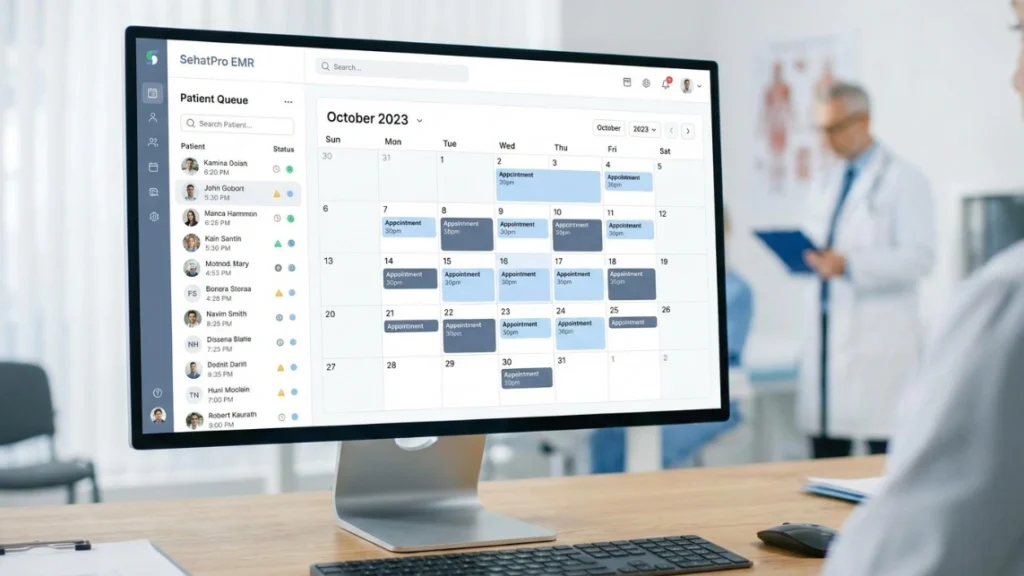
For a clinic in Islamabad or Faisalabad running mixed walk-in and booked slots, the scheduling system must handle both simultaneously without creating two separate lists that staff have to manually reconcile. SehatPro’s appointment scheduling and queue management system handles this automatically — patients who walk in are issued a token that flows into the same live queue as booked appointments, visible on any screen in the clinic.
Double bookings drop to zero. The receptionist stops shouting numbers across a waiting room. You see, in real time, how many patients are ahead and how long the current consultation has been running.
Electronic Medical Records and Lifetime Patient History
A cardiologist in Karachi seeing a patient for the third time in six months should not be reconstructing that patient’s history from scratch. Yet that is exactly what happens when records live in paper files across three different cabinets.
SehatPro’s unlimited patient records system stores a complete clinical timeline — every visit, every diagnosis, every prescription — accessible from any device, from any clinic branch. A pediatrician in Rawalpindi who has a patient’s complete growth and vaccination record at their fingertips makes better decisions than one working blind. A gynecologist in Lahore whose patient’s previous ultrasound notes are a single click away can spend the consultation treating, not reconstructing.
Fast Prescription Writing with Diagnosis Bundles
Handwritten prescriptions produce errors. They also take time. In a high-volume clinic in Multan where you are seeing 60 patients before noon, shaving two minutes off each prescription adds up to two hours reclaimed per day.
SehatPro’s fast consultation and prescription module offers one-click diagnosis bundles — pre-built medication sets for your most common presentations. A GP dealing with URI cases, a dermatologist prescribing for eczema, a pulmonologist managing COPD follow-ups — each can save their standard regimen once and apply it in seconds. Prescriptions print ready, legible, and signed.
How Does Clinic Management Software in Pakistan Handle the Walk-In Patient Problem?
Walk-in patients are not an edge case in Pakistani healthcare — they are the dominant patient type. Most people in Karachi, Multan, or Mirpur-AJK do not book appointments. They walk in, wait, and expect to be seen. Any clinic management software that treats walk-ins as a workaround has already failed the Pakistani market.
A proper queue management system issues tokens at entry, displays wait times on a screen in the waiting area, and allows the doctor to call the next patient from inside the consultation room. No shouting. No confusion. No patient leaving because they didn’t hear their name.
SehatPro’s live token system integrates walk-ins and booked patients in a single queue, managed from one screen. Receptionists in clinics from Sialkot to Larkana report that patient complaints about waiting time drop significantly within the first week of use — not because patients wait less, but because they can see the queue moving and trust the system.
For multi-branch clinics in Faisalabad or Lahore running separate morning and evening sessions, the system handles independent token sequences per session, per doctor, per branch — all feeding into a single centralized reporting view at the end of the day.
Is Cloud-Based Clinic Software Safe When Internet Is Unreliable in Pakistan?
Cloud-based clinic software offers doctors access to patient records from anywhere — home, a second branch, or even while covering an emergency at a hospital. But the question Pakistani doctors ask first is: what happens when the internet cuts out?
It is a legitimate concern. Power and connectivity disruptions are routine in cities like Sahiwal, Toba Tek Singh, and smaller towns in interior Sindh and southern Punjab. A software system that freezes without internet is useless at the exact moment you need it most.
SehatPro addresses this directly with two deployment options. The standard cloud plan gives you access from any browser on any device — mobile, tablet, or PC — so you can check records from home the night before a complex case, or log in from your second clinic across town. For areas with genuinely unreliable connectivity, the ProCare plan includes an offline installation option that runs locally on a PC and syncs to the cloud whenever a connection is available. Your clinic keeps running. Your records keep updating.
SehatPro’s data privacy and security architecture uses end-to-end encryption and automated cloud backups, so even if your local device is damaged or lost, no patient data goes with it.
PRO TIP — From SehatPro’s Experience with 135+ Doctors: The single most common mistake clinics make when adopting new software is trying to digitize everything on day one. Start with just appointments and the daily queue for the first week. Let the receptionist get confident. Then activate EMR. Then prescriptions. Phased onboarding is why clinics in cities like Larkana and Mirpur-AJK — where staff have never used a digital system — are fully operational within 10 to 14 days.
Paper Files vs. Clinic Management Software: What Are You Actually Losing?
If you have been running on paper for 10 years and your clinic is still standing, it is easy to rationalize the status quo. But the cost of paper-based management is rarely visible as a single line item — it shows up as staff overtime, repeat tests ordered because records are missing, and patients who quietly switch to a more organized clinic down the road.
Here is what that comparison looks like side by side:
| Factor | Paper-Based Clinic | SehatPro (Cloud-Based) |
|---|---|---|
| Patient record retrieval | 3–10 minutes searching files | Under 10 seconds, any device |
| Prescription writing time | 3–5 minutes per patient | Under 60 seconds with diagnosis bundles |
| Double booking risk | High — manual registers overlap | Zero — live scheduling with conflict detection |
| No-show rate | 20–35% with no reminders | Drops with automated SMS/WhatsApp reminders |
| Data loss risk | High — fire, flood, misplacement | Near-zero — encrypted cloud backups |
| Urdu language support | Native (handwritten) | Digital Urdu interface + 27 additional languages |
| Remote record access | Not possible | Any device, anywhere with internet |
| Monthly cost (mid-size clinic) | PKR 5,000–15,000 in staff overhead + stationery | From PKR 2,999/month (CareStart plan) |
| Staff training time | None (existing habit) | 1–3 days for full adoption |
| Reporting and insights | Manual tallying, hours of work | One-click daily, monthly, exportable to Excel |
The numbers tell a clear story. But the more important shift is qualitative: when your receptionist stops managing chaos and starts managing patients, your clinic feels different from the moment someone walks in the door.
How Do Automated Reminders Reduce No-Shows in Pakistani Clinics?
A gynecologist in Lahore running an antenatal clinic schedules 30 follow-up visits a week. Without a reminder system, 8 to 10 of those patients simply do not show up — forgetting the date, assuming they can come whenever they like, or switching to a closer facility.
SehatPro’s automated SMS and WhatsApp reminder system sends appointment confirmations the day before, with the option to include medicine reminders for chronic disease patients. For a cardiologist in Karachi managing hypertension follow-ups, or a pulmonologist in Islamabad tracking post-TB patients, this is not a luxury feature — it is a clinical continuity tool.
WhatsApp penetration in Pakistan exceeds 60% of smartphone users, making it the most reliable notification channel for patients across income levels and geographies. A reminder that arrives on WhatsApp gets read. A reminder that sits in an SMS inbox might not.
The result: clinics using SehatPro’s reminder system report a measurable reduction in no-show rates within the first month — meaning fewer empty slots, fewer rescheduling headaches, and more predictable revenue.
What Does Clinic Management Software Cost in Pakistan — and Is It Worth It?
Cost is the question every clinic owner asks before signing up for anything. And it is a fair question, because the Pakistani software market has a history of products that start cheap and quietly add fees once you are dependent.
SehatPro publishes its pricing transparently, structured to fit different clinic sizes:
- CareStart — PKR 2,999/month. Designed for solo GPs or single-branch clinics just starting out. Covers core appointment scheduling, patient records, and prescription printing.
- ProCare — PKR 79,999 one-time. Includes the offline installation option for clinics in areas with unstable internet, plus advanced features and priority support. No recurring monthly cost.
- EnterpriseCare — Custom pricing for multi-branch hospitals and large practices in cities like Lahore, Karachi, and Faisalabad that need centralized records across 3+ locations.
For a clinic seeing 50 patients a day at PKR 500 per visit, that is PKR 25,000 in daily revenue. The CareStart plan at PKR 2,999/month costs less than what most clinics spend on prescription pads, registers, and file folders — and it replaces all of them.
SehatPro’s patient reports and insights module also gives clinic owners daily and monthly summaries exportable to Excel — so you can see, for the first time, exactly how many patients you are seeing per day, per diagnosis category, per referring doctor. That data has real financial value: it tells you when to add a second session, when a service is underperforming, and where your growth is actually coming from.
How Does SehatPro Support Multi-Branch Clinics Across Pakistan?
A dermatologist running two clinics — one in Gulberg, Lahore and one in DHA — needs to know that a patient who walked into the first clinic last Tuesday can be retrieved instantly at the second clinic today. Without a centralized system, that means a phone call between receptionists, a physical record transfer, or starting from scratch.
SehatPro’s multi-branch clinic support gives each branch its own scheduling interface and local queue management, while feeding all patient records into a single shared database. The doctor logs in from either location and sees the complete patient history regardless of where the initial visit occurred.
Role-based access keeps data protected: the receptionist at Branch A can see appointments but not financial reports; the lab technician at Branch B can enter results but not edit clinical notes; the doctor can access everything. A gastroenterologist in Karachi running a hospital-affiliated clinic alongside a private practice can structure these permissions to match exactly how their staff operates.
Conclusion
The paper-based clinic is not just slow — it is costing you patients, revenue, and clinical quality every day. Clinic management software in Pakistan has matured enough in 2026 that you no longer have to choose between affordability and professional capability.
Here are four things to take away from this guide:
First, the right software must be built for Pakistani clinical realities — walk-in patients, Urdu-speaking staff, and areas where internet is not always reliable. Generic international tools will not do this.
Second, features like automated reminders, one-click diagnosis bundles, and live token queues are not luxuries — they directly reduce no-shows, cut consultation time, and eliminate administrative chaos.
Third, cloud-based access with an offline installation option gives you the best of both worlds: mobility and reliability regardless of your connectivity situation.
Fourth, pricing matters. At PKR 2,999/month, there is no longer a financial argument for staying on paper.
FAQ
1. What is the best clinic management software in Pakistan for solo GPs?
The best clinic management software in Pakistan for a solo GP is one that handles appointments, patient records, and prescriptions without needing a dedicated IT setup. SehatPro’s CareStart plan at PKR 2,999/month is built precisely for solo practitioners — it requires no server, runs in Urdu, and most receptionists are comfortable using it within 2 to 3 days.
2. Does clinic software in Pakistan work without a stable internet connection?
Yes — SehatPro’s ProCare plan includes an offline desktop installation that runs locally on your clinic’s PC and syncs to the cloud when connectivity is restored. This is specifically designed for clinics in areas like Sahiwal, Toba Tek Singh, or interior Sindh where internet disruptions are common. Your workflow continues uninterrupted regardless of connection status.
3. How much does EMR software in Pakistan typically cost?
EMR software in Pakistan ranges from PKR 2,999/month for basic cloud-based plans to one-time installations above PKR 50,000 for offline or enterprise setups. SehatPro’s transparent pricing starts at PKR 2,999/month (CareStart), with a one-time ProCare option at PKR 79,999 and custom EnterpriseCare for multi-branch hospitals. There are no hidden fees.
4. Is clinic management software easy for Urdu-speaking staff to use?
SehatPro supports Urdu, English, Arabic, Sindhi, and 27 additional languages, with a fully localized Urdu interface that non-English-literate receptionists can navigate comfortably. The system is designed so that staff with basic smartphone familiarity can handle appointment booking and patient check-in from day one, without formal IT training.
5. How does clinic software protect patient data privacy in Pakistan?
SehatPro uses end-to-end encryption and automated cloud backups to protect patient records. Role-based access controls ensure that only authorised staff can view or edit clinical data — receptionists, lab staff, and doctors each have different permission levels. Patient data is stored on secure servers, not on local devices that can be lost or damaged.
6. How long does it take to set up clinic management software in Pakistan?
Most clinics using SehatPro are fully operational within 3 to 7 days. The setup involves no server installation for cloud-based plans — you log in from any browser. Onboarding support is available in Urdu, and SehatPro’s team provides guided setup for clinics in all cities including smaller cities like Mirpur-AJK, Larkana, and Sahiwal where remote support is especially important.