How to Reduce Patient No-Shows with SMS & WhatsApp Reminders
Every missed appointment costs you. Not just the slot — the electricity, the staff wages, the preparation. A general physician in Sahiwal running 40 appointments a day loses roughly 8 to 10 patients weekly to no-shows, according to data shared by clinic managers using SehatPro. That’s 300 to 400 missed consultations a year, quietly draining revenue you never see on a ledger.
WhatsApp reminders for clinics are the simplest fix most Pakistani doctors aren’t using yet. Not because they don’t know about reminders — but because their current software either doesn’t have it, charges extra, or requires someone to send messages manually. That defeats the purpose.
This article walks you through exactly how SMS and WhatsApp appointment reminders work, why they matter for Pakistani clinics specifically, and how SehatPro automates the whole process so your receptionist can focus on patients walking through the door — not chasing the ones who forgot their appointment.
Why Patient No-Shows Are Worse in Pakistan Than You Realize
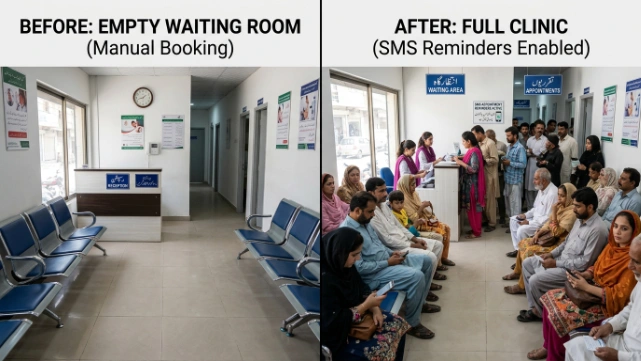
A missed appointment in Pakistan isn’t just an empty chair. It disrupts your token queue, delays walk-in patients, and throws off your entire afternoon.
The no-show problem in Pakistan’s outpatient clinics runs deeper than most clinic owners track. Walk-in culture means patients already treat appointments loosely — many book a slot “just in case” and walk in elsewhere if the queue seems shorter. When there’s no reminder nudging them back to your clinic, they simply don’t show.
A 2022 study published in the Journal of the Pakistan Medical Association found that outpatient no-show rates in urban clinics ranged from 23% to 38%, with the highest rates in clinics that relied on manual follow-up or no reminder system at all. In gynecology clinics in Lahore and pediatric practices in Islamabad, the problem is compounded by patients who book multiple clinics and forget which one confirmed.
For a cardiologist in Karachi running a full schedule of 30 patients, a 25% no-show rate means 7 or 8 empty slots per day. That’s not a minor inconvenience — it’s a structural revenue leak that compounds every month.
The solution isn’t hiring another receptionist. It’s making your existing workflow smarter.
What WhatsApp Reminders for Clinics Actually Do (And What They Don’t)
WhatsApp reminders for clinics send an automated message to the patient’s number as soon as the appointment is booked — and again 24 hours before the visit. No manual steps. No extra staff. No remembering.
This is different from a receptionist calling patients or sending manual WhatsApp messages from a personal phone. That approach takes 30 to 45 minutes per day, creates privacy concerns when your staff’s personal number is exposed, and breaks down whenever the receptionist is absent or overwhelmed with walk-ins.
Automated reminders through SehatPro’s automated SMS and WhatsApp reminder system do three things:
1. Confirm the Appointment Immediately
The moment your receptionist books a slot, the patient receives a WhatsApp or SMS confirmation with the date, time, doctor’s name, and clinic address. No back-and-forth. No “did you note the time?”
2. Send a Pre-Visit Reminder
Typically 24 hours and again 2 hours before the appointment, the patient receives a second reminder. This catches the forgetful and the busy — which, in a city like Faisalabad where people commute long distances for specialist care, makes a real difference.
3. Follow Up for Medicines or Return Visits
For clinics managing chronic patients — diabetics, hypertension cases, pulmonology patients on long-term medication — SehatPro can also send medicine reminders and follow-up prompts, reducing the gap between visits that leads to complications.
What reminders don’t do: they don’t replace your receptionist for rescheduling conversations or handling urgent walk-ins. They handle the routine communication so your staff can handle the human interactions that actually need them.
SMS vs WhatsApp: Which Reminder Works Better for Your Clinic?
For most clinics in Pakistan, WhatsApp outperforms SMS on open rates — but SMS remains the safer fallback. The right setup uses both.
Pakistan has over 84 million WhatsApp users as of 2024, according to DataReportal. In cities like Lahore, Karachi, and Islamabad, nearly every patient with a smartphone uses WhatsApp daily. Message open rates for WhatsApp are consistently above 90%, compared to SMS at roughly 70–80%.
But SMS still matters — and here’s why: rural clinics in areas like Toba Tek Singh, Larkana, or Mirpur-AJK serve patients on basic phones without WhatsApp. For a gynecologist in a peri-urban clinic outside Multan, SMS is the only reliable channel. It doesn’t require internet, works on any handset, and delivers even when connectivity is weak.
| Feature | WhatsApp Reminder | SMS Reminder |
|---|---|---|
| Requires smartphone | Yes | No |
| Works without internet | No | Yes |
| Open rate (Pakistan avg.) | 90–95% | 70–80% |
| Supports media/images | Yes | No |
| Cost per message | Lower (data-based) | Per-message charge |
| Works in rural areas | Limited | Reliable |
| Patient familiarity | Very high (urban) | Universal |
SehatPro lets you set both channels simultaneously. The system tries WhatsApp first; if undelivered, it falls back to SMS. For clinics in Sialkot, Sahiwal, or areas with mixed connectivity, this dual-channel approach ensures no reminder falls through.
How SehatPro Sets Up WhatsApp Reminders for Your Clinic in Under an Hour
You don’t need an IT team, a developer, or a week of training. SehatPro’s reminder system is active within hours of setup — and your receptionist runs it from the same booking screen they already use.
Most clinic software sold in Pakistan treats WhatsApp integration as an add-on or a premium feature that requires a separate setup call. SehatPro built it directly into the appointment workflow. Here’s how it works:
Step-by-Step: Activating Reminders in SehatPro
- Log into your SehatPro account from any device — mobile, tablet, or PC.
- Go to Settings → Communication Preferences.
- Toggle on WhatsApp Reminders and/or SMS Reminders — both options are visible on the same screen.
- Set your reminder timing — choose 24 hours before, 2 hours before, or both.
- Customize the message template — add your clinic name, doctor’s name, or any specific instructions (e.g., “Please bring your previous reports”).
- Save and activate. All future bookings will trigger reminders automatically.
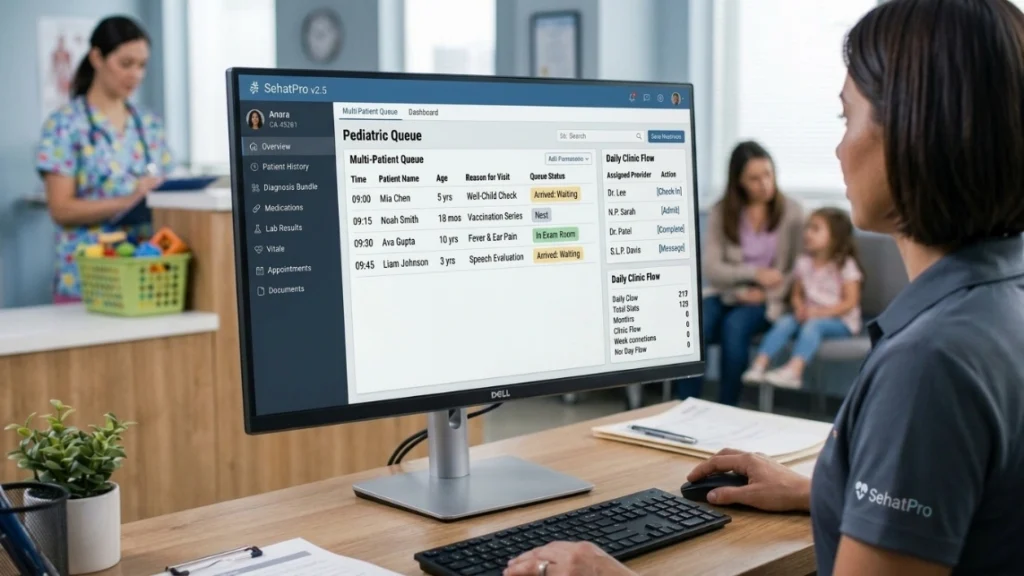
Your receptionist doesn’t touch this again. Every new appointment entered via SehatPro’s appointment scheduling and queue management system automatically queues a reminder without any extra step.
For multilingual clinics — or for doctors in Lahore and Karachi whose patients communicate in Urdu — message templates can be written in Urdu, English, or a mix. SehatPro’s interface supports Urdu input natively, which means your Urdu-speaking staff can set this up without switching languages.
PRO TIP — From SehatPro’s Experience With 135+ Doctors Across Pakistan: The biggest mistake clinics make is sending only one reminder — at booking. Patients who book 5 to 7 days in advance almost always need a second reminder the day before. In our experience with pediatric clinics in Islamabad and general practices in Faisalabad, adding that 24-hour pre-visit message alone cut no-shows by roughly 18%. Set both reminders. It takes 30 seconds in settings and saves hours of chasing.
Reduce Patient No-Shows Without Adding to Your Staff’s Workload
The goal is zero extra steps for your receptionist. Not a new process — a smarter version of the one they already follow.
Clinic receptionists in Pakistan are already stretched. Between walk-in token management, phone calls, prescription printing, and handling insurance queries, adding “send reminder messages” to their list creates errors and burnout. In a busy general practice in Rawalpindi or a multi-doctor clinic in Faisalabad, this isn’t hypothetical — it’s the daily reality.
SehatPro’s automated reminder system removes the human dependency entirely. The receptionist books the appointment. Everything else is automatic.
But reducing no-shows is only half the equation. The other half is knowing which patients actually confirmed, cancelled, or are likely to be late. SehatPro’s reporting dashboard gives you:
- Daily appointment confirmation rate — how many patients confirmed receipt of their reminder
- No-show tracking by doctor or specialization — useful for multi-doctor clinics in Lahore or Karachi
- Rescheduling trends — which time slots attract the most last-minute cancellations
With this data, a dermatologist in Sialkot can quickly see that Saturday afternoon slots have a 40% no-show rate and restructure accordingly. A pulmonologist in Karachi can identify which chronic patients keep missing follow-ups and flag them for a personal call before the next visit.
Access to this data connects directly to SehatPro’s patient reports and insights dashboard, which exports to Excel for clinics that want to analyze trends across months.
Clinic Automation Software: What Should It Actually Automate?
The word “automation” gets thrown around a lot. Here’s what it should mean for a real clinic in Multan or Lahore: fewer manual steps, fewer errors, and fewer patients slipping through the cracks.
When clinic owners in Pakistan say they want clinic automation software, they usually mean one of three things:
- They’re tired of their receptionist writing names in a notebook and losing patients in the shuffle.
- They want their patients to feel like they’re being looked after, even between visits.
- They don’t want to hire a second receptionist just to keep up with communications.
WhatsApp and SMS reminders cover all three. But real clinic automation goes further. SehatPro’s EMR and prescription system stores every patient’s consultation history — so when a patient returns after six months, the doctor sees their previous diagnosis, prescriptions, and test results immediately. No paper file hunting. No asking the patient to repeat their history.
For a gastroenterologist in Islamabad managing patients with recurring conditions, this matters enormously. For a dentist in Karachi running 50 appointments a day, it’s the difference between a smooth consultation and a delayed one.
Combine automated reminders with SehatPro’s unlimited patient records system, and you’ve automated not just the appointment — but the entire patient journey, from first booking to long-term care.
Does Your Patient Data Stay Safe When Using WhatsApp Reminders?
Patient data moving through WhatsApp or SMS raises legitimate concerns — especially for gynecologists, psychiatrists, or dermatologists handling sensitive cases. Here’s what actually protects your patients.
The concern is valid. A reminder message sent over an unsecured channel could expose patient names, diagnosis references, or appointment details to third parties. For clinics handling HIV/AIDS cases in Lahore, reproductive health in Multan, or mental health consultations in Islamabad, this is not a minor issue.
SehatPro handles this by:
- Sending reminders through verified WhatsApp Business API channels — not personal numbers
- Limiting message content to appointment date, time, and clinic name — no diagnosis or clinical details
- Storing all patient data on encrypted cloud servers with secure backups
- Keeping patient records accessible only to authorized roles — doctors, receptionists, and admins each see only what they’re permitted to
For clinics worried about data loss during power outages or internet disruptions in areas like Sahiwal or Toba Tek Singh, SehatPro’s ProCare plan includes an offline installation option that syncs when connectivity is restored. Full details on how data is protected are available on SehatPro’s data privacy and security page.
No patient’s clinical information should ever travel in a reminder message. SehatPro’s templates are designed to prevent that.
How Multi-Branch Clinics in Pakistan Use Reminders Across Locations
For clinics operating across Lahore, Karachi, and Faisalabad simultaneously, centralized reminders prevent double-bookings and ensure no branch operates in isolation.
Multi-branch clinic management is one of the most chaotic operational challenges Pakistani healthcare faces. A patient books at the Gulberg branch. The DHA branch doesn’t know. The doctor shows up at the wrong location. The patient waits. Everyone is frustrated.
SehatPro’s multi-branch support gives you a single dashboard where appointment reminders go out per branch — automatically including the correct address, doctor name, and timing for each location. A gynaecologist running clinics in both Lahore and Sahiwal can see all bookings from one login, with reminders firing separately and correctly for each branch.
For hospital administrators managing multi-specialty wings in Karachi or Faisalabad, this eliminates the need for branch coordinators to manage communication manually. Reminders simply work — for every branch, every doctor, every slot.
CONCLUSION
Missed appointments don’t just hurt revenue — they disrupt patients who needed care and didn’t get rescheduled. WhatsApp reminders for clinics are the simplest way to close that gap.
Here are four things to take away from this article:
- Automate both channels. Set up WhatsApp and SMS reminders together so urban and rural patients both receive confirmation, regardless of their phone type or connectivity.
- Send two reminders, not one. Booking confirmation plus a 24-hour pre-visit nudge consistently produces lower no-show rates than a single message.
- Use the data. Your reminder system generates no-show trends by slot, doctor, and time of day. Use it to restructure your schedule around what your patients actually show up for.
- Security isn’t optional. Keep reminder messages free of clinical details. Patient trust is built on what you don’t send, not just what you do.
SehatPro packages all of this — reminders, records, scheduling, and reporting — in a single system built for Pakistani clinics, with Urdu support, offline options, and pricing plans starting at PKR 2,999/month.
FAQ
What are WhatsApp reminders for clinics and how do they work?
WhatsApp reminders for clinics are automated messages sent to patients before their appointment — confirming the date, time, and clinic location. When a receptionist books a slot in clinic management software like SehatPro, the system sends a WhatsApp message instantly and again 24 hours before the visit, without any manual action from staff.
How much do SMS appointment reminders in Pakistan typically cost?
Costs vary by provider. Some software charges per message; others bundle reminders into monthly plans. SehatPro includes both SMS and WhatsApp reminders in its standard plans starting at PKR 2,999/month — no per-message charges. This makes it practical for clinics sending 30 to 80 appointment confirmations daily without worrying about per-unit costs.
Can I send appointment reminders in Urdu for my Pakistani patients?
Yes. SehatPro supports Urdu-language message templates natively. Your receptionist can write reminder messages in Urdu directly within the system — no transliteration workarounds required. This is especially useful for clinics in Multan, Sahiwal, or Larkana where patients and staff primarily communicate in Urdu.
Is patient data safe when sending WhatsApp appointment reminders?
Safe reminder systems never include clinical details — only date, time, and clinic name. SehatPro sends reminders through verified WhatsApp Business API channels, stores patient data on encrypted cloud servers, and restricts access by role. Patients’ medical histories remain inside the system and are never transmitted through reminder messages.
How quickly can I set up automated reminders in clinic management software? Setup takes under an hour. In SehatPro, you activate WhatsApp and SMS reminders from the Settings panel, choose your timing (booking confirmation, 24 hours before, 2 hours before), write your template, and save. From that point forward, every new appointment automatically triggers a reminder without any additional steps from your receptionist.
Do automated reminders actually reduce patient no-shows in Pakistan?
Yes. A 2022 study in the Journal of the Pakistan Medical Association found outpatient no-show rates in clinics with no reminder system ran as high as 38%. Clinics using automated reminders — particularly dual-channel SMS and WhatsApp — report no-show reductions of 20–30%. SehatPro’s own experience with 135+ doctors across Pakistan shows the largest impact comes from adding a 24-hour pre-visit reminder in addition to booking confirmation.