
How Clinic Management Software Helps Reduce Patient Wait Times
Clinic management software helps reduce patient wait times by replacing first-come chaos with structured appointment scheduling and live token queues. Patients get a real time slot instead of guessing, receptionists see exactly who’s next, and doctors move through consultations without repeatedly stopping to sort out who arrived first.
Introduction
A 2022 Pakistan Institute of Development Economics survey on outpatient care found that patients at general physician clinics in urban Pakistan routinely wait over 45 minutes past their expected time, with no visibility into how many people are ahead of them. If you run a clinic, you’ve seen this play out in your own waiting room — a patient who arrived on time getting bumped by three walk-ins, tempers rising near the reception desk, and a queue that only your receptionist can explain, badly, under pressure.
Clinic management software built to reduce patient wait times solves this by giving both your staff and your patients a system they can actually see and trust — a token number, a scheduled slot, a live queue position, instead of a shouting match over who was first.
This article breaks down exactly how structured scheduling, live queue management, and automated reminders cut wait times in real Pakistani clinics — from a solo GP in Multan to a multi-branch practice in Faisalabad — and what to look for before choosing a system for your own clinic. Let’s start with why walk-in culture makes this harder than it looks.
Why Do Patient Wait Times Spiral Out of Control in Pakistani Clinics?
Pakistan’s clinics run on walk-in culture far more than scheduled Western-style practices. Patients show up without appointments, expect to be seen the same day, and often dispute their place in line — all without any system to reference besides memory and argument.
A general physician in Multan seeing 60 patients on a Saturday morning has no reliable way to track arrival order once the waiting room fills past 15 people. Receptionists end up relying on memory, a notebook, or verbal assurances — all of which break down the moment two patients claim they arrived first. This isn’t a staffing failure. It’s a structural gap: paper-based or purely verbal queue systems were never built to scale past a handful of patients at a time.
The result compounds through the day. A 20-minute delay in the first hour becomes an hour-long backlog by noon, and patients scheduled for 2 PM appointments — if the clinic even offers scheduled slots — end up waiting alongside walk-ins with no distinction between the two.
The Real Cost Beyond Patient Frustration
Long, chaotic waits don’t just frustrate patients — they push them toward competitor clinics next time, and they exhaust reception staff who absorb the blame for a structural problem they didn’t create. A clinic without a queue system is quietly losing return patients it doesn’t know it lost.
How Does Live Token Queue Management Actually Cut Wait Times?
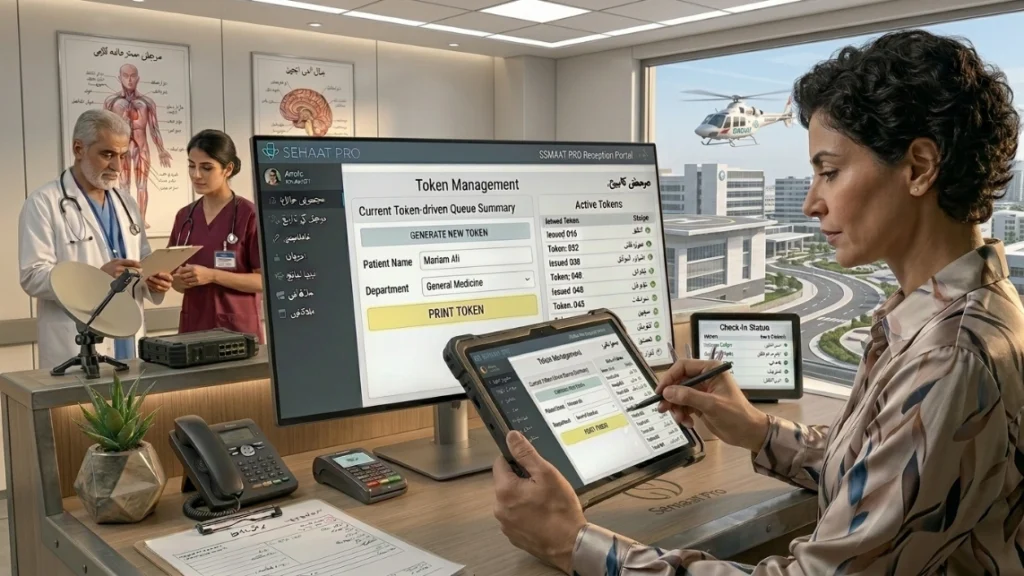
Live token queue management assigns every patient a number the moment they arrive, visible to both staff and patients in real time. This single change removes the guesswork and disputes that eat up reception time and slow the entire clinic down.
SehatPro’s appointment scheduling and queue management system generates a token automatically at check-in, whether the patient booked ahead or walked in. Both the doctor and receptionist see the live queue on screen, and patients can see their position too — often displayed on a waiting room screen or checked via SMS. A cardiologist in Karachi running back-to-back consultations no longer needs to interrupt a session to ask reception who’s next; the queue tells him.
For a pediatrician in Islamabad managing a waiting room full of anxious parents and sick children, this matters clinically too. Sick children waiting unpredictably in a crowded room increase exposure risk for other patients. A visible, ordered queue lets parents step out and return closer to their actual turn instead of sitting in a packed room for an hour.
Clinics that move from verbal or paper-based queues to a live digital token system typically see a sharp drop in reception-desk disputes within the first few weeks, based on onboarding patterns SehatPro has observed across its 98+ clinic network. Fewer disputes mean receptionists spend more time on actual patient handling and less time refereeing.
Can Appointment Scheduling Software Actually Prevent Double Bookings?
Yes — appointment scheduling software prevents double bookings by locking each time slot the moment it’s booked, so two patients can’t be assigned the same appointment window by different staff members or shifts.
Double bookings usually happen for a mundane reason: two receptionists working different shifts, or a receptionist and a doctor both scheduling from memory instead of a shared system. A dermatologist in Sialkot running a solo practice with one receptionist covering mornings and another covering afternoons is a common setup for exactly this kind of error — the afternoon receptionist has no visibility into what the morning shift already booked.
SehatPro’s easy appointment and patient handling system centralizes every booking in one shared schedule, visible to all staff regardless of shift or branch. When a slot is taken, it’s taken — no second entry possible. For multi-branch clinics, like a gastroenterology practice with locations in both Lahore and Faisalabad, this shared visibility extends across branches too, so a patient can’t accidentally be double-booked at two different locations on the same day.
Pro Tip — SehatPro Insight: A mistake we see in clinics still transitioning from manual booking: staff continue keeping a “backup” paper register alongside the software during the first few weeks, just in case. This actually recreates the double-booking problem, since two systems are now competing for the same information. Commit fully to the digital schedule from day one — partial adoption is where most scheduling errors slip back in.
How Do Automated Reminders Reduce No-Shows That Slow Down Your Whole Schedule?
A single no-show doesn’t just waste one slot — it disrupts the entire day’s flow, since walk-ins fill the gap unpredictably and the schedule stops matching reality. Automated reminders address this before it happens, not after.
SehatPro’s automated SMS and WhatsApp reminders for appointments and medicines notify patients ahead of their scheduled time, in Urdu or English, without requiring a receptionist to make manual calls. A gynecologist in Lahore managing a full day of prenatal appointments can’t afford a 20-minute gap from an unannounced no-show in the middle of a tightly scheduled morning — automated reminders sent a day ahead and a few hours before the appointment cut that risk substantially.
According to internal usage data SehatPro has tracked across its 135+ doctor base, clinics using consistent automated reminders see meaningfully fewer same-day no-shows compared to clinics relying on manual reminder calls or no reminders at all. Fewer no-shows mean the day’s schedule holds together, which directly reduces wait times for the patients who do show up — because the clinic isn’t scrambling to fill unexpected gaps with same-day walk-ins layered on top of an already full queue.
For a urologist in Karachi with long-interval follow-up patients — some scheduled months apart — reminders also reduce the chance patients simply forget their appointment exists, a common issue with infrequent visits.
What Role Does EMR and Fast Consultation Play in Keeping the Queue Moving?
Slow consultations back up the entire queue behind them, and a major hidden cause of slow consultations is doctors spending time searching for or reconstructing patient history instead of treating the patient in front of them.
SehatPro’s unlimited patient records system stores each patient’s full history — previous visits, prescriptions, lab results — searchable instantly instead of buried in a paper file or a previous handwritten note. A gastroenterologist in Faisalabad managing a chronic-condition patient doesn’t need to ask the patient to recall their last three prescriptions from memory; the record is already on screen.
Combined with SehatPro’s fast consultation and prescription writing tools — reusable templates and one-click diagnosis bundles — a five-minute administrative delay per patient searching for history or writing prescriptions from scratch disappears. Multiply that across 40 or 50 patients in a day, and the cumulative time saved directly shortens the wait for everyone still in the queue.
Why This Matters More in High-Volume Specialties
Eye specialists and dentists, who often see a high volume of short, repetitive procedures in a single day, feel this compounding effect the most. Even small per-patient delays stack into hour-long backlogs by afternoon if records and prescriptions aren’t instantly accessible.
Manual Queue Management vs. SehatPro’s Live Queue System
| Factor | Manual / Paper-Based Queue | SehatPro Live Queue System |
|---|---|---|
| Patient visibility into wait | None — relies on verbal estimates | Real-time token/queue position |
| Double-booking risk | High, especially across shifts | Eliminated via shared live schedule |
| Reception disputes | Frequent, time-consuming | Rare — queue order is visible to all |
| No-show impact | High — no reminder system | Reduced via automated SMS/WhatsApp |
| Consultation delays | Common — manual record search | Reduced — instant EMR access |
| Multi-branch coordination | Not possible | Centralized across branches |
| Staff workload | High — constant manual tracking | Reduced — automated queue and reminders |
How Should You Set Up Your Clinic’s Queue System to Actually Reduce Wait Times?
A queue system only reduces wait times if it’s configured to match your clinic’s actual patient flow — not just installed and left on default settings.
- Separate scheduled appointments from walk-ins visually. Patients should see which category they fall into, so expectations are set correctly from arrival.
- Assign realistic consultation time slots per specialty. A dermatology follow-up and a first-time cardiology consultation don’t take the same time — configure slot lengths accordingly.
- Turn on automated reminders at least 24 hours and 2 hours before appointments. This window catches most patients who would otherwise forget or double-book themselves elsewhere.
- Display the live queue where patients can see it. A visible screen or SMS queue update reduces the “how much longer” questions at the reception desk.
- Review daily reports weekly, not just monthly. SehatPro’s reporting and insights tools show which time blocks consistently back up, so you can adjust scheduling before it becomes a pattern.
Clinics that configure these settings deliberately in their first month typically see wait time improvements faster than clinics that adopt the software passively and keep old habits running alongside it.
Conclusion
Long patient wait times in Pakistani clinics aren’t a staffing problem — they’re a structural one, caused by systems that were never built to track walk-ins, scheduled slots, and shift changes at the same time. Clinic management software built to reduce patient wait times fixes this by giving every patient a visible token, every booking a locked time slot, and every doctor instant access to the record they need.
The takeaways are clear: live queue management ends reception disputes, shared scheduling eliminates double bookings, automated reminders keep no-shows from derailing the day, and instant EMR access keeps consultations moving instead of stalling on paperwork.
Whether you’re a solo GP in Multan or managing branches across Lahore and Sialkot, shorter wait times start with a system your staff and patients can both actually see.
FAQ
How does clinic management software reduce patient wait times?
Clinic management software helps reduce patient wait times by replacing verbal or paper-based queues with a live token system, locking appointment slots to prevent double bookings, and sending automated reminders that cut no-shows. Together, these keep the day’s schedule accurate instead of backing up unpredictably.
Is appointment management software expensive for a small clinic in Pakistan?
No. SehatPro’s appointment management software starts at PKR 2,999/month under the CareStart plan, built specifically for small and solo clinics. There are no hidden fees, and clinics can upgrade to plans with offline capability or multi-branch support as they grow.
Can clinic workflow software Pakistan clinics use handle both walk-ins and scheduled appointments together?
Yes. SehatPro’s queue system assigns tokens to walk-ins while keeping scheduled appointment slots separately protected, so both patient types are visible in one live queue without one disrupting the other’s expected wait time.
Will queue management software be difficult for Urdu-speaking receptionists to learn?
No. SehatPro’s interface is available in Urdu along with English, Arabic, Sindhi, and 27+ other languages, letting receptionists manage the queue, scheduling, and check-ins in the language they’re most comfortable with from day one.
How long does it take to set up clinic efficiency software and see results?
Most clinics complete setup within a few days to two weeks, depending on clinic size. Noticeable improvement in reduce patient wait times typically appears within the first month, once staff stop relying on parallel paper systems alongside the new software.
Is patient queue and scheduling data secure on cloud-based clinic software?
Yes. SehatPro protects scheduling and patient data through encryption and secure cloud backups, with role-based access ensuring receptionists, doctors, and lab staff only see the information relevant to their role.