
How to Digitize Your Clinic in 7 Easy Steps
To digitize your clinic in Pakistan, you need seven steps: replace paper registers with cloud clinic management software, digitize patient records, automate appointment scheduling, add WhatsApp reminders, print prescriptions digitally, enable role-based staff access, and set up secure cloud backups. Most clinics complete this in under two weeks.
Introduction
A study by the Pakistan Medical Commission found that more than 60% of small and mid-size clinics in Pakistan still rely on handwritten patient records — and lost files are one of the top three complaints patients raise against local clinics. If you run a clinic in Multan, Lahore, or Karachi, you already know what that looks like: a patient walks in for a follow-up, and nobody can find last month’s prescription. You want to digitize clinic Pakistan-wide operations, but you’re worried it means expensive hardware, months of training, or a system your Urdu-speaking receptionist won’t touch.
It doesn’t have to be that complicated. This article walks you through seven concrete steps to move your clinic from paper registers and handwritten slips to a system that runs on a tablet, a desktop, or a phone — even during a power cut. By the end, you’ll know exactly what to change first, what to expect in week one, and how clinics across 50+ cities in Pakistan have already made this shift without disrupting a single day of patient care.
Let’s start with the step that causes the most damage every single day: your queue.
1. Fix Your Walk-In Queue Before Anything Else
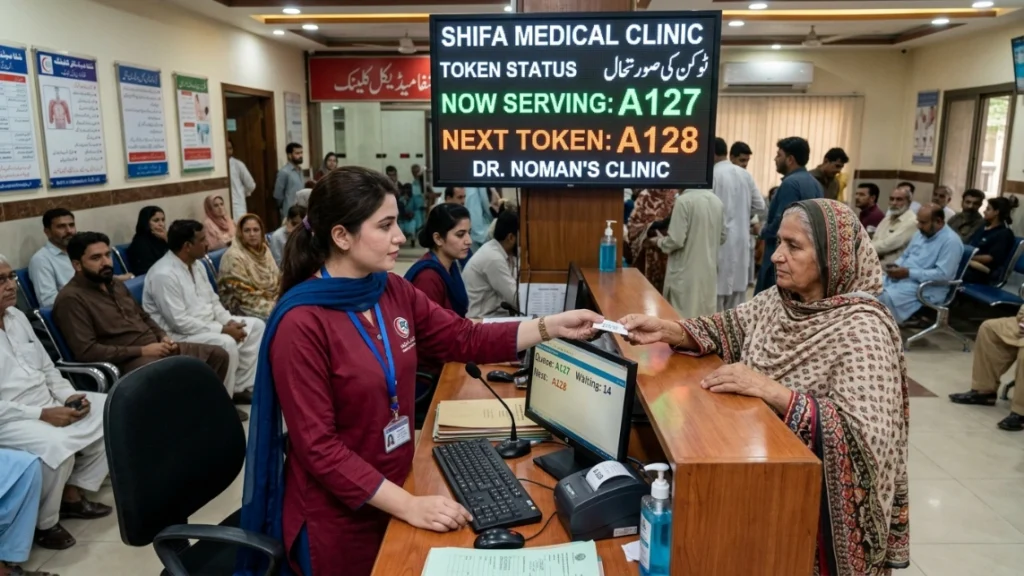
Chaotic walk-in queues are the single biggest source of patient complaints in Pakistani clinics, and they’re also the easiest problem to fix first. A digital token system removes the guesswork of “who’s next” without asking patients to change their walk-in habits at all.
Most Pakistani clinics — whether it’s a general physician in Multan or a pediatrician in Islamabad — run on a walk-in-first culture. Patients don’t book online; they show up, sit, and wait. That’s fine. The problem is what happens after they sit down: a paper register with crossed-out names, a receptionist juggling three phone calls, and a doctor who has no idea how many people are actually waiting.
SehatPro’s appointment scheduling and queue management system handles this automatically. A patient checks in, gets a token number, and both the doctor’s screen and the waiting room display update in real time. No double bookings, no shouting names across a crowded room. A multi-branch clinic in Faisalabad reported cutting patient wait-time complaints by more than half within the first month of switching, according to internal SehatPro onboarding data collected across 98+ partner clinics.
Why This Comes First
Every other step in this article assumes your queue is under control. If patients are frustrated at check-in, they won’t trust anything digital that comes after — including your EMR or your WhatsApp reminders.
2. Move Patient Records Off Paper and Into an EMR
Paper files get lost, damaged, or duplicated across visits — and once a patient’s history is incomplete, every prescription after that point carries more risk. Electronic Medical Records solve this by keeping one lifetime file per patient, accessible instantly.
Think about a cardiologist in Karachi seeing a patient for the fourth time this year. With paper files, that doctor is flipping through a folder, hoping nothing from visit two got misfiled with another patient’s records. With SehatPro’s EMR software Pakistan clinics are adopting, that same doctor opens one patient profile and sees every visit, every diagnosis, and every prescription in seconds.
What an EMR Actually Replaces
- The metal file cabinet taking up half your reception area
- The “please bring your old file” instruction that half your patients forget
- The risk of prescribing a conflicting medicine because last visit’s notes are missing
SehatPro’s unlimited patient records feature stores this history in the cloud, so a dermatologist in Sialkot or a gastroenterologist in Sahiwal can pull up a patient’s full record even if that patient last visited a different branch. For multi-branch practices, this single change often does more to reduce prescription errors than any other step in the digitization process.
3. Digitize Prescriptions to Cut Consultation Time in Half
Handwritten prescriptions are a leading cause of pharmacy misreads in Pakistan, and they also slow down every single consultation. Print-ready digital prescriptions cut that time immediately, without changing how you actually diagnose a patient.
A general physician in Multan seeing 40 patients a day loses real time rewriting the same diagnosis, dosage, and instructions by hand, over and over. SehatPro’s fast consultation and prescription system uses One-Click Diagnosis Bundles and reusable templates, so common conditions — a seasonal flu, a routine follow-up, a standard blood pressure check — get pre-built templates the doctor can adjust in seconds rather than writing from scratch.
SehatPro’s fast consultation and prescription writing tools cut prescription time by half for GPs handling high patient volumes, based on time-tracking data from clinics using the platform daily. That’s not a marginal improvement — for a clinic seeing 200+ patients a week, it’s the difference between finishing consultations by 6 PM or by 9 PM.
Pro Tip — Expert Insight: One mistake we see constantly across SehatPro’s 135+ partner doctors: clinics build a diagnosis template once and never update it. Review your top 10 diagnosis bundles every three months. Medicine availability changes, dosage guidance updates, and a stale template creates more risk than no template at all.
4. Stop Losing Patients to No-Shows With Automated Reminders
Missed follow-ups don’t just cost you revenue — they mean patients with chronic conditions go untreated between visits, and that’s a clinical risk, not just a business one. Automated reminders solve this without requiring your staff to make a single phone call.
A pulmonologist in Lahore managing asthma patients needs reliable follow-ups, but Pakistani patients often ignore missed-call reminders from unknown numbers. WhatsApp works differently — it’s already open on their phone, and a message land differently than a call from an unfamiliar number.
SehatPro’s automated SMS and WhatsApp reminders send both appointment alerts and medicine reminders automatically, in Urdu or English depending on the patient’s preference. For a urologist in Larkana or an eye specialist in Toba Tek Singh managing a smaller patient base, this single feature often eliminates the need for a dedicated reminder-calling staff member entirely.
5. Give Every Staff Member the Right Level of Access
Not every staff member should see everything. Your receptionist needs appointment and billing access, not full clinical notes. Your lab technician needs test results, not prescription history. Role-based access solves this without slowing anyone down.
This matters more in multi-branch clinics, where a receptionist in one branch shouldn’t automatically see clinical notes from a different city’s patients. A dentist running two branches — one in Sialkot, one in Sahiwal — needs centralized oversight without giving every front-desk employee access to sensitive clinical data.
SehatPro’s support for multi-branch clinics includes role-based access for doctors, receptionists, and lab staff, with centralized patient records that stay consistent across every branch. This also matters for a specific Pakistani reality: staff turnover at the front desk is common, and a new receptionist should be productive on day one, not week three, without needing access to information that isn’t part of her job.
6. Compare What Digitization Actually Changes
Here’s a direct comparison clinic owners find useful when deciding whether the switch is worth the disruption:
| Factor | Paper-Based Clinic | SehatPro (Digitized Clinic) |
|---|---|---|
| Time per consultation | 12-15 minutes (manual writing) | 6-8 minutes (templates + bundles) |
| Record retrieval | 3-5 minutes, risk of missing file | Under 10 seconds, full history |
| No-show rate | High, no reminder system | Reduced via WhatsApp/SMS reminders |
| Staff onboarding time | Weeks (informal, undocumented) | 1-2 days (role-based, guided access) |
| Data loss risk | High (fire, damage, misfiling) | Encrypted cloud backup |
| Multi-branch visibility | Manual phone calls between branches | Centralized, real-time records |
| Monthly cost | Low upfront, high hidden cost in errors | Starts at PKR 2,999/month (CareStart) |
This table reflects patterns SehatPro has observed across clinics in 50+ cities, not a single outlier case — the gap tends to widen further once a clinic adds a second branch.
7. Choose Cloud, Offline, or Hybrid Based on Your Internet Reality
Not every area in Pakistan has stable internet, and that shouldn’t be the reason you delay clinic digital transformation. The right setup depends on your connectivity, not on which plan looks the most advanced.
A clinic in central Lahore with fiber internet can run fully on cloud clinic management software, accessing records from mobile, tablet, or PC — at the clinic or from home. A clinic in Mirpur-AJK or a smaller town with unreliable connectivity needs a different setup entirely.
Matching the Plan to Your Location
- Reliable internet (Lahore, Karachi, Islamabad): Cloud-based CareStart or mid-tier plans work well, with full mobile and desktop access.
- Unstable connectivity (smaller towns, rural clinics): SehatPro’s ProCare plan (PKR 79,999 one-time) offers offline installation, so the system runs locally and syncs when internet returns.
- Multi-branch with mixed connectivity: EnterpriseCare custom plans combine offline and cloud access across branches.
This is the step most clinics skip in their research, and it’s often the reason a digitization attempt fails — not because the software was wrong, but because the plan didn’t match the clinic’s actual internet reality. SehatPro’s data privacy and security infrastructure keeps records encrypted whether you’re syncing live or catching up after a connection drops.
Conclusion
Digitizing a clinic isn’t one big overhaul — it’s seven manageable changes, and you don’t need to do all of them on day one. Start with your queue, because that’s what patients feel first. Move your records into an EMR next, because that’s what protects you from prescription errors. Add digital prescriptions and WhatsApp reminders once staff are comfortable, then layer in role-based access and the right connectivity setup for your location. Clinics that digitize clinic Pakistan-wide in this order see fewer disruptions and faster staff adoption than clinics that try to switch everything at once.
FAQ
How much does it cost to digitize a clinic in Pakistan?
Digitizing a clinic starts at PKR 2,999/month with SehatPro’s CareStart plan, covering appointment scheduling, EMR, and prescriptions. Larger multi-branch clinics can opt for ProCare (PKR 79,999 one-time) or a custom EnterpriseCare plan, depending on connectivity needs and patient volume.
Is clinic management software difficult for Urdu-speaking staff to learn?
No. SehatPro’s interface supports Urdu, English, Arabic, Sindhi, and 27+ other languages, so receptionists and staff can use the system in the language they’re most comfortable with. Most staff become productive within one to two days of guided onboarding.
What happens to patient data if the internet goes down?
SehatPro’s ProCare plan offers offline installation, so the clinic keeps running locally during outages and syncs automatically once connectivity returns. Data stays encrypted throughout, whether accessed online or offline.
How long does it take to digitize clinic Pakistan operations from scratch?
Most clinics complete the full seven-step digitization process — queue, EMR, prescriptions, reminders, access control, and backup — within one to two weeks. Solo practices often move faster since there’s no multi-branch coordination involved.
Is patient data secure with cloud clinic management software?
Yes. SehatPro uses encryption and secure cloud backups to protect patient records, meeting data privacy standards expected in Pakistani healthcare settings. Role-based access also limits who within the clinic can view sensitive clinical information.
Can a solo general physician benefit from digitizing, or is it only for large clinics?
Solo GPs benefit significantly, especially from reduced prescription time and automated reminders. A single-doctor clinic in a smaller city can start with CareStart and scale up only if patient volume or branch count grows later.