Top Reasons Patients Trust Digitally Managed Clinics
Patients trust digitally managed clinics because they reduce waiting time, eliminate lost paperwork, and produce clear, error-free prescriptions. With one doctor for roughly every 1,300 people in Pakistan, clinics that use EMR software like SehatPro build confidence through faster, more organized, and more transparent care.
Introduction
Pakistan has one doctor for roughly every 1,300 patients — well below the World Health Organization’s recommended ratio of 1 to 1,000. That gap means every minute inside a clinic matters, and every patient interaction has to count. When a patient waits forty minutes past their token number, or watches a receptionist dig through a metal cabinet for a file that “should be here somewhere,” trust erodes fast — no matter how skilled the doctor is.
This is the real problem digitally managed clinics solve. It isn’t about looking modern for its own sake. It’s about removing the friction that makes patients doubt whether a clinic actually has its act together. A clinic running on paper can have an excellent physician and still lose patients to a competitor down the road who simply answers the phone, keeps records straight, and starts appointments on time.
This article walks through the specific, practical reasons patients place more trust in clinics that have moved to digital systems — and what that shift looks like inside a real clinic in Multan, Lahore, or Karachi. By the end, you’ll see exactly where trust is won or lost, and what to fix first.
Why Do Patients Trust Digitally Managed Clinics More Than Paper-Based Ones?
Patients trust what they can see working. A clinic that calls their name on time, hands them a printed prescription instead of a scribbled note, and remembers their last visit without asking twice sends a clear signal: this place is organized, and organized places make fewer mistakes.
That signal matters more in Pakistan’s walk-in culture than it might elsewhere. Most clinics — from a general physician’s practice in Multan to a multi-specialty setup in Faisalabad — don’t run on strict appointment slots. Patients arrive, take a token, and wait. A 2019 study published in a Pakistani medical journal found doctor-to-patient ratios in the country are severely strained, which means queue chaos is often the first thing a patient experiences, before they’ve even seen the doctor. If that first experience is disorganized, it colors everything after it.
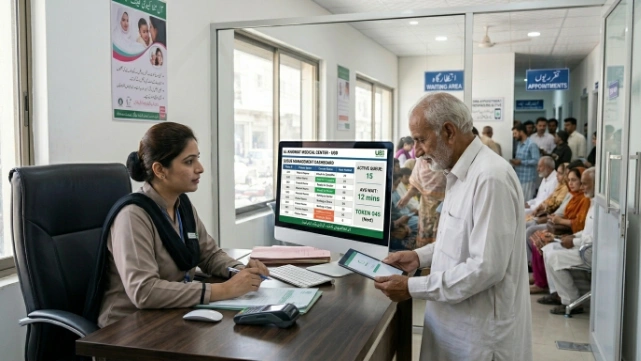
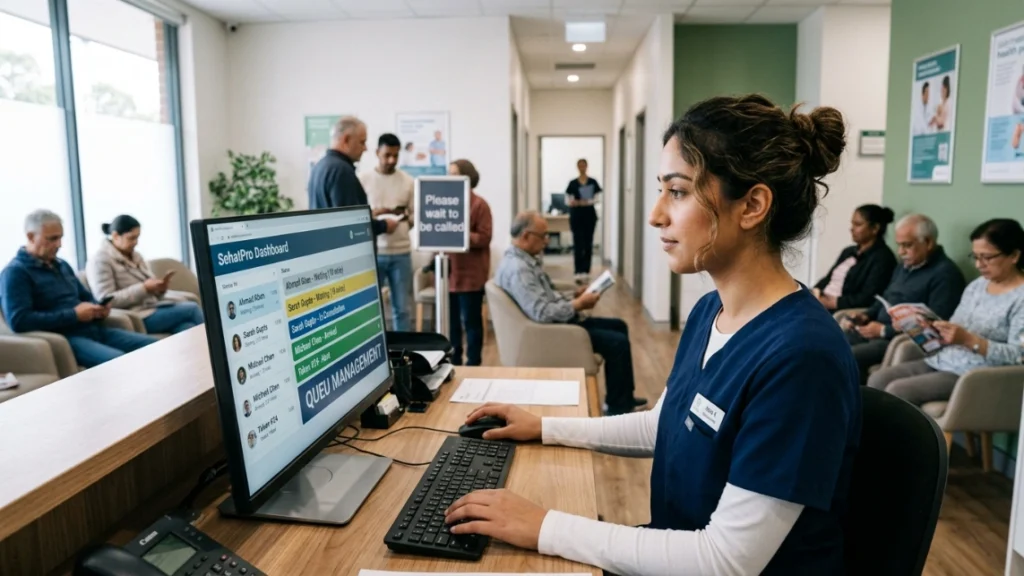
Digitally managed clinics change this at the entry point. SehatPro’s appointment scheduling and queue management system handles this automatically — patients get a token number, staff see live queue status on screen, and there’s no separate paper register that can be misplaced or duplicated. A pediatrician in Islamabad running two token systems (one paper, one mental) will always create confusion. A single digital queue removes the guesswork for staff and the uncertainty for patients.
Trust also comes from consistency. When a patient’s second or third visit feels exactly as organized as their first, they stop worrying about whether the clinic “has it together” and start focusing on their actual health concern. That shift — from logistical anxiety to clinical focus — is the real value digital management delivers.
How Do Electronic Medical Records Build Long-Term Patient Trust?
A patient who has to repeat their medical history at every visit doesn’t feel cared for — they feel like a stranger in a clinic they’ve visited for years. Electronic Medical Records end that repetition by keeping a complete, searchable history the doctor can pull up in seconds.
Consider a gynecologist in Lahore managing hundreds of patients across pregnancy stages, follow-ups, and referrals. Paper files get separated from their folders, pages go missing after being borrowed for a lab report, and handwriting from a previous visit is sometimes illegible even to the doctor who wrote it. SehatPro’s unlimited patient records feature keeps every consultation, test result, and prescription attached to one patient profile, accessible from any branch, at any time.
What This Looks Like in a Real Consultation
When a cardiologist in Karachi opens a returning patient’s file, they immediately see past ECG notes, medication history, and allergy flags — without asking the patient to recall dosages from memory. This cuts consultation time and reduces the chance of prescribing something that conflicts with an existing condition.
Why This Matters More for Chronic Care
Diabetic and hypertensive patients, common across Pakistani clinics from Sialkot to Sahiwal, need continuity above all else. A dermatologist treating a long-term skin condition needs to see what was tried before and what failed. Without EMR, that history depends entirely on the patient’s memory or a folder that may or may not have survived the last house move.
Pro Tip — SehatPro Expert Insight: One mistake we see often among clinics newly adopting EMR software in Pakistan is treating it purely as a filing system rather than a clinical tool. Doctors who actively glance at flagged allergies or past diagnoses before writing a new prescription report far fewer contradictory prescriptions — this is where patient trust in EMR software is actually built, not just in having records, but in visibly using them during the consultation.
Can Faster Prescriptions Actually Increase Patient Trust?
Yes — a legible, printed prescription tells a patient their doctor is being precise, not rushed. Handwritten prescriptions carry a well-documented error risk, and patients increasingly notice the difference when a clinic hands them something they can actually read.
A study on prescription quality found that roughly 35% of handwritten prescriptions contained identifiable errors, compared to about 2.5% for electronic ones — a gap large enough to explain why pharmacists frequently call clinics back to confirm a scrawled dosage. That callback, from the patient’s point of view, looks like a mistake even when it’s caught in time. It plants doubt.
SehatPro’s fast consultation and prescription writing tools let a general physician in Multan complete a visit with a clean, printed prescription in the time it used to take to write one by hand. One-click diagnosis bundles and reusable templates mean common conditions — seasonal flu, routine antenatal checkups, standard pediatric vaccinations — don’t require rewriting the same instructions from scratch every time.
This isn’t just about speed. A printed prescription with the clinic’s name, the doctor’s details, and clear dosage instructions reads as more credible to patients, especially when they take it to a pharmacist who has to interpret it correctly on the first try. Urdu-speaking staff and patients benefit as well, since SehatPro’s multilingual interface lets clinics generate prescriptions and instructions in the language the patient actually understands, not just the language the software defaults to.
Does Automated Follow-Up Communication Change How Patients Perceive a Clinic?
A clinic that reminds a patient about their appointment or medicine refill feels like it’s paying attention to them specifically — not just processing them through a queue. That perception directly shapes whether a patient returns or drifts to another clinic after one missed visit.
No-shows are a persistent problem across Pakistani outpatient practices, and they hurt both the clinic’s schedule and the patient’s continuity of care. A patient who forgets a follow-up for a chronic condition — say, a pulmonologist’s asthma review or a urologist’s post-procedure check — often doesn’t return until symptoms worsen. By then, the relationship built on that first good visit has quietly ended.
SehatPro’s automated SMS and WhatsApp reminders for appointments and medicines close that gap without requiring staff to manually call every patient on a list. A multi-branch clinic operating across Faisalabad and Toba Tek Singh can schedule reminders centrally, so a receptionist in one branch isn’t manually tracking patients seen at another. This is one of the more visible ways patients notice a clinic has “modernized” — not through the interface they never see, but through a text message that arrives exactly when it should.
What Role Does Data Privacy Play in Building Trust in Digitally Managed Clinics?
Patients share their most sensitive information with a clinic — diagnoses, test results, family history — and they need confidence that it won’t be lost, misused, or exposed. Data privacy isn’t a background feature; for many patients, it’s the deciding factor in whether they feel safe returning.
This concern is especially pointed in smaller cities and towns, including Larkana and Mirpur-AJK, where patients may know clinic staff personally and worry about informal information leaks more than they worry about hackers. A clear, professional data policy — visible cloud backups, encrypted storage, controlled staff access — reassures patients that their file isn’t just sitting in an unlocked drawer that anyone passing by could open.
SehatPro’s data privacy and security infrastructure includes encryption and secure cloud backups, so a clinic owner in Sialkot doesn’t need an in-house IT team to keep patient data protected. Role-based access for doctors, receptionists, and lab staff also means a front-desk employee can manage appointments without seeing full clinical notes — a distinction that matters both for compliance and for patient comfort.
Comparison: Paper-Based Clinic Management vs. SehatPro
| Factor | Paper-Based Clinics | SehatPro (Digitally Managed) |
|---|---|---|
| Time per patient record lookup | 3–5 minutes, if the file is found | Under 10 seconds, searchable by name or ID |
| Prescription error rate | Higher, per documented handwriting-error studies | Reduced through templates and printed output |
| Patient experience | Long waits, repeated history-taking | Live queue tracking, no repeated intake |
| Staff workload | Manual filing, duplicate data entry | Centralized records, role-based access |
| Cost over time | “Free” paper, but rising storage and labor cost | Fixed monthly or one-time plans from PKR 2,999 |
| Compliance readiness | Difficult to audit or produce records quickly | Exportable reports, backed-up records |
How Does Multi-Branch Support Affect Patient Trust Across Locations?
A patient who visits a clinic’s Lahore branch and then needs care at its Karachi branch shouldn’t have to start from zero. When records don’t follow the patient, trust in the “brand” of the clinic — not just the individual doctor — breaks down.
Multi-branch practices are becoming more common as successful clinics expand into second and third cities. But expansion without centralized systems often means each branch effectively operates as its own isolated clinic, with separate paper files and no shared history. A patient with a complex case, treated by different specialists across branches, ends up carrying their own medical history by memory — exactly the burden digital systems are supposed to remove.
SehatPro’s support for multi-branch clinics with centralized patient records solves this directly. A patient seen by a general physician in one city and referred to a specialist in another can have their full record pulled up instantly, without waiting for files to be physically transferred or re-explained. This is particularly relevant for healthcare entrepreneurs setting up new clinics or labs connected through QuickLab integration, where lab results need to reach the treating doctor without delay regardless of which branch ordered the test.
What Should a Clinic Check Before Fully Trusting Its Digital System?
Before rolling out a digital system clinic-wide, it’s worth confirming the basics are actually in place — not assumed. A quick internal checklist prevents the common mistake of adopting software but never fully using its trust-building features.
- Are patient records accessible from more than one device (mobile, tablet, PC) without depending on a single computer?
- Does the clinic have an offline option for days when internet connectivity in the area is unreliable?
- Are appointment reminders actually reaching patients via SMS or WhatsApp, or just sitting unused in the system?
- Is staff trained to use role-based access correctly, so receptionists aren’t seeing clinical notes they don’t need?
- Are reports being exported and reviewed monthly, or just generated and ignored?
- Is there a written, simple explanation staff can give patients about how their data is stored and protected?
Clinics that can answer “yes” to each of these are typically the ones patients describe as feeling dependable — not because of the technology itself, but because the technology is actually being used the way it was designed to be.
Conclusion
Patient trust is built in small, repeated moments — a queue that moves, a file that’s never missing, a prescription that’s easy to read, a reminder that arrives on time. Digitally managed clinics win that trust not through complexity, but through consistency patients can feel on every single visit.
If you’re running a clinic anywhere from Multan to Mirpur-AJK, the takeaway is straightforward: fix the queue first, centralize records second, clean up prescriptions third, and automate reminders fourth. Each step removes a specific reason patients lose confidence, and together they compound into a clinic patients recommend to others without being asked.
FAQ
How much does clinic management software cost in Pakistan?
SehatPro’s plans start at PKR 2,999/month for the CareStart tier, scaling up to a one-time ProCare option at PKR 79,999 for clinics needing offline installation. EnterpriseCare pricing is custom for multi-branch or hospital-level needs, so most small and mid-size clinics can find a plan that fits their budget.
Is EMR software difficult for non-technical clinic staff to learn?
No. SehatPro is built with simple, guided screens and a multilingual interface, including Urdu, so receptionists and doctors without technical backgrounds can use it within days. Most clinics report staff comfort within the first week of daily use.
Does digitally managed clinic software work with an unstable internet connection?
SehatPro’s ProCare plan includes an offline installation option specifically for areas with unreliable connectivity, so appointment scheduling and EMR access continue working even during outages, syncing once the connection returns.
How secure is patient data in a cloud-based clinic system?
Patient data is protected through encryption and secure cloud backups, with role-based access limiting what receptionists, doctors, and lab staff can each view. This structure is a core reason patient trust EMR software over unsecured paper files sitting in a cabinet.
How long does it take to set up a digitally managed clinic system?
Most single-branch clinics can be fully set up on SehatPro within a few days, including staff training and data migration from existing paper records. Multi-branch clinics typically need a slightly longer rollout to centralize records across locations.
Why are patients more comfortable with digitally managed clinics than traditional paper-based ones?
Patients notice fewer wait-time surprises, clearer printed prescriptions, and no repeated history-taking at every visit. These visible improvements are why digitally managed clinics consistently earn more patient confidence than clinics still relying on paper files and handwritten notes.