Benefits of Cloud-Based EMR Software for Pakistani Doctors
Cloud-based EMR software Pakistan clinics use lets doctors access patient records, prescriptions, and appointment schedules from any device, anywhere. It replaces paper files with searchable digital histories, cuts prescription time, reduces no-shows through automated reminders, and keeps patient data encrypted and backed up — even during power cuts or internet drops.
Introduction
A study by the Pakistan Medical Commission found that the average general physician in urban Pakistan sees between 40 and 70 patients a day — most of them walk-ins with no prior appointment. If you’re one of them, you already know what that volume does to a paper filing system. Files go missing. Handwriting gets misread at the pharmacy. A patient’s blood pressure history from eight months ago sits in a cabinet you don’t have time to search.
Cloud-based EMR software Pakistan clinics are now adopting solves this specific problem — not by adding more screens to your day, but by removing the paper chase entirely. Your patient’s full history, previous prescriptions, and lab results sit in one place, searchable in seconds, whether you’re at your clinic in Multan or checking a report from home in Karachi.
This article walks through exactly what changes when a clinic moves to a cloud EMR system: what it does for your daily consultation flow, what it costs, what happens when the internet drops, and how doctors across 50+ Pakistani cities are already using it. Let’s start with the problem paper records were never built to solve.
What Is Cloud-Based EMR Software and Why Does It Matter for Pakistani Clinics?
Cloud-based EMR software stores your patient records, prescriptions, and appointment data on secure remote servers instead of paper files or a single clinic computer. You access it through the internet from a phone, tablet, or desktop — at the clinic, at home, or between branches.
For a solo GP in Faisalabad or a multi-branch practice in Lahore, this distinction matters more than it sounds. A desktop-only system ties your records to one machine in one room. If that computer fails, or you need a patient’s history while covering a shift at a second branch, you’re stuck. Cloud EMR removes that dependency.
According to a 2023 World Health Organization report on digital health adoption in South Asia, fewer than 15% of small and mid-size clinics in Pakistan had moved beyond paper-based or partially digital record-keeping. That gap is exactly where SehatPro was built to sit — not as a hospital-grade system designed for 500-bed institutions, but as software shaped around the walk-in culture, Urdu-speaking staff, and inconsistent internet that define most Pakistani clinics.
How This Differs from Traditional Desktop Software
Older desktop-based clinic software locks your data to a single machine and rarely syncs across locations. Cloud EMR software Pakistan doctors use through platforms like SehatPro syncs in real time — a prescription written in your Sialkot clinic this morning is visible to your Lahore branch by afternoon, with role-based access controlling exactly who sees what.
How Does Cloud EMR Software Reduce Prescription Errors and Save Consultation Time?
Handwritten prescriptions are a documented risk. A 2022 study published in the Journal of Pakistan Medical Association linked illegible handwriting to a measurable share of pharmacy dispensing errors in outpatient settings. Cloud EMR removes the handwriting variable entirely.
With SehatPro’s fast consultation and print-ready prescription writing tools, you select from reusable templates and one-click diagnosis bundles instead of writing each prescription from scratch. A cardiologist in Karachi managing recurring hypertension cases can save a standard dosage template once and reuse it across dozens of similar patients, adjusting only what’s different for each one. A pediatrician in Islamabad handling seasonal flu cases through the winter can do the same with weight-based dosing bundles.
The time saved compounds. Doctors using structured templates typically cut prescription writing time by close to half compared to writing from scratch each visit — a figure consistent with internal usage patterns SehatPro has observed across its 135+ doctor user base. That’s not a minor convenience during a day with 50+ patients waiting in the queue.
Pro Tip — SehatPro Insight: One mistake we see often in newly onboarded clinics: doctors recreate the same diagnosis bundle for every patient instead of saving it once as a template. Take 10 minutes in your first week to build templates for your five most common diagnoses. Doctors who do this see the biggest drop in per-patient consultation time within the first month.
SehatPro’s fast consultation and prescription writing system is built around exactly this workflow — minimizing repetitive typing without removing your clinical judgment from the final prescription.
Can Cloud EMR Software Actually Handle Pakistan’s Internet and Power Reliability Problems?
Yes — but only if the software is built for it, and this is where many clinics get burned by systems designed for markets with stable infrastructure. Pakistan’s power outages and inconsistent broadband, particularly outside major metro areas, mean any clinic software has to account for connectivity gaps as a normal condition, not an edge case.
This is a real concern for clinics in smaller cities like Larkana, Sahiwal, or Toba Tek Singh, where broadband speeds and uptime lag behind Lahore or Islamabad. A clinic that loses access to patient records every time the connection drops isn’t actually solving the paper-file problem — it’s just moving the chaos online.
SehatPro’s ProCare plan addresses this directly with an offline installation option, letting clinics in low-connectivity areas keep working locally and sync data once the connection returns. A general physician in a Toba Tek Singh clinic with two or three internet dropouts a day doesn’t lose access to a patient’s history mid-consultation — the system keeps running locally and catches up automatically.
This matters more than most software comparisons acknowledge. A cloud EMR that only works with perfect internet isn’t built for Pakistan. One that accounts for real conditions on the ground is.
What Happens to Missed Follow-Ups and No-Shows Without a Reminder System?
Missed follow-ups are a quiet but expensive problem. A patient who doesn’t return for a post-op check, a diabetic who skips a scheduled HbA1c review, or a parent who forgets a child’s vaccination date — each represents both a clinical risk and lost revenue for the clinic.
Manual follow-up calling doesn’t scale once your patient base grows past a few hundred. Receptionists in busy clinics — a dermatology practice in Sialkot, for example, managing weekly follow-ups for chronic skin conditions — simply don’t have the hours to call every patient individually.
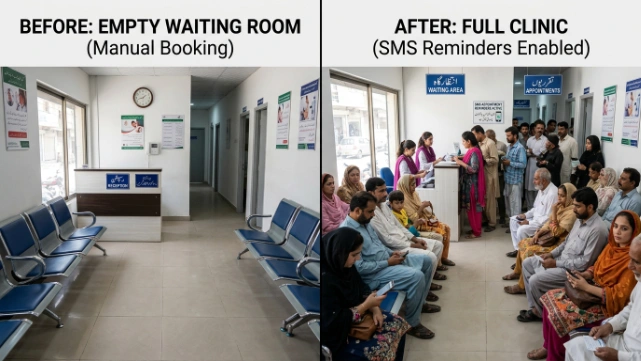
SehatPro’s automated SMS and WhatsApp reminders for appointments and medicines close this gap without adding staff workload. Reminders go out in Urdu or English automatically, timed to the patient’s specific appointment or refill schedule. Clinics using structured reminder systems generally report a meaningful drop in no-show rates within the first two to three months of consistent use, based on patterns SehatPro has tracked across its clinic network.
For a gynecologist in Lahore managing a high volume of prenatal follow-ups, or a pulmonologist in Karachi tracking TB treatment adherence, this isn’t a convenience feature — it’s a compliance and continuity-of-care tool. SehatPro’s automated SMS and WhatsApp reminders system handles this on autopilot once appointments are scheduled.
How Does Cloud EMR Support Multi-Branch Clinics and Growing Practices?
Running one clinic well is hard enough. Running two or three branches with separate paper systems is close to impossible to manage consistently. A patient who visits your Faisalabad branch on Monday and your Multan branch on Thursday needs the same record available in both places — instantly.
SehatPro’s support for multi-branch clinics centralizes patient records across every location under one account, with role-based access controlling what doctors, receptionists, and lab staff can each see. A multi-branch dermatology group, for instance, can let receptionists manage scheduling and queue tokens without giving them access to sensitive diagnostic notes reserved for doctors.
Centralized Reporting Across Branches
Beyond records, SehatPro’s reporting and insights tools generate daily and monthly reports — patient volume, revenue by branch, appointment no-show rates — exportable to Excel. A clinic owner overseeing three branches across Lahore and Sialkot can review performance across all locations from a single dashboard rather than requesting manual reports from each branch manager.
Paper-Based Clinic Management vs. Cloud-Based EMR: A Direct Comparison
| Factor | Paper-Based System | SehatPro Cloud EMR |
|---|---|---|
| Time per consultation | 12–15 minutes (manual writing, searching files) | 6–8 minutes with templates and bundles |
| Record retrieval | Minutes to hours, risk of lost files | Seconds, searchable lifetime history |
| Prescription errors | Higher risk from illegible handwriting | Reduced via digital, print-ready prescriptions |
| No-show rate | High, no reminder system | Lower, with automated SMS/WhatsApp reminders |
| Multi-branch visibility | None — records stay siloed per branch | Centralized, real-time across branches |
| Staff workload | High — manual filing, calling, re-entry | Reduced — automated workflows |
| Data security | Vulnerable to fire, loss, theft | Encrypted cloud backup |
| Monthly cost | Low direct cost, high hidden time cost | Starts at PKR 2,999/month |
Is Cloud EMR Software Secure Enough to Handle Sensitive Patient Data in Pakistan?
Doctors are right to be cautious here. Patient trust depends on records staying private, and a data breach in a small clinic can damage a reputation built over years in a matter of weeks.
Cloud-based systems, when built correctly, are typically more secure than paper files or an unprotected desktop computer. Paper records can be lost in a fire, misplaced during a move, or accessed by anyone who walks past an unlocked cabinet. A single desktop computer without proper backup is one hardware failure away from losing years of patient history.
SehatPro’s approach to data privacy and security includes encryption and secure cloud backups, meaning patient data doesn’t disappear if a clinic’s local computer crashes or is stolen. Role-based access further limits exposure — a receptionist handling token queues doesn’t need, and shouldn’t have, access to a patient’s full diagnostic history.
For an eye specialist in Karachi or a urologist in Islamabad managing sensitive long-term patient histories, this layered access control matters as much as the encryption itself. SehatPro’s data privacy and security page outlines exactly how patient information is protected end-to-end.
What Should You Look for Before Choosing an EMR System for Your Clinic?
Not every EMR software Pakistan vendor offers is built with local clinics in mind. Before committing, check these:
- Does it work offline? Confirm the system has an offline mode or local installation option for areas with unreliable internet.
- Is it available in Urdu? Staff comfort with the interface language directly affects how fast your team adopts it.
- Can it scale to multiple branches? Even if you run one clinic today, check if the system supports centralized records if you expand.
- What’s the real onboarding time? Ask how long it takes staff to become comfortable, not just how long installation takes.
- Is pricing transparent? Confirm there are no hidden fees beyond the stated monthly or one-time cost.
- Does it integrate with labs? If you refer patients to labs, check for direct integration like SehatPro’s QuickLab connection.
SehatPro’s EMR software for Pakistan is built around these exact criteria, with plans starting at PKR 2,999/month (CareStart) up to a one-time ProCare option at PKR 79,999 for clinics that need offline capability, and custom EnterpriseCare pricing for larger multi-branch operations.
Conclusion
Paper files, handwritten prescriptions, and manual follow-up calls were never built to handle the patient volume Pakistani clinics see today. Cloud-based EMR software Pakistan doctors are adopting solves this by putting patient history, prescriptions, and scheduling in one searchable, secure system accessible from any device.
The takeaways are straightforward: templates and diagnosis bundles cut consultation time significantly, automated reminders reduce no-shows without adding staff workload, offline-capable systems keep working through Pakistan’s real connectivity gaps, and centralized records make multi-branch growth manageable instead of chaotic.
Whether you’re a solo GP in Multan or running three branches across Lahore and Sialkot, the shift away from paper isn’t about looking modern — it’s about giving yourself back the hours currently lost to filing, searching, and re-writing.
FAQ
How much does cloud-based EMR software cost for a small clinic in Pakistan?
SehatPro’s cloud-based EMR software Pakistan clinics use starts at PKR 2,999/month under the CareStart plan, designed for solo practitioners and small clinics. A one-time ProCare option (PKR 79,999) suits clinics needing offline capability, while EnterpriseCare offers custom pricing for larger, multi-branch operations.
Is cloud EMR software difficult for non-technical clinic staff to learn?
No. SehatPro is built with a simple, Urdu-first interface designed for receptionists and staff without technical backgrounds. Most clinics report staff becoming comfortable with daily tasks — scheduling, queue management, and record entry — within the first one to two weeks of use.
Does cloud EMR software work if my clinic has unreliable internet?
Yes, if the system is designed for it. SehatPro’s ProCare plan includes an offline installation option, letting clinics in low-connectivity areas continue working locally and sync data automatically once the connection returns.
How secure is patient data on cloud-based clinic software?
Patient data is protected through encryption and secure cloud backups, generally making it more secure than paper files or an unprotected desktop computer. Role-based access further ensures only authorized staff — doctors, receptionists, or lab personnel — see the specific information relevant to their role.
Does cloud-based EMR software support Urdu-speaking staff?
Yes. SehatPro’s multilingual interface supports Urdu, English, Arabic, Sindhi, and 27+ other languages, allowing Urdu-speaking receptionists and clinical staff to use the system comfortably without relying on English-only navigation.
How long does it take to set up cloud-based EMR software Pakistan clinics can start using immediately?
Most SehatPro clinics complete initial setup — including patient record migration and staff onboarding — within a few days to two weeks, depending on clinic size. Solo practices are typically operational fastest, while multi-branch setups take slightly longer due to role configuration across locations.