Urdu-Language EMR Software: Why It Matters for Pakistani Clinics
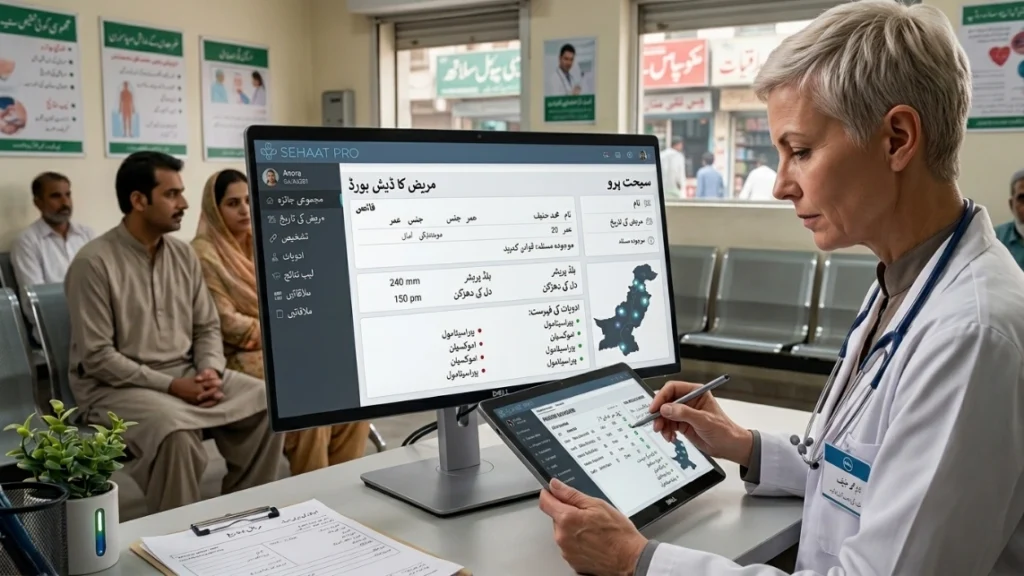
Urdu EMR software lets Pakistani clinics record patient history, write prescriptions, and manage staff in the language their team actually speaks. It reduces transcription errors, speeds up training for Urdu-speaking receptionists, and makes patients more comfortable during consultations — without forcing clinics into English-only systems built for other markets.
Introduction
Ask any receptionist in a Multan clinic to fill out an English-only patient intake form, and watch how long it takes. A 2023 Pakistan Medical Commission workforce report noted that a majority of clinic support staff outside major metropolitan hospitals have limited working proficiency in English. Yet most clinic management software sold in Pakistan is still built with English as the only interface language.
This is where Urdu EMR software changes the daily reality of a clinic. It is not a translation feature bolted on for show — it is the difference between a receptionist who confidently manages a Saturday morning queue of forty walk-ins and one who quietly struggles through dropdown menus she does not fully understand.
This article walks through why Urdu-language support in electronic medical records matters clinically and operationally, what to look for in multilingual clinic software in Pakistan, and how SehatPro has built this into every layer of its platform — from token queues to printed prescriptions.
Let’s start with the problem most clinics don’t realize they have.
Why Does Language Become a Barrier in Pakistani Clinic Software?
Most EMR systems sold internationally assume English fluency at every staff level — a assumption that breaks down fast in a Sialkot dermatology clinic or a Larkana general practice.
Software built for US or UK markets treats English as the default and other languages as an afterthought, if they exist at all. In Pakistan, this creates a real operational gap. Your front-desk staff may speak fluent Urdu and Punjabi with patients all day, then face a software interface that assumes a different working language entirely. The result is slower data entry, more typing mistakes in patient names and medicine dosages, and a longer training period for every new hire.
This isn’t a hypothetical problem. Clinics that switch software systems report that staff onboarding takes noticeably longer when the interface language doesn’t match daily spoken language — a pattern SehatPro has observed directly across its base of 135+ doctors and 98+ clinics in more than 50 cities.
The Hidden Cost of English-Only Systems
Consider a general physician’s clinic in Toba Tek Singh with two receptionists, both fluent in Urdu but with basic English reading skills. An English-only queue management screen means every patient check-in involves a small mental translation step. Multiply that by 60 to 80 patients a day, and you have measurable time loss — plus a higher chance of a misspelled name or a mismatched token number.
local language EHR system support removes that translation step entirely. Staff read, click, and confirm in the language they think in.
What Should Multilingual Clinic Software in Pakistan Actually Include?
Real multilingual support goes beyond a language toggle in settings — it needs to cover patient records, prescriptions, staff screens, and patient-facing messages consistently.
A software vendor claiming “multilingual support” sometimes means the marketing website has an Urdu version, while the actual clinical software stays in English. That’s not useful to a receptionist in Faisalabad managing your token queue at 9 AM. Genuine multilingual clinic software in Pakistan needs Urdu (and ideally regional languages like Sindhi) across four specific layers: the staff-facing interface, the EMR data entry screens, the printed prescription output, and patient communication like SMS and WhatsApp reminders.
SehatPro was built around this exact requirement, offering a multilingual interface across Urdu, English, Arabic, Sindhi, and 27+ languages — chosen specifically because clinics in Pakistan rarely operate in a single language. A pediatrician’s clinic in Islamabad might have English-speaking doctors, Urdu-speaking receptionists, and Pashto-speaking patients, sometimes all in the same afternoon.
A Quick Checklist for Evaluating Language Support
- Does the staff dashboard fully translate, or only the login page?
- Can prescriptions print in Urdu for patients who read it more comfortably than English?
- Do appointment reminders sent via SMS or WhatsApp use the patient’s preferred language?
- Can you switch languages per staff member, not just clinic-wide?
- Is medical terminology translated accurately, not just literally?
SehatPro’s fast consultation and prescription writing tool lets doctors toggle prescription language per patient, which matters when an elderly patient in Sahiwal needs an Urdu printout but the doctor prefers documenting in English for their own records.
How Does Urdu EMR Software Reduce Prescription and Record-Keeping Errors?
Handwritten prescriptions and English-only digital forms both create room for error when the person filling them out isn’t working in their strongest language — Urdu EMR software closes that gap at the point of entry.
A 2022 study published in the Journal of Pakistan Medical Association found handwriting-related prescription errors remain a persistent patient safety concern in outpatient settings across South Asia. Digital EMR systems solve part of this by removing handwriting entirely, but if the digital interface itself is confusing to the person entering data, you’ve just moved the error somewhere else.
This matters most in electronic medical records (EMR) and patient history entry, where a receptionist or nurse in Karachi might be logging allergy information, current medications, or previous diagnoses under time pressure during a busy walk-in period. When the interface language matches their working language, they read faster, click the correct field faster, and double-check faster.
Where SehatPro Reduces This Risk Directly
SehatPro’s unlimited patient records system stores lifetime patient history, searchable and editable in the staff’s preferred language. Combined with one-click diagnosis bundles and reusable templates, a gastroenterologist in Lahore doesn’t retype the same medication list for common conditions — they select a pre-built bundle and adjust only what’s different for that patient. This cuts prescription time noticeably compared to handwriting or typing from scratch in an unfamiliar interface, and reduces the chance of missing a critical field like drug interaction warnings.
Expert Insight — SehatPro Team: The most common mistake we see when clinics switch from paper to digital is assuming any EMR system will do, without checking if staff can actually navigate it without hand-holding. We’ve watched a well-meaning clinic in Sialkot buy an English-only system, then quietly go back to registers within three weeks because the front desk couldn’t keep pace with patients waiting in line. Language fit isn’t a nice-to-have — it decides whether your staff actually uses the software daily.
Paper Files vs. Urdu EMR Software: What Actually Changes?
Clinics moving from paper registers to a local language EHR system see the difference most clearly in daily time spent, error rates, and how confident staff feel using the tool without supervision.
| Factor | Paper-Based System | Urdu EMR Software (SehatPro) |
|---|---|---|
| Time per patient check-in | 3–5 minutes, manual searching | Under 1 minute, searchable records |
| Prescription writing | Handwritten, error-prone | Print-ready, template-assisted |
| Staff training time | Weeks, tribal knowledge | Days, native-language interface |
| Record loss risk | High — fire, misplaced files | Low — encrypted cloud backup |
| Patient reminders | Manual phone calls or none | Automated SMS/WhatsApp |
| Multi-branch visibility | None — records stay on-site | Centralized across branches |
| Staff confidence (Urdu-speaking) | Depends on tenure | High from week one |
For a multi-branch clinic group operating between Faisalabad and Multan, this table isn’t theoretical. Centralized records mean a patient who visits either branch has one continuous history, viewable by any authorized doctor — something paper files structurally cannot do.
Does Urdu Support Actually Improve the Patient Experience Too?
Language support in clinic software isn’t only a staff-facing benefit — it directly shapes how comfortable and informed patients feel during their visit and afterward.
When a gynecologist’s clinic in Lahore sends an appointment reminder in Urdu via WhatsApp, patients are more likely to read it fully and act on it, compared to an English SMS that gets skimmed or ignored. This connects directly to SMS and WhatsApp reminders for appointments and medicines — a feature that only works as intended if the message language matches what the patient actually reads comfortably.
Printed prescriptions matter here too. An elderly patient in Larkana handed an English-only prescription may not fully understand dosage instructions, timing, or warnings — and may rely on a pharmacist to explain it verbally, introducing another point of possible miscommunication. An Urdu-printed prescription, generated directly from SehatPro’s fast consultation and print-ready prescription writing tool, removes that dependency.
Building Trust Through Familiar Language
Patients form impressions of a clinic’s professionalism partly through small details — how clearly a prescription is written, whether a reminder message feels personal or automated-and-foreign. A cardiologist in Karachi running a modern digital front desk but issuing confusing English printouts sends a mixed signal. Consistency across every patient touchpoint, in the language they’re most comfortable with, reinforces trust in ways that are hard to quantify but easy to notice in patient retention.
What About Clinics with Unreliable Internet? Does Urdu EMR Software Still Work?
Connectivity concerns are real across many parts of Pakistan, and any clinic software claiming full-language support needs to also account for clinics that can’t rely on constant internet access.
A general physician’s practice in a smaller town near Mirpur-AJK may deal with frequent power cuts and inconsistent broadband. Software that only works with a live internet connection becomes a liability during exactly the hours patients need care most. This is a practical concern separate from language, but the two are connected — clinics in less-connected areas are often the same ones with fully Urdu-speaking staff who need local-language software the most.
SehatPro addresses this through its ProCare plan, which includes an offline installation option for clinics in areas with poor connectivity, while still supporting the full multilingual interface. Data syncs to the cloud once connectivity returns, backed by SehatPro’s data privacy and security infrastructure, so a temporary outage in Sahiwal doesn’t mean lost patient records or a frozen front desk.
How Do Multi-Branch and Multi-Specialty Clinics Benefit from a Local Language EHR System?
Clinics operating across more than one city need consistent language support at every branch, or staff at different locations end up working in fragmented, inconsistent systems.
A dermatology and general practice group with branches in Sialkot and Faisalabad faces a specific challenge: different branches often hire locally, and staff comfort with English can vary significantly between a bigger city and a smaller town branch. If your clinic software only partially supports Urdu, one branch operates smoothly while another struggles — creating inconsistent patient experiences and slower reporting across the group.
SehatPro’s support for multi-branch clinics keeps the same multilingual interface, the same EMR structure, and the same role-based access for doctors, receptionists, and lab staff across every branch, regardless of city. A pulmonologist reviewing a patient’s history from a Karachi branch sees the same Urdu-labeled fields a receptionist entered in Multan two years earlier — no format mismatch, no re-training required when staff move between branches.
Reporting benefits too. SehatPro’s patient reports and insights tool exports daily and monthly data to Excel, giving clinic owners a consolidated view across branches without needing every location to standardize on English internally first.
Conclusion
Language support in clinic software is not a cosmetic feature — it decides whether your staff use the system confidently every single day or quietly resist it. Urdu EMR software speeds up patient check-in, cuts down prescription and record-keeping errors, and makes reminders and printed prescriptions genuinely useful to patients who read Urdu more comfortably than English. For multi-branch clinics, consistent language support across every location keeps reporting and record-sharing accurate instead of fragmented.
If you’re evaluating clinic software and language keeps getting treated as an afterthought in the sales pitch, that’s worth questioning directly. Ask to see the actual EMR and prescription screens in Urdu — not just the marketing site.
FAQ
What is Urdu EMR software and why do Pakistani clinics need it? A: Urdu EMR software is electronic medical record software with a fully translated Urdu interface, covering data entry, patient history, and prescriptions. Pakistani clinics need it because many receptionists and support staff work more confidently in Urdu than English, reducing errors and training time.
Is SehatPro’s clinic software available in Urdu? A: Yes. SehatPro offers a multilingual interface covering Urdu, English, Arabic, Sindhi, and 27+ other languages, applied consistently across appointment scheduling, EMR, prescriptions, and patient reminders — not just the login screen.
How much does Urdu EMR software from SehatPro cost? A: SehatPro’s plans start at PKR 2,999/month for the CareStart tier, scaling up to a one-time ProCare option at PKR 79,999 for offline-capable clinics, plus custom EnterpriseCare pricing for larger multi-branch operations.
How long does it take to set up SehatPro in a clinic? A: Most solo and small clinics can be fully set up within a few days, since SehatPro’s Urdu-language interface shortens staff training time considerably compared to English-only systems that require extra onboarding support.
Is patient data secure in a cloud-based Urdu EMR system? A: Yes. SehatPro uses encryption and secure cloud backups for all patient records, regardless of interface language, so clinics in areas with unreliable power or internet don’t risk losing data during outages.
Can Urdu EMR software work in clinics with poor internet connectivity? A: Yes. SehatPro’s ProCare plan includes an offline installation option that keeps the full Urdu interface functional without constant internet access, syncing data to the cloud automatically once a connection is available.