What Is an EMR, and What Does It Actually Do for Your Clinic?
An Electronic Medical Record (EMR) is a digital version of a patient’s chart within your clinic. It captures diagnoses, prescriptions, visit notes, lab results, and medical history — everything your paper files hold, but stored securely and searchable in seconds.
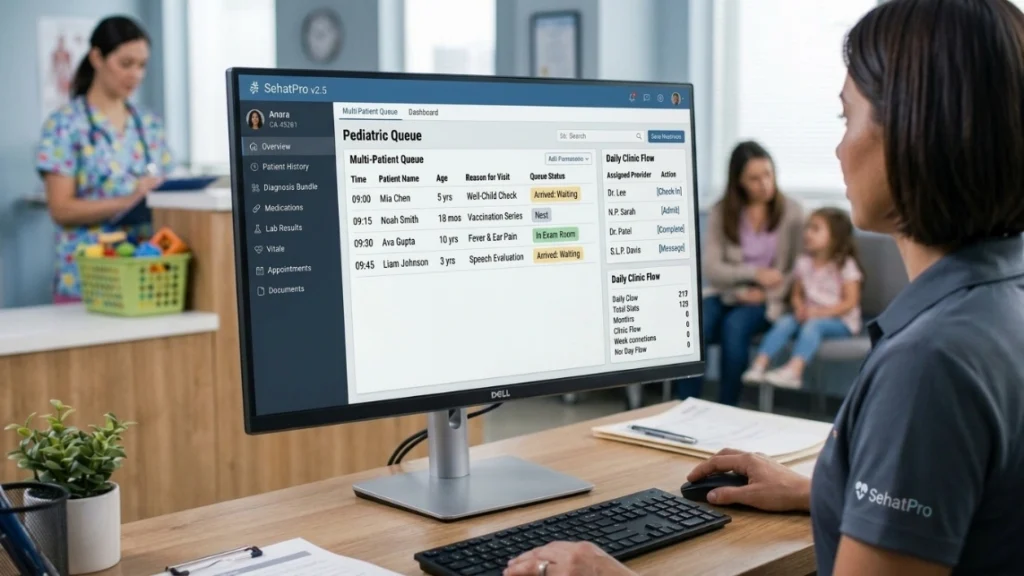
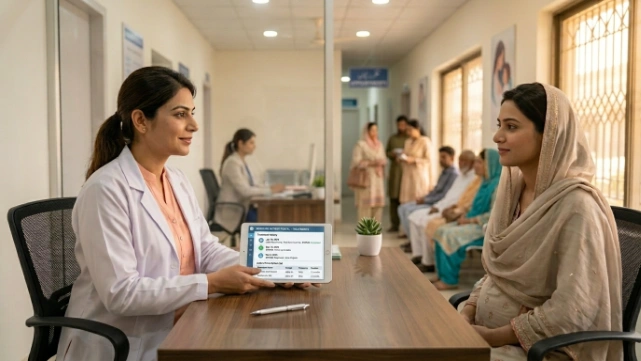
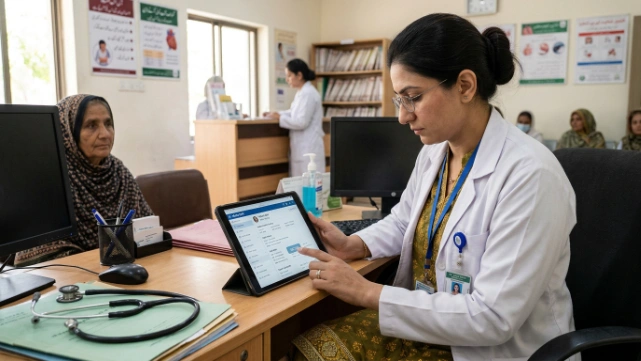
Think of an EMR as your clinic’s internal patient database. When a patient walks in for their third visit, you don’t ask what they were prescribed last time — you open their profile and it’s all there: allergies, chronic conditions, past investigations, current medications. No file hunting, no guessing, no errors from reading last month’s handwritten note.
This is where the EMR vs EHR distinction actually matters for a clinic owner deciding what to invest in. An EMR is built for a single clinic — it’s your practice’s internal record of a patient’s care under your roof. An EHR (Electronic Health Record) is designed to be shared across multiple providers — hospitals, labs, specialists — so a patient’s full health history follows them anywhere they seek care. For most solo practices and small-to-mid-size clinics in Pakistan, an EMR is the right fit: it does everything a paper file did, only faster and searchable, without the added complexity of multi-provider data-sharing that an EHR is built for.
For a general physician running a 40-patient-a-day clinic in Multan, this is not a small upgrade. It’s the difference between spending 3 minutes per patient reviewing history versus 12. A reliable clinic management software makes this possible — and SehatPro’s unlimited patient records system takes it further by storing lifetime records for every patient, accessible from any device, any time.
What an EMR Does Day-to-Day
- Pulls up a patient’s complete history in under 5 seconds
- Lets you write and print a prescription without rewriting the patient’s details by hand
- Tracks chronic disease progression (diabetes, hypertension, asthma) over months and years
- Flags drug interactions or allergy conflicts before you confirm the prescription
- Saves reusable diagnosis templates so your most common consultations take 60 seconds, not 6 minutes
A pediatrician in Islamabad using SehatPro’s fast consultation and prescription module reported cutting average prescription writing time from 7 minutes to under 2 — simply because they stopped retyping patient names, ages, and medication details from scratch every visit.
What Is an EHR — and Is It Different from an EMR?
An Electronic Health Record (EHR) is a broader system designed to share patient data across multiple healthcare providers — your clinic, a referring specialist, a hospital, a diagnostic lab, and a pharmacy — often through a national or regional health information network.
The core difference: EMR stays inside your clinic. EHR follows the patient wherever they go.
An EHR is the system a cardiologist in Karachi would use to receive referral notes from a GP in Larkana, see the patient’s complete history, and send discharge summaries back — all digitally, without a single printed sheet of paper being handed across.
In countries like the UK (NHS), Australia, and the UAE, national EHR frameworks are well-established. In Pakistan, a full national EHR network is still in early stages. The Pakistan Health Authority has announced digital health pilots in several provinces, but interoperability between providers is not yet standardized across the country.
The Practical Reality for Pakistani Clinics Right Now
| Feature | EMR | EHR |
|---|---|---|
| Stores patient records for your clinic | ✅ Yes | ✅ Yes |
| Shares data with other providers/hospitals | ❌ No | ✅ Yes |
| Required for day-to-day clinic management software | ✅ Essential | Optional |
| Available and functional in Pakistan today | ✅ Widely available | ⚠️ Limited/Developing |
| Cost for small to mid-size clinics | Affordable | Higher, often enterprise-only |
| Setup complexity | Low to Medium | High |
| Requires national health IT infrastructure | ❌ No | ✅ Yes |
For 95% of solo and small-practice clinics in Pakistan, an EMR system is the right starting point — and it delivers everything you need to run a professional, organized, patient-centered clinic today.
Why the EMR vs EHR Debate Matters for Clinics in Pakistan
When a gynecologist in Lahore asks “should I get EMR or EHR software?”, the right answer isn’t a textbook definition. It’s a question of what problems you’re actually trying to solve — and which tool solves them without making your staff’s life harder.
Pakistan’s clinic environment has specific realities that most international software ignores entirely:
Walk-in culture is dominant. A large share of patients in cities like Faisalabad, Sahiwal, and Toba Tek Singh arrive without appointments. Software that only works with pre-booked slots creates friction at the front desk rather than reducing it.
Staff may not be tech-trained. Your receptionist has likely never used a clinic management platform before. Any system that takes more than a day to learn will be quietly abandoned for the paper register.
Internet is inconsistent. Power fluctuations and mobile data gaps in areas like Mirpur-AJK or rural Punjab mean software that requires constant connectivity can fail you mid-consultation.
Urdu is the working language. A system built only in English creates a barrier between your receptionist and your records.
SehatPro was built inside these realities. Its multilingual interface supports Urdu, English, Arabic, Sindhi, and 27+ other languages. It has an offline installation option (available under the ProCare plan) for clinics in areas where internet reliability is a genuine concern. And its walk-in queue and token management system handles unbooked patients without any manual workaround.
According to a 2023 report by McKinsey Health Institute, clinics that adopt digital records reduce patient wait times by an average of 28% within the first three months — and that figure rises to 40%+ when appointment reminders are integrated. SehatPro’s automated SMS and WhatsApp reminder system handles this automatically, cutting no-shows without any daily manual effort from your team.
Which One Does Your Clinic Actually Need? A Practical Decision Guide
Here is the honest answer, based on SehatPro’s experience working with 135+ doctors and 98+ clinics across 50+ cities in Pakistan:
If you run a solo or small group practice — a GP, dermatologist, eye specialist, dentist, or urologist seeing patients at a single location — you need an EMR. Full stop. An EHR adds complexity and cost that delivers no practical benefit until national infrastructure catches up.
If you run a multi-branch clinic — a cardiology group in Karachi with two locations, a gynecology practice with a Lahore main clinic and a Faisalabad branch — you need a cloud-based EMR with centralized patient records that syncs across branches. SehatPro’s multi-branch clinic support covers this without requiring separate systems at each site.
If you run a hospital or teaching institution with referral relationships across departments and external providers, EHR capabilities become more relevant — and SehatPro’s EnterpriseCare plan is designed for exactly this scale, with custom integration options.
Step-by-Step: How to Choose the Right System for Your Clinic
- Define your clinic type — solo, group, multi-branch, or hospital
- List your biggest daily pain points — missing records, slow prescriptions, no-shows, double bookings, staff errors
- Check your connectivity — do you have stable internet, or do you need offline capability?
- Assess staff readiness — how quickly can your team learn a new system?
- Set a realistic budget — SehatPro plans start at PKR 2,999/month, with no hidden per-user fees
- Start with an EMR demo — see the system live before committing
- Scale to EHR when infrastructure supports it — the transition is smoother when your records are already digital
Pro Tip — from SehatPro’s field experience: The most common mistake clinics make is choosing software based on the feature list rather than the onboarding experience. A system with 200 features that takes 3 weeks to train your team on is less valuable than a system with 30 features your receptionist masters in a single afternoon. SehatPro’s onboarding is designed for clinics where the receptionist is also managing the phone, the walk-in queue, and the billing — simultaneously. Simplicity isn’t a limitation. It’s the product.
How SehatPro’s EMR Works in a Real Pakistani Clinic
Let’s make this concrete. Here’s how a typical consultation day looks for a pulmonologist in Karachi using SehatPro’s EMR system:
8:00 AM — Clinic opens. The receptionist logs in. Walk-in patients are issued tokens automatically. Appointment patients are already listed from the previous evening’s bookings. No separate register, no sticky notes.
9:15 AM — First consultation. The patient has visited before. The doctor opens their profile: three prior visits, a diagnosis of mild COPD, current medications, and a spirometry result from two months ago. No file hunting. The entire history loads in under 4 seconds.
9:20 AM — Prescription. The doctor selects a diagnosis from their saved bundle — “COPD Maintenance Protocol” — which pre-fills the standard medications and dosing instructions. They adjust one medication, add a note, and hit print. The prescription is ready in 45 seconds. The patient’s record is updated automatically.
9:22 AM — Next patient is called via the token display system.
End of day. Reports are auto-generated: total patients seen, diagnosis breakdown, revenue summary. Exportable to Excel in one click via SehatPro’s patient reports and insights dashboard.
This is not a hypothetical. This is what SehatPro delivers out of the box, from day one — for PKR 2,999/month under the CareStart plan.
Is Your Patient Data Safe in a Cloud-Based EMR?
Data security is the most common concern doctors raise before switching to digital records — and it is a completely legitimate concern. Patient data is sensitive. A breach isn’t just embarrassing — it erodes patient trust permanently.
Here is what responsible EMR security looks like, and what SehatPro provides:
End-to-end encryption. Data is encrypted both in transit and at rest, meaning even in the unlikely event of a server breach, the data is unreadable without the decryption key.
Role-based access. Your receptionist can see appointment slots and patient contact details. Your lab staff can see investigation results. Your doctor sees the full clinical record. No one accesses what they don’t need to. SehatPro’s role-based access system enforces this automatically.
Automated cloud backups. Records are backed up daily to secure cloud servers. A power cut, a hardware failure, or a flood in your clinic does not mean lost patient data.
No third-party data sharing. SehatPro does not sell, share, or monetize your clinic’s patient data. Full details are available at SehatPro’s data privacy and security page.
A 2023 IBM Security report found that healthcare data breaches cost an average of $10.9 million per incident globally — the highest of any industry for the 13th consecutive year. Paper files are not a “safer” alternative; they are simply an untracked vulnerability. A locked cabinet can be opened. A corrupted hard drive can lose years of records. A cloud-based EMR with proper encryption is, objectively, more secure than a shelf of paper charts.
What to Look for in Electronic Medical Records Software for Pakistan
Not all EMR software is built for how Pakistani clinics actually work. Here are the non-negotiable features to evaluate before committing to any system:
Walk-in patient support. If your system requires every patient to be pre-booked, it will fail in the first week. The majority of clinics across Lahore, Karachi, and Multan see a significant share of walk-ins every day.
Urdu language interface. Your receptionist and support staff work in Urdu. A system they can’t read confidently becomes a system they quietly ignore.
Prescription printing that works. The prescription must print in a format patients and pharmacies recognize — with your clinic name, the doctor’s credentials, the patient’s name, and clearly legible medication names and doses.
Offline or low-bandwidth capability. If you’re practicing in an area where internet drops during load-shedding, you need a system that doesn’t freeze mid-consultation.
Affordable pricing without hidden costs. Many international EMR platforms charge per user, per feature, or per integration. SehatPro’s pricing is transparent and flat — from PKR 2,999/month for CareStart to a one-time PKR 79,999 for ProCare (with offline installation).
Local customer support. When something goes wrong at 10 AM with 30 patients in the waiting room, you need support that responds in hours, not days — and ideally in Urdu or English, not a distant time zone.
SehatPro’s EMR software for Pakistan was built specifically to meet all of these requirements — not adapted from a Western product and localized as an afterthought.
What the Electronic Health Records System of the Future Looks Like in Pakistan
Pakistan’s digital health infrastructure is moving. Slowly, but moving.
The National Health Vision 2025 and the Ministry of National Health Services have identified digital health records interoperability as a priority. Several provincial health departments are running pilot programs for digital patient records in public hospitals. The Sehat Sahulat Program has integrated digital verification for beneficiaries. NHSRC (National Health Services, Regulations and Coordination) has been exploring a national patient identifier system.
What this means practically: clinics that go digital now — even with a standalone EMR — will be positioned to connect into an eventual national EHR network far more easily than clinics that wait. Your digital records become the foundation.
According to WHO’s Global Health Observatory, countries that implemented EMR systems at the primary care level before building national EHR infrastructure had 3x faster national rollout timelines than those that tried to build both simultaneously.
The practical takeaway: start with a solid EMR today. When EHR infrastructure matures in Pakistan, the transition will be a software update, not a ground-up rebuild.
Conclusion
The EMR vs EHR debate in Pakistan is simpler than it sounds. For the vast majority of clinics — whether you’re a dermatologist in Sialkot, a gastroenterologist in Karachi, or a GP with two locations in Faisalabad — an EMR system is what you need right now, and it solves most of the daily problems you’re dealing with.
Here’s what to take away:
- EMR = your clinic’s digital patient records. It replaces paper files, speeds up prescriptions, eliminates lost records, and makes patient history available in seconds.
- EHR = cross-provider data sharing. It’s the future of Pakistani healthcare, but the national infrastructure isn’t there yet for most private clinics.
- The right EMR for Pakistan supports walk-ins, works in Urdu, functions with limited internet, prints proper prescriptions, and doesn’t require a 3-week staff training program.
- Starting digital now gives you a head start when Pakistan’s national health records network expands — and it pays for itself quickly in time saved, errors avoided, and patients retained.
EMR vs EHR in Pakistan is ultimately a question of where your clinic is today versus where the system wants to be in five years. SehatPro helps you get there, practically and affordably.
FAQ
What is the difference between EMR and EHR in Pakistan?
An EMR (Electronic Medical Record) stores patient records within a single clinic and is the standard for most private practices in Pakistan today. An EHR (Electronic Health Record) shares data across multiple providers and healthcare facilities. Because Pakistan’s national health data infrastructure is still developing, most clinics need an EMR right now — not a full EHR system.
Which electronic medical records software is best for small clinics in Pakistan?
SehatPro is purpose-built for small and mid-size clinics in Pakistan, with support for walk-in patients, Urdu-language interface, low-bandwidth performance, and prescription printing. Plans start at PKR 2,999/month with no per-user charges. It’s used by 135+ doctors across 50+ cities. Most clinics are fully operational within one to two days of setup.
How much does clinic software cost in Pakistan?
Clinic software in Pakistan ranges from PKR 2,000 to PKR 80,000+ depending on features and installation type. SehatPro’s CareStart plan starts at PKR 2,999/month and includes appointment scheduling, EMR, prescription writing, and SMS reminders. The ProCare plan is a one-time PKR 79,999 payment with offline installation — ideal for clinics in areas with unreliable internet.
Is patient data safe in a cloud-based EMR?
Yes — when the system uses end-to-end encryption, role-based access controls, and automated backups, cloud-based EMR is significantly more secure than paper files. SehatPro encrypts all patient data in transit and at rest, restricts access by staff role, and backs up records daily. No patient data is shared with third parties.
Does SehatPro’s electronic health records system support Urdu?
Yes. SehatPro’s interface supports Urdu, English, Arabic, Sindhi, and 27+ other languages. This means your receptionist can manage the queue, update patient records, and handle billing in Urdu — without needing to navigate an English-only platform. Language settings can be configured per staff account.
How long does it take to set up EMR software in a clinic in Pakistan?
Most clinics using SehatPro are live within one to two business days. Setup includes account configuration, staff role assignment, and basic training. SehatPro’s onboarding team provides hands-on support in Urdu and English. There is no complex server installation required for cloud plans — only the ProCare offline plan requires a local installation visit.