Best Clinic Software for Dermatologists in Pakistan
Your reception desk is stacked with paper files by 11 a.m., three walk-in patients are arguing about whose turn it is next, and you’re still trying to remember what cream you prescribed to the patient from two visits ago. Pakistan has one doctor for roughly every 1,300 people — well below the World Health Organization’s recommended ratio of 1 per 1,000 — which means every dermatologist here sees more patients per day than the system was ever designed to handle. That volume, combined with paper files and handwritten prescriptions, is where most skin clinics lose time and lose patients. This article walks through what dermatology clinic software should actually do in a Pakistani clinic, what to compare before you buy, and how SehatPro handles the specific chaos of a dermatology practice — from acne follow-ups to eczema treatment tracking. If you’ve ever lost a patient’s photo history in a drawer full of files, keep reading.
What Should Dermatology Clinic Software in Pakistan Actually Do?
Dermatology clinic software should replace three things at once: your appointment register, your paper patient file, and your prescription pad — without asking your staff to learn a new system from scratch.
Most “clinic management software” sold in Pakistan is built for general practice and bolted onto specialties afterward. Dermatology doesn’t work that way. A dermatologist in Sialkot treating chronic acne, a cosmetic dermatologist in Lahore doing laser sessions, and a pediatric dermatologist in Islamabad managing eczema in children all need the same core thing — a system that remembers exactly what happened at the last visit, without you flipping through a file folder while a queue builds outside.
That means the software needs live token queue management for walk-ins, since most Pakistani skin clinics don’t run on strict appointment slots. It needs an EMR that stores treatment history over years, not months, because dermatology is a long-game specialty — psoriasis, vitiligo, and acne scarring are all tracked across repeat visits. It needs fast, print-ready prescription writing, because a dermatologist writing the same retinoid or antifungal combination fifteen times a day shouldn’t be rewriting it by hand fifteen times. SehatPro’s fast consultation and prescription writing tool was built around exactly this repetition — reusable templates cut prescription time roughly in half, based on internal usage patterns across SehatPro’s 135+ doctor network. And it needs to run in Urdu as easily as English, because your receptionist and your patient’s mother are not always comfortable with an English-only interface.
Why Dermatologists Lose Hours to Manual Queues and Paper Records
Manual queue management is the single biggest time drain in a walk-in-heavy dermatology clinic, and it’s almost entirely avoidable with a live token system.
Here’s what actually happens in most skin clinics across Multan, Faisalabad, and Karachi: patients arrive without appointments, receptionists write names on a register or a whiteboard, and disputes over turn order eat into consultation time multiple times a day. A published systematic review of outpatient clinics found no-show and scheduling disorganization contribute to missed-appointment rates as high as 23% on average across specialties, with dermatology clinics specifically averaging around 30% no-shows in industry benchmarking of patient scheduling data. That’s nearly a third of your booked slots going empty while walk-ins pile up chaotically in the waiting room.
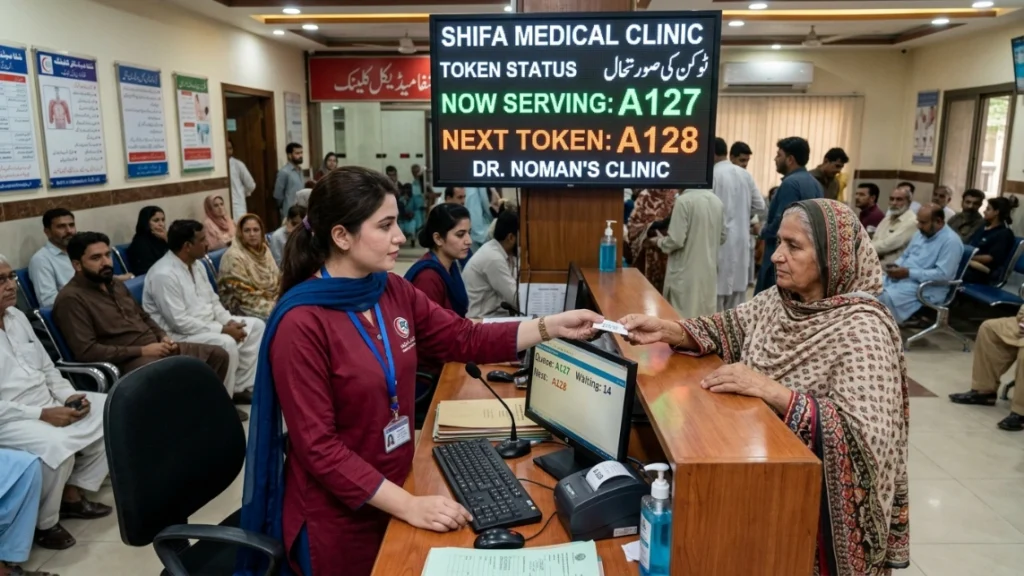
SehatPro’s appointment scheduling and queue management system handles this automatically — patients get a live token number, your front desk sees real-time queue status on screen, and the doctor’s room shows who’s next without anyone shouting a name across the waiting area. For a dermatologist in Larkana or Sahiwal running a solo practice with one receptionist, this alone removes the daily friction of manual token slips.
The Paper File Problem
Paper files get lost, damaged in monsoon-season humidity, or simply left at the wrong branch if your clinic has more than one location. For dermatology specifically, this is worse than in general practice — you’re often comparing a patient’s skin condition against photos or notes from six months ago, and a missing file means starting the diagnosis from zero.
Expert Insight: In our work with dermatology and cosmetic clinics across SehatPro’s network of 135+ doctors, the most common mistake we see is clinics treating patient history as optional data entry — done “when there’s time.” Skin conditions are chronic and comparative by nature. A dermatologist who can’t pull up what was prescribed three visits ago is re-diagnosing blind. Clinics that migrate their full patient history into EMR in the first month see the biggest drop in repeat-visit confusion.
Dermatologist EMR Pakistan: Tracking Skin History Without Losing a File
A dermatology-specific EMR needs to store more than vitals — it needs lifetime treatment history, medication changes, and follow-up notes that a general EMR often flattens into a single generic field.
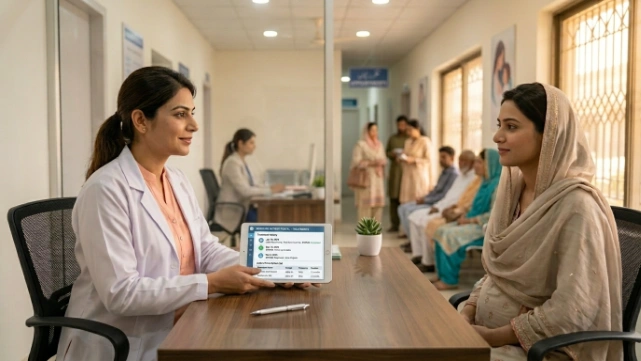
For a chronic condition like psoriasis or vitiligo, a dermatologist in Lahore might see the same patient every 4-6 weeks for a year or more. Without structured EMR, that history lives in scattered paper notes or, worse, in the doctor’s memory. SehatPro’s unlimited patient records feature keeps a permanent, searchable history per patient — every visit, every prescription, every diagnosis note, accessible instantly whether the doctor is at the Lahore clinic or checking a file from home before a follow-up call.
This matters even more for multi-visit treatments like laser sessions or chemical peels, where dosage and interval tracking directly affects patient safety. A cardiologist might need lab trend lines; a dermatologist needs treatment-cycle continuity. SehatPro’s EMR software for Pakistan was designed to flex across these specialty needs rather than forcing every doctor into the same generic template.
One-Click Diagnosis Bundles for Common Skin Conditions
Dermatology has a high volume of repeat-pattern cases — acne, fungal infections, allergic dermatitis, eczema. Typing the same diagnosis, medication list, and advice notes dozens of times a week wastes consultation minutes that should go to the patient. SehatPro’s one-click diagnosis bundles let a dermatologist save a treatment template once — say, a standard mild-acne protocol — and apply it in a single click for the next matching case, adjusting only what’s different for that patient.
Skin Clinic Management Software: Paper Files vs. SehatPro
Before choosing a system, it helps to see the real difference in daily operations, not just a features list.
| Factor | Paper-Based Clinic | SehatPro |
|---|---|---|
| Time per patient (registration to prescription) | 8-12 minutes | 3-5 minutes |
| Risk of lost/incomplete records | High — files misplaced across branches | Low — cloud-stored, accessible from any device |
| Prescription legibility errors | Common with handwritten notes | Eliminated with print-ready prescriptions |
| Follow-up reminders | Manual phone calls or none | Automated SMS/WhatsApp reminders |
| Multi-branch record access | Not possible without physically moving files | Centralized, real-time across branches |
| Staff training time | Familiar, but slow | 1-2 days for most reception staff |
| Monthly cost | “Free” but hidden in lost time and no-shows | Starts at PKR 2,999/month (CareStart) |
The paper column looks cheaper on the surface. It isn’t — the cost shows up as lost consultation time, no-show revenue, and the occasional misdiagnosis from an incomplete file history.
WhatsApp and SMS Reminders: Fixing No-Shows in Skin Clinics
Automated reminders are the single most effective low-cost fix for the no-show problem that dermatology clinics face more than most specialties.
Skin treatments are rarely one-visit fixes. A patient on a 6-week acne protocol, a vitiligo patient on a long-term follow-up schedule, or a post-laser patient needing a check-in — all of them are prone to simply forgetting, especially when the gap between visits is weeks rather than days. Research on outpatient scheduling shows automated reminder systems measurably reduce missed appointments compared to clinics relying on memory or manual phone calls alone, even though reminders alone don’t eliminate no-shows entirely.
SehatPro’s automated SMS and WhatsApp reminders send appointment confirmations and medicine refill nudges in Urdu or English, matched to what the patient is comfortable reading. For a pediatric dermatology practice in Islamabad managing eczema in young children, this also means reminding parents about medication refills between visits — something that’s nearly impossible to track manually across a full patient book. With Pakistan’s mobile broadband now reaching close to 140 million users nationwide according to 2025 telecom industry tracking, WhatsApp-based reminders reach patients far more reliably than phone calls that go unanswered.
Multi-Branch Dermatology Practices: Managing Sialkot to Lahore From One System
Multi-branch clinics need centralized records, not five separate paper systems that never talk to each other.
A growing number of dermatologists in Pakistan now run more than one location — a main clinic in Lahore and a satellite branch in a smaller city like Sialkot or Toba Tek Singh, often staffed by a junior associate on certain days. Without shared records, a patient who visits the Lahore branch one month and the Sialkot branch the next is treated as a stranger each time. That’s a real risk for a specialty where treatment continuity directly affects outcomes.
SehatPro’s support for multi-branch clinics keeps every patient record centralized and accessible in real time, regardless of which branch they walk into. Role-based access means your senior dermatologist can review a junior associate’s consultation notes remotely, while receptionists at each branch only see what’s relevant to their location — appointment slots, queue status, and billing, not clinical notes they don’t need to touch. This is particularly useful for practices expanding into Mirpur-AJK or smaller towns where the doctor can’t be physically present every day but still needs oversight.
Dermatology Practice Management: Choosing the Right SehatPro Plan
Cost sensitivity is real for solo dermatology practices, and the right plan depends on clinic size, not ambition.
A solo dermatologist just starting out in a smaller city doesn’t need the same tier as a five-branch cosmetic dermatology group in Karachi. SehatPro’s CareStart plan, at PKR 2,999/month, covers core appointment scheduling, EMR, and prescription writing — enough for a single-doctor practice to move off paper immediately. Clinics with unreliable internet in areas outside major cities often choose the ProCare plan (PKR 79,999 one-time), which includes an offline installation option so the system keeps running through connectivity drops without losing a single patient record. Multi-branch groups typically move to a custom EnterpriseCare plan once they need centralized reporting across locations.
Pakistan’s internet penetration sits at roughly 45.7% of the population nationally, with far higher usage in major cities and noticeably patchier coverage in smaller towns and rural clinics — which is exactly why the offline option matters for dermatology practices operating outside Lahore, Karachi, or Islamabad.
Data Privacy for Skin Clinics: Photos, History, and Patient Trust
Dermatology clinics often store more sensitive material than general practices — clinical photos, treatment-progress images, and long-term diagnosis histories that patients are especially protective of.
A skin condition, especially anything involving visible scarring, pigmentation, or cosmetic procedures, carries a level of patient sensitivity that a routine general-physician visit doesn’t. Patients need real assurance that their records — and any clinical images attached to their file — aren’t sitting on an unsecured shared drive or a receptionist’s personal phone. SehatPro’s data privacy and security setup uses encryption and secure cloud backups so patient records survive a lost laptop, a power cut, or a device left behind — situations that are common in day-to-day clinic operations across Pakistan.
This also matters for compliance readiness as Pakistan’s healthcare regulatory environment gradually tightens around digital patient data. Clinics that build good record-keeping habits now, rather than scrambling later, are in a stronger position regardless of how local data protection rules evolve.
Reporting and Insights: Knowing Which Treatments Actually Work
Dermatology practice management isn’t only about the patient in front of you — it’s about understanding patterns across your whole patient base over time.
Which acne protocol has the highest follow-up completion rate? Which season sees the highest spike in fungal infection cases in your city? Which branch is seeing the most no-shows? Without exportable reporting, these questions stay guesses. SehatPro’s reporting and insights tool generates daily and monthly summaries, exportable to Excel, giving a clinic owner in Faisalabad or a hospital administrator overseeing multiple dermatology branches actual numbers instead of gut feeling when deciding where to focus.
Setting Up Dermatology Clinic Software: A Practical Checklist
Before switching from paper to digital, walk through this sequence to avoid disruption to daily patient flow:
- Audit your current patient volume — daily walk-ins vs. scheduled appointments, so you configure the right queue settings from day one
- Migrate existing patient history — start with your most active chronic-treatment patients (psoriasis, vitiligo, long-term acne cases) first
- Set up diagnosis bundles — build templates for your five most common skin conditions before go-live
- Train reception staff on the token queue — most staff are comfortable within 1-2 days
- Enable WhatsApp/SMS reminders — activate this in week one, since it’s the fastest visible win for reducing no-shows
- Choose offline or cloud-only based on your clinic’s internet reliability, not assumptions
Frequently Missed Detail: Prescription Errors From Handwriting
Handwritten prescriptions remain one of the most preventable sources of medication errors in Pakistani clinics, and dermatology is not exempt — topical steroid strength, antifungal duration, and antihistamine dosing are all easy to misread when scribbled quickly between patients.
SehatPro’s fast consultation and print-ready prescription tool removes ambiguity entirely — every prescription prints clearly, with dosage and duration typed rather than handwritten, and pulls from the patient’s saved medication history to flag repeat prescriptions automatically.
Running a dermatology clinic in Pakistan today means competing on patient experience as much as clinical skill — and patient experience starts at the front desk, not the consultation room. The clinics pulling ahead are the ones that eliminated double bookings with live queue management, moved patient history into a searchable EMR instead of a file cabinet, cut prescription time with reusable templates, and stopped losing follow-up patients to forgotten appointments. Choosing the right dermatology clinic software isn’t about the longest features list — it’s about which system actually fits how your clinic runs day to day, in Urdu or English, with or without reliable internet. Ready to see how SehatPro can simplify your clinic? Book a free demo today.
FAQ
What is the best dermatology clinic software in Pakistan? The best dermatology clinic software in Pakistan combines live queue management, a lifetime patient EMR, and fast prescription printing in one system. SehatPro is built specifically for Pakistani clinics — Urdu-language support, walk-in queue handling, and an offline mode for areas with unreliable internet, unlike generic international software.
How much does clinic management software cost in Pakistan? Pricing typically starts around PKR 2,999/month for a basic plan covering appointments, EMR, and prescriptions. Offline installation options run as a one-time cost near PKR 79,999. Multi-branch or hospital-scale setups usually move to a custom enterprise plan based on the number of branches and staff accounts.
Is dermatology clinic software difficult for staff to learn? No — most reception and clinical staff become comfortable with core features like queue management and prescription writing within 1-2 days. Systems built for Pakistani clinics, like SehatPro, use a multilingual interface including Urdu, which removes the biggest learning barrier for non-English-fluent staff.
Is patient data safe on cloud-based skin clinic management software? Reputable dermatology clinic software encrypts patient records and clinical images, with secure automated cloud backups so data survives device loss, theft, or power cuts. This is more secure than paper files, which can be lost, damaged, or accessed without any audit trail.
Does dermatology clinic software work without reliable internet? Some systems, including SehatPro’s ProCare plan, offer offline installation so appointment scheduling, EMR access, and prescription writing continue working during connectivity drops, with data syncing once internet returns — a critical feature for clinics outside major Pakistani cities.
How long does it take to set up dermatology practice management software? Basic setup — appointment configuration, staff accounts, and prescription templates — typically takes a single day. Full patient history migration takes longer and depends on how many existing records need to be digitized, but most solo dermatology practices are fully operational within a week.