How Clinic Management Software Improves Patient Data Security
Clinic management software improves patient data security by replacing paper files with encrypted, cloud-backed records, restricting access by staff role, and logging every login and edit. Secure clinic management software like SehatPro protects sensitive patient history from theft, loss, and unauthorized viewing — something a locked file cabinet never could.
Introduction
A single healthcare data breach now costs an average of $7.42 million, and healthcare has held the title of the most expensive industry for breaches for 14 years running, according to <cite index=”5-1″>IBM’s Cost of a Data Breach report</cite>. You might be thinking, “That’s an American hospital problem, not mine.” But if you’re running a clinic in Multan or Sialkot with a steel almirah full of patient files, your risk isn’t a foreign hacker — it’s a missing folder, a flooded storeroom, or a receptionist who mixed up two patients’ prescriptions during a rushed Saturday queue.
Secure clinic management software isn’t a luxury built for hospitals with IT departments. It’s the difference between a patient’s diabetes history sitting in a labeled folder anyone in your clinic can flip through, and that same history sitting behind a login only you and your assigned staff can access. This article walks through exactly how software like SehatPro secures patient data — encryption, backups, access control, and the daily habits that keep a Pakistani clinic compliant and trustworthy.
Here’s where most clinics are exposed, and what actually fixes it.
What Makes Clinic Management Software “Secure” in the First Place?
Secure clinic management software combines three things: encrypted storage, controlled access, and automatic backups. Together, they replace the guesswork of paper files with a system where you always know who touched a record, when, and why — even if your clinic loses power mid-consultation.
Most clinic owners hear “secure software” and picture something abstract — a padlock icon, maybe a password screen. In practice, security is built from layers that work quietly in the background. Encryption scrambles patient data so that even if someone intercepts it, they can’t read it. Role-based access means your receptionist in Faisalabad can update a token queue but can’t open a cardiology patient’s full diagnostic history. Automatic cloud backup means that even if your clinic PC crashes or a monsoon flood damages your front desk, the patient records stay untouched on a separate server.
Compare this to the standard file-cabinet setup still common in general practice clinics across Toba Tek Singh and Sahiwal: one key, one cabinet, one point of failure. A pediatrician in Islamabad recently told us her clinic lost six months of vaccination records when a water pipe burst in her storage room — records that would have taken seconds to restore from SehatPro’s cloud backup. <cite index=”1-1″>Healthcare data breaches in the United States dropped in average cost year-over-year but healthcare remains the costliest industry studied, a position it has held for 14 consecutive years</cite> — a reminder that patient data is valuable enough to protect deliberately, not accidentally.
Why Are Handwritten Prescriptions and Paper Files a Security Risk?
Paper records aren’t just slow — they’re a security gap with no audit trail. Anyone who touches the file cabinet can read, remove, or alter a patient’s history, and there’s no record of it happening. Handwritten prescriptions add a second layer of risk: misread doses and drug names.
Research on ambulatory prescribing found that roughly 21% of handwritten prescriptions contain at least one writing error, according to a study published via the <cite index=”24-1″>Agency for Healthcare Research and Quality’s PSNet</cite>. Separate hospital-based research comparing paper and electronic prescribing found <cite index=”21-1″>37 medication errors per 100 handwritten prescriptions, compared to just seven per 100 when prescriptions were generated electronically</cite>. In a Multan general practice seeing 80 walk-ins a day, that gap adds up fast — and every misread dosage is a patient safety incident as much as a data problem.
Paper also fails silently. A cardiologist in Karachi can’t run a query to see which staff member accessed a VIP patient’s file last month. A dermatologist in Sialkot can’t prove, if ever questioned, that a competing clinic didn’t walk off with a patient list. SehatPro’s fast consultation and prescription printing workflow removes handwriting from the equation entirely — every prescription is typed, templated, and printed, with the underlying record encrypted and logged. This alone closes two risks at once: legibility errors and unauthorized access.
The Compliance Angle Pakistani Clinics Often Miss
Pakistan doesn’t yet have a fully enacted data protection law in force, but the direction is clear. The <cite index=”12-1″>Personal Data Protection Bill, 2023 explicitly classifies health data as “sensitive personal data,” requiring explicit consent for processing except in defined medical exceptions</cite>, and it sits alongside the existing <cite index=”14-1″>Prevention of Electronic Crimes Act, 2016, which already addresses unauthorized data access and misuse</cite>. Clinics that build encrypted, access-controlled record-keeping now won’t be scrambling later. Waiting for the law to fully take effect before securing patient data is a bit like waiting for a leak to become a flood before fixing the roof.
How Does Encryption Actually Protect a Patient’s Medical History?
Encryption converts patient data into unreadable code that only authorized systems can decrypt. Even if a device is lost or a network is compromised, the underlying medical history, prescriptions, and lab results stay unreadable to anyone without the correct access credentials.
Think about what a full patient record actually contains in your clinic: national ID number, phone number, home address, diagnosis history, prescribed medications, sometimes lab results shared through your QuickLab integration. That’s a complete profile of someone’s health and identity in one place — exactly the kind of data package that’s valuable on the black market and devastating if leaked locally, especially in smaller cities where everyone knows everyone.
SehatPro encrypts patient data both in transit (when it moves between your tablet, your front desk PC, and the cloud) and at rest (when it’s sitting in storage). This matters practically in areas with unstable internet — a common reality in parts of Larkana or rural Punjab — because even a weak or interrupted connection doesn’t expose raw, unencrypted data mid-transfer. <cite index=”10-1″>Stolen or compromised credentials remain one of the most common ways attackers gain unauthorized access to systems, taking on average nearly six months to identify once a breach occurs</cite> — which is exactly why encryption paired with strict login controls matters more than a single strong password.
Expert Insight — SehatPro Team: The most common mistake we see across our 135+ doctor network isn’t a technical failure — it’s shared logins. Clinics that let every receptionist use one generic “Reception” account lose the entire point of role-based access. When each staff member has their own login, you get a real audit trail, and if someone leaves the clinic, you revoke exactly one account instead of changing a password everyone knew.
Should Every Staff Member Have the Same Access to Patient Records?
No. Role-based access is one of the most overlooked security features in clinic software, and it’s also one of the simplest to set up correctly. Your receptionist needs the appointment queue. Your lab staff need test results. Only the treating doctor needs the full medical history.
In a solo general practice, this might feel unnecessary — after all, it’s just you and one assistant. But most clinics in Lahore, Karachi, and Islamabad aren’t solo operations anymore. A multi-branch clinic in Faisalabad might have three receptionists, two nurses, a lab technician, and rotating consultant doctors across shifts. Without role-based access, every one of those people can technically open any patient’s complete file, including sensitive diagnoses that have nothing to do with their job.
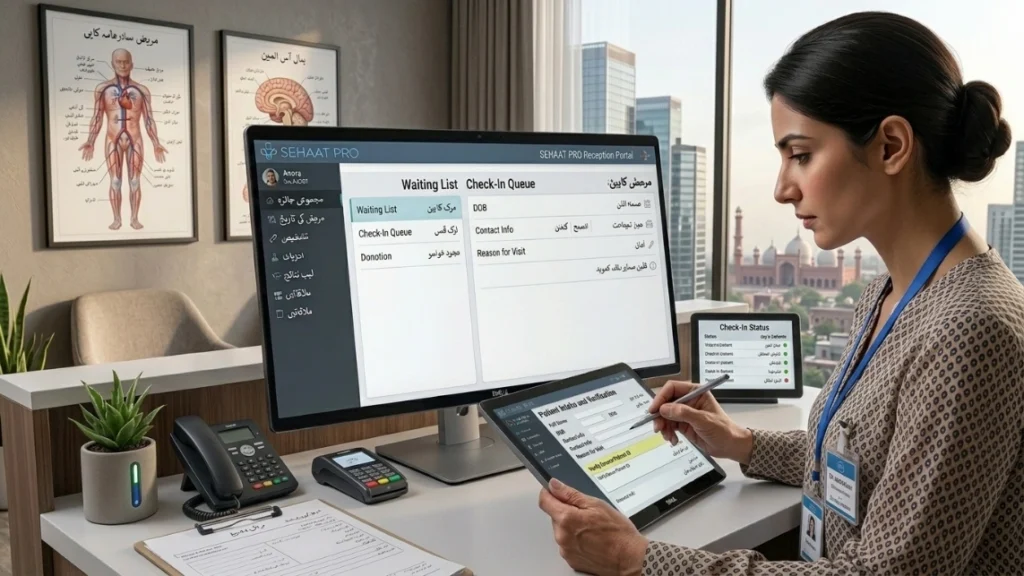
SehatPro’s role-based access for doctors, receptionists, and lab staff solves this at the account level, not through office policy that people forget to follow. A gynecologist in Lahore can restrict a patient’s obstetric history to herself and her nursing assistant, while the front desk only sees appointment status and contact details. This isn’t about distrust of your staff — it’s about limiting exposure so that a single compromised login, lost phone, or disgruntled former employee can’t walk away with your entire patient database.
What Role-Based Access Looks Like Day to Day
- Receptionist logs in → sees today’s token queue and appointment calendar, not diagnosis history
- Lab staff logs in → sees pending and completed test orders through QuickLab, not full consultation notes
- Doctor logs in → sees full EMR, prescription history, and diagnosis for their own patients
- Clinic owner/admin logs in → sees reporting and insights across branches, with configurable visibility into clinical detail
Paper Files vs. Secure Clinic Software: A Direct Comparison
Numbers make this easier to see than description alone. Here’s how a typical paper-based clinic compares to one running SehatPro across the factors that actually affect a doctor’s day and a patient’s trust.
| Factor | Paper-Based Clinic | SehatPro (Cloud-Based) |
|---|---|---|
| Time to retrieve a patient’s history | 5–15 minutes, if the file isn’t misplaced | Under 10 seconds via patient search |
| Prescription error risk | <cite index=”21-1″>Roughly 37 errors per 100 handwritten prescriptions</cite> | Templated, typed, print-ready prescriptions |
| Data loss risk | Fire, flood, theft, or misfiling — no backup | Automatic encrypted cloud backup |
| Who can view a record | Anyone with physical access to the cabinet | Role-based login, logged and restricted |
| Multi-branch visibility | None — each branch holds its own paper | Centralized records across all branches |
| Compliance readiness | No audit trail, no breach detection | Access logs and encrypted storage |
| Staff learning curve | Familiar, but slow and error-prone | Simple Urdu/English interface, guided setup |
| Monthly cost | “Free,” but hidden in lost time and errors | Starting at PKR 2,999/month (CareStart) |
How Do WhatsApp Reminders and Multi-Branch Records Fit into Data Security?
Every additional channel that touches patient data — SMS, WhatsApp, a second clinic branch — needs to be secured the same way as your core records, not treated as a side feature. SehatPro builds these into the same encrypted system rather than bolting them on separately.
Automated reminders are one of the most-used SehatPro features because they directly cut no-shows, but clinic owners sometimes worry: does sending a WhatsApp reminder about a patient’s follow-up expose their condition to whoever else uses that phone? SehatPro’s automated SMS and WhatsApp reminders for appointments and medicines are designed to confirm appointment times and medicine schedules without exposing full diagnostic detail in the message itself — protecting the patient even if the message is seen by a family member.
Multi-branch clinics face a related but bigger challenge. A cardiologist in Karachi running two branches needs a patient’s record to follow them between locations — but that same centralization, if built badly, becomes a bigger single point of failure. SehatPro’s support for multi-branch clinics with centralized patient records keeps data unified for continuity of care while still applying the same encryption and role-based access at every branch, so a receptionist at your Model Town branch in Lahore still can’t see clinical notes reserved for the treating doctor at your DHA branch.
What Happens to Patient Data When the Internet Goes Down?
Connectivity gaps are a daily reality in many parts of Pakistan, and clinic software has to plan for that instead of assuming constant broadband. A secure system doesn’t just protect data when everything’s working — it protects continuity of care when the connection drops.
This is where the ProCare offline installation option matters for clinics in areas with poor connectivity — smaller towns near Mirpur-AJK, or clinics in parts of interior Sindh where fiber lines are unreliable. Rather than forcing a doctor to revert to paper the moment the internet cuts out, an offline-capable system keeps the clinic running locally and syncs securely once connectivity returns, so no record is lost or duplicated in the gap.
This matters more than it might seem. A gastroenterologist in Sahiwal who loses internet mid-consultation shouldn’t have to choose between stopping patient care and writing on a scrap of paper that becomes an untracked, unencrypted record the moment it’s created. SehatPro’s data privacy and security architecture is built around this exact scenario — continuity without compromising the encryption and audit trail that protects the patient once the system reconnects.
Quick Security Checklist Before You Choose Clinic Software
Before signing up for any clinic management system run through this:
- Does the vendor explain, in plain terms, how patient data is encrypted — both in transit and in storage?
- Can you assign different access levels to doctors, receptionists, and lab staff?
- Is there automatic, regular cloud backup — not a manual export you have to remember to run?
- Does the system keep a log of who accessed or edited a record, and when?
- Is there an offline option for clinics in low-connectivity areas, so you’re not forced back to paper?
- Is the interface available in Urdu or another language your staff is comfortable working in, so mistakes from confusion don’t become security gaps?
- Does the pricing structure match what you’d actually use — no forced upgrade just to get basic encryption?
Conclusion
Patient trust is the actual asset at stake here, not just the software. A clinic that loses a file, misreads a handwritten dose, or lets an unauthorized staff member browse a diagnosis isn’t just risking a fine under future data protection law — it’s risking the relationship a patient has with their doctor. Secure clinic management software fixes this at the structural level: encrypted storage instead of an unlocked cabinet, role-based access instead of one shared password, automatic backups instead of hoping nothing goes wrong.
If you’re running a general practice in Multan, a multi-branch operation in Faisalabad, or a solo dermatology clinic in Sialkot, the fix isn’t complicated — it’s a system built for exactly this environment. That’s what secure clinic management software from SehatPro is built to do, starting at PKR 2,999/month with no hidden setup complexity for your Urdu-speaking staff.
FAQ
Is clinic management software actually more secure than paper patient files? A: Yes. Secure clinic management software encrypts patient records, restricts access by staff role, and creates an audit trail of who viewed or edited a file. Paper records have no such protection — anyone with physical access to the cabinet can read or remove them, with no way to trace it.
How much does secure clinic management software cost in Pakistan? A: SehatPro’s plans start at PKR 2,999/month for the CareStart tier, with a one-time ProCare option at PKR 79,999 for clinics needing offline installation. Custom EnterpriseCare pricing is available for multi-branch hospitals with larger data and staffing needs.
Does clinic management software work in Urdu for clinics with Urdu-speaking staff? A: Yes. SehatPro’s interface supports Urdu, English, Arabic, Sindhi, and 27+ other languages, so receptionists and clinical staff can work in the language they’re most comfortable with, reducing the data-entry mistakes that come from an unfamiliar interface.
How long does it take to set up secure clinic management software? A: Most single-branch clinics using SehatPro are running within a day, including staff training on appointment scheduling, EMR entry, and prescription printing. Multi-branch setups with centralized records typically take a few days longer to configure role-based access across locations.
What happens to patient data if my clinic’s internet connection is unreliable? A: SehatPro’s ProCare plan includes an offline installation option for clinics in areas with poor connectivity. The system keeps working locally and syncs securely once the connection returns, so no patient record is lost or left unencrypted during an outage.
Is patient data backed up automatically, or do I have to do it manually? A: SehatPro backs up patient data automatically to encrypted cloud storage as part of every plan. You don’t need to remember to run exports or maintain a separate backup drive — the system handles it in the background continuously.