
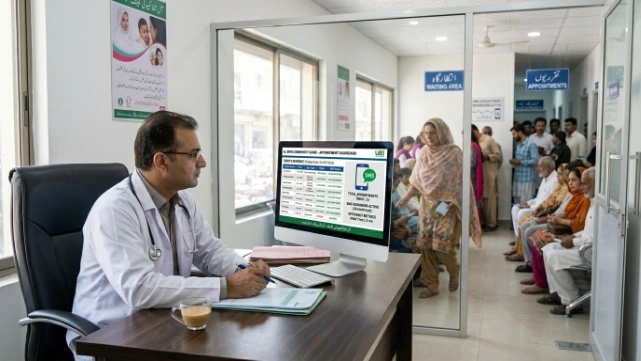
Best Appointment Scheduling Software for Clinics in Pakistan
The best appointment scheduling software for clinics in Pakistan combines online booking, live token queue management, and WhatsApp reminders in one system — like SehatPro. It replaces paper registers, prevents double bookings, cuts patient wait times, and works even in areas with unstable internet, starting at PKR 2,999/month.
Your Waiting Room Is Losing You Money Every Single Day
A 2025 PTA report shows Pakistan has crossed 150 million broadband connections and over 60% broadband penetration nationwide — your patients are online, checking their phones between chores, expecting to book things the way they book a rickshaw or order groceries. Yet most clinics in Multan, Lahore, and Karachi still run appointments off a spiral notebook and a receptionist’s memory.
That gap is the problem. When a patient calls three times because no one confirmed their slot, or walks in expecting to be seen “around noon” and waits two hours instead, you don’t just lose that visit — you lose the referral they would have sent your way. Appointment scheduling software Pakistan clinics adopt today isn’t a luxury upgrade. It’s the difference between a clinic that runs on guesswork and one that runs on data.
This article walks through what real appointment scheduling software does, what it costs, how it fits Pakistan’s walk-in culture, and how to pick a system that won’t collapse the first time the internet drops mid-consultation.
What Does Appointment Scheduling Software Actually Do for a Pakistani Clinic?
Appointment scheduling software replaces your register and phone-based booking with a digital system that shows real-time slot availability, assigns queue tokens automatically, and sends reminders — so your receptionist stops double-booking and your patients stop guessing when they’ll be seen.
For a general physician in Multan running 40 to 60 patients a day, the register system breaks down fast. Two receptionists can’t see the same page at once. A patient calls to book while another sits at the counter — someone forgets to write it down, and now two people show up expecting the 11 a.m. slot. This is the single most common complaint SehatPro hears from new clinics: not lost revenue directly, but the friction and embarrassment of managing conflicts in front of a full waiting room.
A proper system solves this by centralizing every booking — phone, walk-in, or online — into one live calendar every staff member sees at once. SehatPro’s appointment scheduling and queue management system handles this automatically, so a booking made by a receptionist in your Faisalabad branch and one made by a patient through WhatsApp update the same schedule instantly, with no double entry.
For gynecologists in Lahore managing follow-up-heavy practices, or cardiologists in Karachi juggling walk-ins alongside scheduled consults, this single source of truth matters more than any other feature. It’s the foundation everything else — queue tokens, reminders, records — is built on.
Why Paper Registers and Phone-Based Booking Are Costing You Patients
Manual booking systems fail quietly — you don’t see the patient who gave up calling after three busy signals, or the one who found a clinic down the road with an online form. That invisible attrition is the real cost, and it compounds every month you delay switching.
Here’s what typically goes wrong in a paper-based Pakistani clinic:
The Double-Booking Problem Two staff members, two memories, one register. A study on Pakistan’s health information systems (published via NCBI/PMC) found that facilities lacking structured information management consistently reported coordination breakdowns between staff — exactly the pattern behind double bookings and missed slots. When a patient in Sialkot drives 40 minutes for an appointment that was accidentally double-booked, you don’t just lose that visit. You lose their trust.
The No-Show Problem Without automated reminders, patients forget. A follow-up scheduled three weeks out for a diabetic patient in Islamabad is easy to lose track of — no calendar alert, no nudge, nothing between the appointment and the empty chair. SehatPro’s automated SMS and WhatsApp reminders close this gap by pinging patients a day before and again a few hours out, in Urdu or English depending on what the patient prefers.
The Handwriting Problem Handwritten prescriptions and appointment slips get misread — by pharmacists, by lab staff, by the receptionist herself trying to decipher a doctor’s rushed note between patients. Illegible records are a well-documented source of medication errors globally, and Pakistani clinics are not exempt.
None of this is a staff competence issue. It’s a systems issue. Paper cannot scale past a certain patient volume without breaking somewhere.
How Does an Online Appointment Booking System Work Day to Day?
An online appointment booking system lets patients reserve a slot through a link, WhatsApp message, or app — without calling the clinic — while your staff sees every booking land on one shared calendar in real time, whether it came from the front desk or the patient’s phone.
Picture a pediatrician in Islamabad on a Monday morning. Before SehatPro, her receptionist fielded 30+ calls before 10 a.m. just to confirm slots. After switching, half those bookings now come in overnight through the online link she shares on her clinic’s Facebook page and WhatsApp Business number — patients pick an open slot themselves, get an instant confirmation, and show up without a single phone call.
This doesn’t remove the human element clinics in Pakistan still rely on — many patients, especially older ones or those in smaller towns like Toba Tek Singh or Sahiwal, will always prefer calling or walking in. A good system has to support both. SehatPro’s easy appointment and patient handling module lets your receptionist book manually in the exact same calendar a patient books online, so there’s never a mismatch between the two channels.
Pro Tip — Expert Insight from SehatPro:
One mistake we see constantly across our 135+ doctor network: clinics turn on online booking but never train the front desk to check it first thing in the morning. The result is a receptionist who still calls every patient individually out of habit, defeating the purpose. The fix takes ten minutes — build a morning checklist that starts with reviewing the online queue before making a single phone call.
For multi-branch practices — a dermatologist in Sialkot running two locations, for instance — the same booking system needs to show branch-specific availability without merging calendars incorrectly. SehatPro’s support for multi-branch clinics keeps each branch’s schedule distinct while still centralizing patient history, so a patient who visits either location is recognized instantly.
Solving Pakistan’s Walk-In Culture With Live Queue and Token Management
Pakistan’s clinics run on walk-ins as much as scheduled bookings — a live queue and token system for clinics assigns real-time numbers to both, so a patient who scheduled online and one who just walked in both know exactly how long the wait is, without a receptionist manually managing a line.
This matters more here than almost anywhere else, because unlike clinics in fully appointment-based healthcare systems, Pakistani general practice runs on a hybrid model. A GP in Multan might have 15 scheduled patients and 25 walk-ins on the same afternoon. Managing that mix with a paper token slip and a shouting receptionist creates chaos — and chaos in a waiting room reads as unprofessionalism to patients, even when the actual care is excellent.
A digital token system displays live queue position on a screen or sends it via SMS, so patients know whether they have time to step out for tea or should stay seated. It also lets your doctor control pacing — pulling in a scheduled patient between two walk-ins without losing track of who’s next. This is one of the most requested features from SehatPro’s clinic base, because it directly addresses the visible chaos that damages a clinic’s reputation in the neighborhood, regardless of clinical quality.
| Metric | Paper-Based Token System | SehatPro Digital Queue |
|---|---|---|
| Time to check in a patient | 2–4 minutes (manual writing) | Under 30 seconds |
| Booking conflict / double booking rate | Common, especially multi-staff | Near-zero — single shared calendar |
| Patient wait-time visibility | None — patients ask repeatedly | Live queue position shown on screen/SMS |
| Staff workload during peak hours | High — manual coordination | Reduced — automated queue logic |
| Data recovery after loss/damage | Not possible (paper destroyed) | Full cloud backup, recoverable anytime |
| Monthly cost | “Free” but hidden in lost patients | Starts at PKR 2,999/month |
What Should You Look for in Appointment Scheduling Software in Pakistan?
The right appointment scheduling software Pakistan clinics can rely on needs to work reliably during power cuts and weak internet, support Urdu-speaking staff without a steep learning curve, and connect scheduling directly to patient records — not exist as a separate, disconnected booking tool.
Not every scheduling tool built for other markets survives contact with Pakistan’s actual clinical environment. Before you commit to a system, check for these five things:
- Offline resilience. Areas outside major city centers — parts of Larkana, rural Punjab near Toba Tek Singh — still deal with unreliable connectivity. SehatPro’s ProCare plan includes an offline installation option specifically for this, so scheduling and queue management keep running even when the internet doesn’t.
- Genuine multilingual support. Not just an English interface with Urdu labels bolted on. SehatPro runs in Urdu, English, Arabic, Sindhi, and 27+ other languages, so a receptionist who’s more comfortable working in Urdu isn’t fighting the software on top of managing patients.
- Integration with records, not just bookings. A scheduling tool that doesn’t talk to patient history forces double data entry. SehatPro’s unlimited patient records module links every appointment directly to that patient’s full history, so the doctor sees context the moment they’re called in.
- Role-based access. Your receptionist shouldn’t see the same screen as your doctor or your lab technician. Role-based permissions protect sensitive data and keep each staff member’s interface focused on their actual job.
- Transparent, predictable pricing. Cost sensitivity is real for small and mid-size clinics. Look for tiered pricing — SehatPro’s CareStart plan begins at PKR 2,999/month, scaling up to the one-time ProCare license at PKR 79,999 for clinics that want offline capability and a custom EnterpriseCare tier for hospital networks.
How Multi-Branch Clinics and Labs Use Digital Scheduling Together
Multi-branch clinics and labs connected to them need scheduling software that centralizes patient records across every location — so a lab result ordered at one branch is visible to the doctor scheduling a follow-up at another, without phone calls or physically transferred files.
Consider a diagnostic setup common in cities like Faisalabad or Lahore: a clinic with two branches, both feeding into a shared lab. Without centralized scheduling, a patient’s blood work ordered at Branch A might not be visible to the physician seeing them at Branch B two days later — the receptionist has to call around, or the patient has to carry a printed slip. SehatPro’s QuickLab integration connects lab workflows directly into the same scheduling and records system, so test orders, results, and the next appointment all live in one place regardless of which branch handled which step.
This same centralization helps hospital administrators managing multi-branch operations get a real picture of patient flow — SehatPro’s reporting and insights module exports daily and monthly data to Excel, showing which branch is overbooked, which specialty has the longest wait times, and where no-show rates are highest. That’s decision-making data a paper system simply cannot produce.
Is It Hard to Switch From Paper to Digital Scheduling?
Switching from paper-based booking to digital scheduling software typically takes a few days to two weeks for a single clinic, most of which goes into loading existing patient data and training staff — not the software setup itself, which SehatPro’s team handles directly.
The fear we hear most from clinic owners evaluating software isn’t cost — it’s whether their staff can actually learn it. A receptionist who has worked from a register for fifteen years is understandably wary of a screen replacing her system. This concern is valid, and it deserves a real answer, not a dismissive one.
In practice, the learning curve is shorter than expected because SehatPro’s interface mirrors the logical flow staff already know: patient walks in or calls, gets a slot, gets a token, sees the doctor. The software formalizes a process your staff already runs mentally — it doesn’t ask them to learn a new way of thinking about patient flow, just a new way of recording it. SehatPro’s fast consultation and prescription writing tools also reduce the doctor’s side of the workload, since one-click diagnosis bundles and reusable templates cut repetitive typing during consultations, which is often the bigger resistance point than scheduling itself.
For a solo GP practice, expect to be fully operational within a week. For a multi-branch clinic with years of paper records to digitize, budget closer to two to three weeks — and lean on SehatPro’s support team rather than trying to migrate everything internally overnight.
Take Control of Your Clinic’s Schedule Before It Controls You
A clinic that runs on guesswork loses patients quietly, one frustrated visit at a time. The right appointment scheduling software Pakistan clinics trust doesn’t just look modern — it fixes the specific, daily friction points costing you time and reputation: double bookings, chaotic queues, forgotten follow-ups, and records scattered across paper files.
Four things to act on this month:
- Audit how many booking conflicts and no-shows your clinic had last month — most owners underestimate this until they see the number.
- Move to a shared digital calendar so every staff member, across every branch, sees the same live schedule.
- Turn on automated WhatsApp and SMS reminders — this alone typically produces the fastest visible drop in no-shows.
- Choose a system built for Pakistan’s real conditions: Urdu support, offline capability, and pricing that fits a small or mid-size clinic budget.
FAQ
What is the best appointment scheduling software for clinics in Pakistan?
The best options combine online booking, live queue/token management, and patient records in one platform. SehatPro is built specifically for Pakistani clinics, offering Urdu support, offline capability, and pricing starting at PKR 2,999/month — making it accessible to small and mid-size practices.
How much does appointment scheduling software cost in Pakistan?
Pricing varies by provider. SehatPro’s CareStart plan starts at PKR 2,999/month, with a one-time ProCare license at PKR 79,999 for offline-capable clinics, and custom EnterpriseCare pricing for hospital networks and multi-branch operations.
Is appointment scheduling software difficult for clinic staff to learn?
Most receptionists become comfortable within a few days because the software mirrors the booking process they already follow — patient arrives, gets a slot, gets a token. SehatPro’s Urdu-language interface removes the language barrier that often slows adoption elsewhere.
Does appointment scheduling software work with unreliable internet in Pakistan? Reliable systems account for this. SehatPro’s ProCare plan includes an offline installation option, so clinics in areas with unstable connectivity — including parts of Larkana or rural Punjab — can keep scheduling and queue management running without interruption.
Is patient data safe with an online appointment booking system?
Yes, when the provider uses encryption and secure cloud backups. SehatPro’s data privacy and security framework protects patient records with encrypted storage and automatic backups, so information isn’t lost even if a device is damaged or stolen.
How long does it take to set up appointment scheduling software Pakistan clinics can use immediately?
A solo practice can typically be fully operational within a week. Multi-branch clinics migrating years of paper records should budget two to three weeks, with SehatPro’s support team assisting the data transfer directly rather than leaving staff to handle it alone.