Best Clinic Management Software for Cardiologists in Pakistan
The best cardiology clinic software in Pakistan is one built for high patient volume, test-heavy records, and follow-up-driven care — like SehatPro. It combines EMR, appointment scheduling, ECG-ready templates, and WhatsApp reminders in one cloud system, so cardiologists spend less time on paperwork and more time on patients.
Introduction
A cardiologist in Karachi sees an average of 40 to 60 patients a day, many of them repeat visits for blood pressure monitoring, post-angioplasty follow-up, or lipid profile review, according to data shared by the Pakistan Cardiac Society at its 2023 clinical conference. That volume alone makes a paper file system unworkable. Add ECG strips, stress test reports, and medication histories that need to be cross-checked at every visit, and the risk of a missed detail becomes a patient safety issue, not just an inconvenience.
This is the exact problem cardiology clinic software was built to solve. A general-purpose booking app doesn’t understand what a cardiac patient’s chart actually needs — lifetime history, drug interaction awareness, and fast retrieval during a 10-minute consultation slot.
In this article, you’ll learn what separates cardiology-ready software from generic clinic tools, how Pakistani cardiac practices from Lahore to Multan are using digital records to cut errors, and what to check before you commit to a platform for your practice.
What Makes Cardiology Clinic Software Different From General Clinic Software?
Cardiology practices manage more recurring visits, more test data, and more long-term medication tracking than most specialties — which means generic appointment apps fall short fast. You need a system built around chronic-care patterns, not one-time visits.
A general physician’s clinic in Toba Tek Singh might see a patient once for a fever and never again. A cardiologist in Lahore sees the same hypertension or post-MI patient every 4 to 6 weeks, sometimes for years. That changes what the software needs to do. It has to pull up a patient’s full history — previous ECGs, prescribed beta-blockers, past dosage changes — in seconds, not minutes, because cardiac consultations are short and the patient is often anxious.
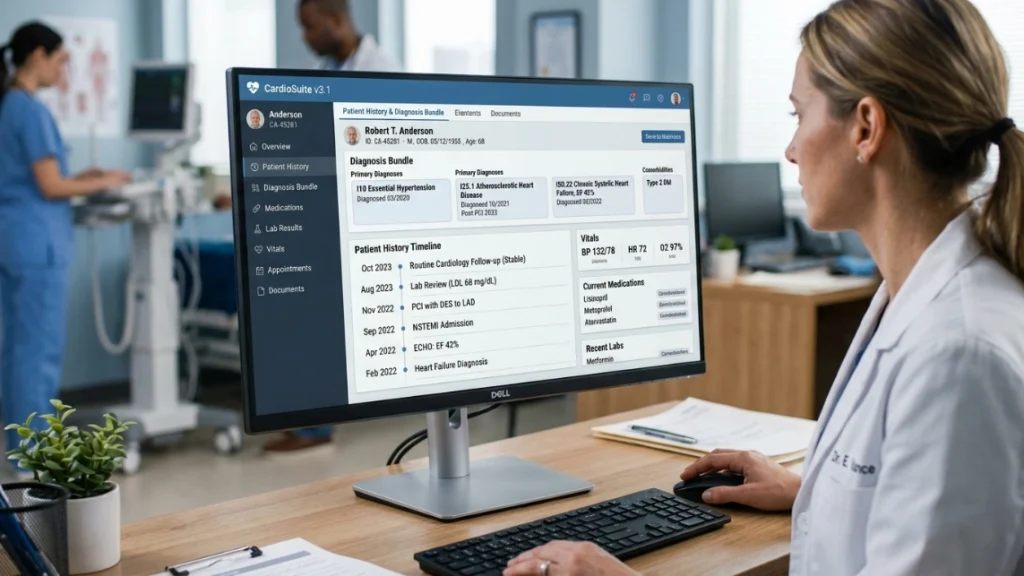
This is where SehatPro’s EMR software Pakistan cardiologists use differs from a basic patient list. Every visit is stored as a lifetime record, so when a patient walks in for a routine follow-up, you’re not flipping through a paper folder or asking the patient to recall their last dosage. SehatPro’s unlimited patient records system keeps every test result, prescription, and consultation note attached to one patient profile, accessible from your desktop, tablet, or phone.
For cardiac practices specifically, this matters most during emergencies. If a patient with a known arrhythmia history walks in during a busy Tuesday afternoon in Faisalabad, your receptionist can flag the record instantly, and you can review their last three visits before they’ve even sat down. That’s not a convenience feature — for cardiology, it’s closer to a safety requirement.
Why Are Pakistani Cardiologists Moving Away From Paper-Based Cardiac Records?
Paper records fail cardiology practices in a specific way: they can’t be cross-referenced quickly enough for chronic disease management, and they’re vulnerable to loss during exactly the kind of high-pressure moment when a doctor needs them most.
A 2022 survey by the Pakistan Medical Association’s digital health working group found that over 60% of small-to-mid-size clinics reported losing or misplacing at least one patient file in the previous year. For a general physician, a lost file means redoing an intake form. For a cardiologist, it can mean missing a documented allergy to a specific anticoagulant, or repeating an ECG that was already done two weeks earlier — wasting the patient’s money and your clinic’s time.
The Real Cost of Manual Cardiac Charting
Handwritten prescriptions carry their own risk. Cardiac medications — anticoagulants, antiarrhythmics, statins — often have narrow safety margins, and a misread dosage on a handwritten note can be dangerous. SehatPro’s fast consultation and prescription tool generates print-ready, typed prescriptions in seconds, pulling from templates you’ve already set up for common cardiac protocols. That single change removes a category of error that paper simply can’t.
There’s also the compliance angle. Clinics applying for hospital partnerships or insurance panel approval increasingly need to show digital record-keeping. A cardiologist in Islamabad recently told our team that switching to digital records was the deciding factor in a hospital referral partnership — the hospital wouldn’t consider paper-based practices for its cardiac referral network.
How Does Cardiologist EMR Pakistan Software Handle ECG and Test-Heavy Workflows?
Cardiac EMR software needs to do more than store a diagnosis — it needs to organize repeat tests, flag trends over time, and let you build reusable templates for the diagnoses you see most often, like hypertension, arrhythmia, or heart failure.
Most cardiology visits in Pakistan follow recognizable patterns: a new patient presents with chest pain or palpitations, gets an ECG or echo, and returns for follow-up. SehatPro’s one-click diagnosis bundles let you set up templates for these recurring cases — hypertension management, post-angioplasty follow-up, arrhythmia monitoring — so you’re not typing the same notes and medication lists from scratch every single visit.
Why Templates Matter More in Cardiology Than Other Specialties
A dermatologist in Sialkot might see 15 different conditions in a day. A cardiologist often sees variations of the same 5 or 6 conditions, repeated across dozens of patients. That repetition is exactly what templates are built for. Instead of rewriting a lisinopril dosage instruction every time, you select the bundle, adjust the specifics for that patient, and print. Clinics using structured templates for chronic disease management report consultation times dropping by close to half, based on internal usage data SehatPro has collected across its 135+ doctor network.
This also protects against a subtler risk — inconsistency. When notes are typed from a standard template and only the patient-specific details change, you reduce the chance of contradicting a previous prescription or forgetting to note a drug allergy that was flagged three visits ago.
Heart Clinic Management System: Solving the Queue Chaos of Walk-In Cardiac Patients
Walk-in culture is a defining feature of Pakistani healthcare, and cardiac clinics feel it acutely — patients arrive without appointments, often in distress, and expect to be seen quickly. A heart clinic management system needs a live queue, not just a booking calendar.
Picture a Monday morning in a busy Karachi cardiology clinic. Six patients have booked appointments, but four more walk in — one with chest discomfort, three for routine BP checks. Without a live token system, your receptionist is left guessing who to prioritize, and that guesswork can delay a patient who genuinely needs urgent attention.
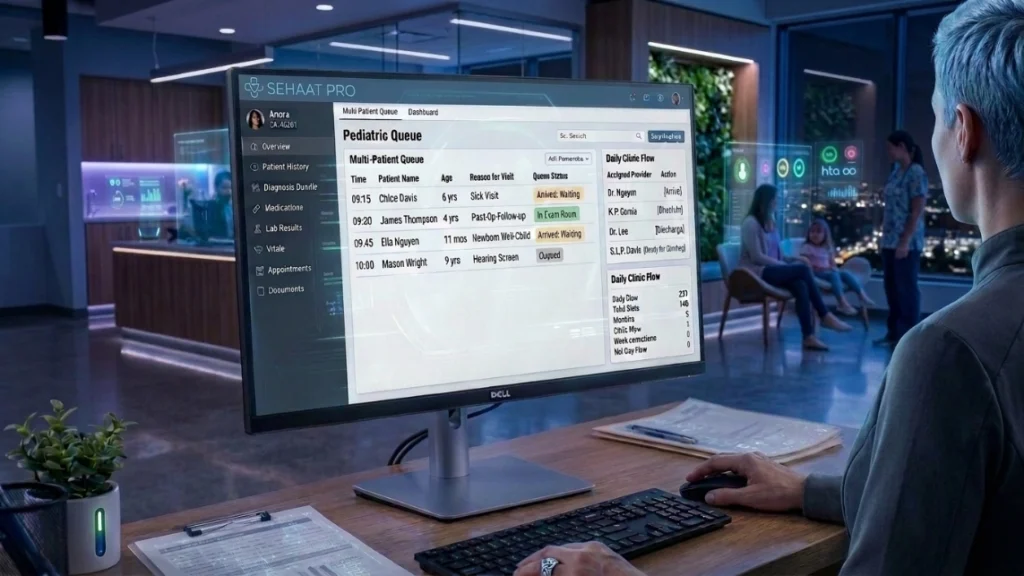
SehatPro’s appointment scheduling and queue management system gives your front desk a real-time token board. Booked patients keep their slot, walk-ins get added to a live queue, and your staff — including Urdu-speaking receptionists who may not be comfortable with English-only software — can manage the flow without confusion. The interface itself supports Urdu, English, and 27+ other languages, which matters when your front-desk team is more comfortable working in their first language.
Pro Tip — SehatPro Insight: A common mistake we see in cardiac clinics switching to digital systems is under-training receptionists on the queue override feature. Chest pain and breathlessness cases should always be manually prioritized ahead of the queue order — the system allows this in two taps, but staff need to be told it’s there. Clinics that build this into their morning briefing see fewer complaints about wait times from urgent cases.
Cardiac Practice Software and Multi-Branch Cardiology Clinics: From Karachi to Faisalabad
Cardiology groups running more than one branch face a specific challenge — a patient seen at a Karachi branch on Monday may walk into the Faisalabad branch on Thursday, and the second doctor needs the same history instantly, not a phone call to the first clinic.
Multi-branch cardiac practice software has to centralize records without slowing anyone down. SehatPro’s multi-branch clinic support keeps every branch connected to one patient database, so a cardiologist covering a satellite clinic in Sahiwal can pull up a patient’s full history from the main Lahore branch without waiting for a fax or phone confirmation.
| Factor | Paper-Based Multi-Branch Setup | SehatPro Cardiac Practice Software |
|---|---|---|
| Record access across branches | Manual transfer or phone calls | Instant, centralized access |
| Time to retrieve patient history | 10–20 minutes (if file is found) | Under 10 seconds |
| Risk of duplicate testing | High | Low — full test history visible |
| Staff training time | Varies by handwriting/system | 1–2 days, multilingual interface |
| Data loss risk | High (fire, misplacement) | Encrypted cloud backup |
| Reporting across branches | Manual compilation | Auto-generated, exportable to Excel |
This kind of centralized visibility is especially valuable for role-based access — a receptionist at your Multan branch shouldn’t necessarily see the same clinical notes a doctor sees, and SehatPro’s role-based permissions keep that boundary intact across every branch you operate.
Do WhatsApp and SMS Reminders Actually Reduce No-Shows for Cardiac Follow-Ups?
Cardiac patients on long-term medication plans are especially prone to missing follow-ups once symptoms improve — and a missed follow-up for a hypertension or arrhythmia patient carries real clinical risk, not just a scheduling inconvenience.
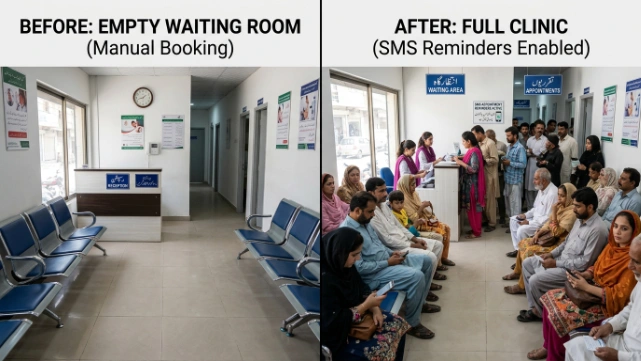
Follow-up adherence is one of the biggest challenges in chronic cardiac care. A patient in Larkana who feels fine three weeks after starting a new blood pressure medication may skip their follow-up entirely, unaware that dosage adjustments often happen in that exact window. SehatPro’s automated SMS and WhatsApp reminders send appointment and medicine reminders automatically, in the patient’s preferred language, without your staff having to make manual calls.
Clinics using automated reminders across SehatPro’s network report meaningfully fewer missed follow-ups compared to clinics relying on manual phone reminders — a pattern consistent with findings from a 2023 Aga Khan University study on chronic disease follow-up adherence in Pakistan, which linked automated reminder systems to improved appointment attendance. For a cardiology practice, that translates directly into better long-term outcomes and fewer patients lost to follow-up after a cardiac event.
What Data Privacy Standards Should Cardiac Patient Records Meet in Pakistan?
Cardiac records contain some of the most sensitive clinical data a clinic holds — cardiovascular risk history, medication regimens, and sometimes family history of heart disease — which means data security isn’t optional for a cardiology clinic software platform.
Patients increasingly ask direct questions about where their data is stored, especially after news coverage of data breaches in other sectors. A gastroenterologist or urologist might not face this question often, but a cardiologist managing a patient’s long-term risk profile should expect it. SehatPro’s data privacy and security infrastructure uses encryption and secure cloud backups, so patient records aren’t sitting on a single unprotected computer that could be lost, stolen, or damaged.
For clinics in areas with unreliable internet — parts of Mirpur-AJK or rural Sindh, for instance — SehatPro’s ProCare plan includes an offline installation option, so connectivity issues don’t mean choosing between digital records and dependable access during a consultation.
Choosing the Right Cardiology Clinic Software: A Step-by-Step Checklist
Before committing to any platform, run your options through this checklist. It’s built specifically around what cardiac practices need, not generic clinic requirements.
- Does it support lifetime, cross-visit patient records for chronic disease tracking?
- Can you build reusable templates for common cardiac diagnoses and prescriptions?
- Is there a live queue system that lets staff prioritize urgent cases over scheduled order?
- Does it centralize records across branches if you operate more than one location?
- Are reminders automated via SMS or WhatsApp for follow-up-heavy care?
- Is the interface available in Urdu or your staff’s working language?
- What happens during an internet outage — is there an offline option?
- Is patient data encrypted and backed up, and can you explain this to a patient who asks?
If a platform can’t answer yes to at least six of these, it wasn’t built with cardiology’s realities in mind.
Conclusion
Cardiology practices in Pakistan run on repeat visits, dense patient histories, and a walk-in culture that doesn’t wait for a perfectly organized filing cabinet. The right cardiology clinic software should shrink your consultation time, not add another screen to manage. Focus on four things when you evaluate your options: lifetime patient records that load instantly, reusable templates for your most common diagnoses, a live queue that lets urgent cases jump ahead safely, and automated reminders that keep chronic patients from disappearing after their symptoms ease.
SehatPro was built around these exact patterns, tested across 135+ doctors and 98+ clinics in more than 50 Pakistani cities — including cardiac practices managing everything from routine hypertension follow-ups to post-procedure monitoring.
Ready to see how SehatPro can simplify your clinic? Book a free demo today.
Related reading: “How EMR Software Reduces Prescription Errors in Pakistani Clinics” and “Multi-Branch Clinic Management: A Guide for Growing Pakistani Healthcare Groups.”
FAQ
What is the best cardiology clinic software for small practices in Pakistan?
For small and mid-size cardiac practices, cardiology clinic software with lifetime patient records, appointment queuing, and Urdu-language support works best. SehatPro’s CareStart plan starts at PKR 2,999/month and includes EMR, scheduling, and prescription tools built for exactly this scale.
How much does cardiologist EMR Pakistan software typically cost?
Pricing varies by plan and clinic size. SehatPro’s plans range from PKR 2,999/month for the entry-level CareStart tier up to a one-time PKR 79,999 ProCare plan with offline support, plus custom EnterpriseCare pricing for multi-branch cardiac groups.
Is cardiac practice software difficult for non-technical staff to learn?
No. SehatPro’s interface is built for walk-in-heavy Pakistani clinics with Urdu-speaking staff in mind. Most receptionists and clinical staff become comfortable with core functions like queue management and appointment booking within 1 to 2 days of training.
How secure are cardiac patient records stored in cloud-based clinic software?
Cardiac records need strong protection given their sensitivity. SehatPro uses encryption and secure automated cloud backups, so patient data isn’t dependent on a single local computer and remains protected against loss, theft, or hardware failure.
Does cardiology clinic software work in areas with poor internet connectivity?
Yes, if you choose the right plan. SehatPro’s ProCare tier includes an offline installation option specifically for clinics in areas with unreliable internet, such as parts of Mirpur-AJK or rural regions, so records remain accessible without constant connectivity.
How long does it take to set up a heart clinic management system?
Most clinics are up and running within a few days. Setup includes staff training, patient record migration, and template configuration for common cardiac diagnoses — SehatPro’s onboarding team supports this process directly for new cardiac practices.