Best Clinic Software for Pediatricians in Pakistan
The best pediatric clinic software in Pakistan combines EMR, vaccination tracking, appointment scheduling, and WhatsApp reminders in one cloud-based system. SehatPro is built for Pakistani pediatric clinics, handling walk-ins, growth charts, immunization schedules, and Urdu-speaking staff — starting at PKR 2,999/month with no long-term contract.
Introduction
A child’s vaccination is overdue by three weeks, and nobody in your clinic knows it because the record is buried in a paper file from last year. According to the Pakistan Demographic and Health Survey, only 66% of children aged 12-23 months are fully immunized — and missed follow-ups at the clinic level are part of that gap. If you run a pediatric practice, you already know the problem isn’t medical knowledge. It’s tracking.
Pediatric clinic software exists to solve exactly this — keeping vaccination schedules, growth records, and follow-up visits organized so nothing slips through a crowded waiting room. This article walks through what pediatric clinics in Pakistan actually need from software, how SehatPro handles vaccination tracking and child-specific EMR, what it costs, and how it compares to running things on paper.
If you’ve ever lost a growth chart, double-booked two mothers at 4 PM, or had a receptionist call a number that’s now disconnected — keep reading.
What Makes Pediatric Clinic Software Different From General Clinic Software?
Pediatric practices track things general clinics don’t — growth percentiles, immunization schedules, and repeat visits for children who can’t describe their own symptoms. Generic clinic software often misses these entirely.
A general physician’s software needs to record a diagnosis and move on. A pediatrician in Islamabad seeing 40 children a day needs something different: a system that flags an overdue DTP booster before the mother even reaches the consultation room, that plots weight-for-age automatically, and that remembers a child had a penicillin reaction two visits ago — because the child can’t tell you that themselves.
This is where most “one-size-fits-all” clinic software falls short in Pakistan. It’s built around adult consultations — blood pressure, prescriptions, billing — with vaccination tracking bolted on as an afterthought, if it exists at all. Pediatricians end up keeping a separate paper immunization register anyway, which defeats the purpose of going digital.
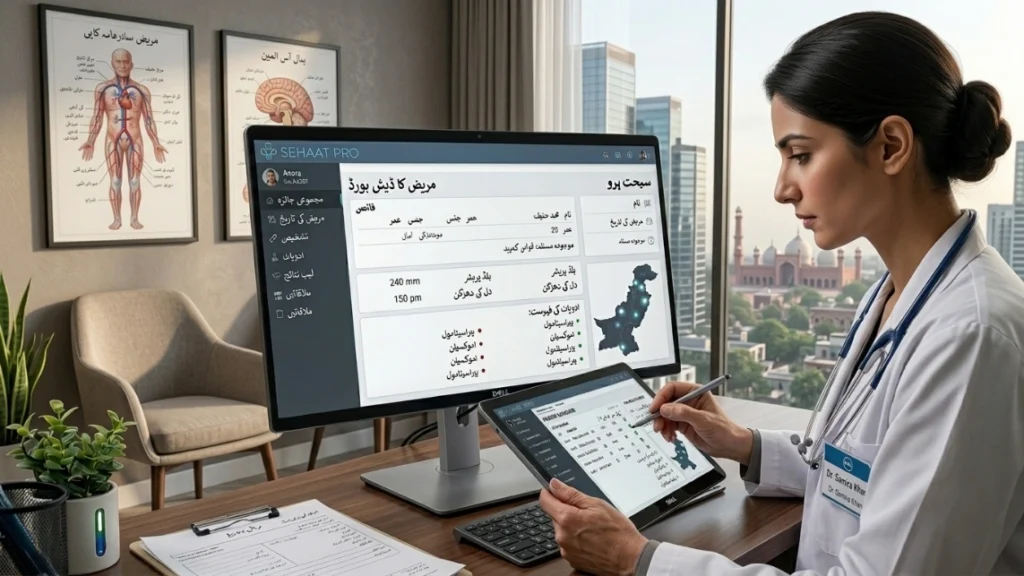
SehatPro’s EMR software built for Pakistan stores a child’s complete history — from the first newborn visit through adolescence — in one lifetime record, linked to the parent’s profile. A pediatrician in Faisalabad running a multi-branch setup can pull up a child’s full record instantly, even if the family last visited a different branch. That continuity matters more in pediatrics than almost any other specialty, because so much of the care is preventive and sequential.
How Does Vaccination Tracking Software Actually Reduce Missed Immunizations?
Vaccination tracking software automatically calculates each child’s next due date based on age and vaccine history, then triggers a reminder before the visit is missed — instead of relying on a receptionist remembering or a parent guessing.
Missed immunizations rarely happen because parents don’t care. They happen because nobody reminded them, or the family moved, or the clinic’s paper register wasn’t updated after the last visit. UNICEF Pakistan has flagged missed follow-up visits as one of the leading contributors to incomplete immunization coverage in urban clinics, where patient volume makes manual tracking unreliable.
How SehatPro’s vaccination tracking works in practice:
Automatic Scheduling
When a child’s first vaccine is logged, SehatPro calculates the entire remaining schedule — BCG, Pentavalent, OPV, Measles, and boosters — based on Pakistan’s standard EPI schedule, and flags each one as it approaches.
Reminders Before the Gap Happens
Through automated SMS and WhatsApp reminders, the parent gets a message in Urdu or English a few days before the due date — not after it’s already missed. For a dermatologist this feature is nice-to-have. For a pediatrician in Sialkot, it’s the difference between full coverage and a child falling behind on DTP.
Visual Flags at Check-In
When the family walks in for any reason — even an unrelated fever visit — the receptionist sees a flag on the token screen if a vaccine is overdue, so the doctor can address it in the same visit instead of scheduling a separate trip.
This turns vaccination tracking from a register nobody checks into a system that checks itself.
What Should a Pediatric EMR Actually Record for a Growing Child?
A pediatric EMR needs to track growth trends over time, not just single visit snapshots — weight, height, head circumference, developmental milestones, and vaccine history all plotted against a timeline the doctor can review in seconds.
Growth and Development Tracking
Unlike an adult patient, a child’s “normal” changes every visit. A weight that’s fine at 6 months might signal a problem at 12 months if the trend is flat. SehatPro’s EMR keeps every measurement in the child’s unlimited patient record, so a pediatrician in Lahore can glance at a growth trend line instead of flipping through six months of paper charts.
Allergy and Reaction History
A child who reacted to amoxicillin at 8 months needs that flagged permanently, visible the instant the file opens — not dependent on a parent remembering to mention it during a rushed consultation.
Family and Sibling Linking
Pakistani households often bring multiple children to the same clinic. Linking siblings under one family profile means a pediatrician in Karachi treating three children from the same household isn’t creating three disconnected records — one search brings up the whole family.
A study published by the Pakistan Pediatric Association noted that incomplete history-taking — often due to missing or inaccessible prior records — contributes to repeat diagnostic testing in outpatient pediatric settings. A centralized digital record directly addresses that gap.
Paper Records vs. SehatPro: What Changes for a Pediatric Clinic?
Here’s a direct comparison of what daily operations look like before and after moving a pediatric clinic onto SehatPro.
| Factor | Paper-Based System | SehatPro |
|---|---|---|
| Time per patient check-in | 5-8 minutes searching files | Under 1 minute via search |
| Vaccination tracking | Manual register, easy to miss | Automatic scheduling + reminders |
| Missed follow-ups | No reminder, relies on memory | SMS/WhatsApp reminder before due date |
| Growth chart review | Manual calculation, error-prone | Auto-plotted trend over time |
| Multi-branch continuity | Records stuck at one location | Centralized across all branches |
| Data loss risk | High — fire, flood, misplacement | Encrypted cloud backup |
| Staff learning curve | None, but slow daily operations | 2-3 days for front desk staff |
| Monthly cost | “Free” but hidden time/error cost | Starts at PKR 2,999/month |
The paper system looks cheaper until you count the hours receptionists spend searching for files and the cost of a missed immunization that turns into a preventable illness.
Expert Insight — What SehatPro Has Learned From 135+ Doctors
Pro Tip: The most common mistake pediatric clinics make when adopting software isn’t choosing the wrong system — it’s only digitizing new patients and leaving years of paper vaccination history behind. Clinics that scan and enter even the last 12 months of immunization records into SehatPro see far fewer “we’re not sure if this child is up to date” moments at check-in. Start with your active patients, not a blank slate.
How Does Appointment Scheduling Work for a High Walk-In Pediatric Clinic?
Pediatric clinics in Pakistan run on a mix of scheduled appointments and walk-ins, often with a sick or crying child in the waiting room. Software needs to manage both without creating chaos at the front desk.
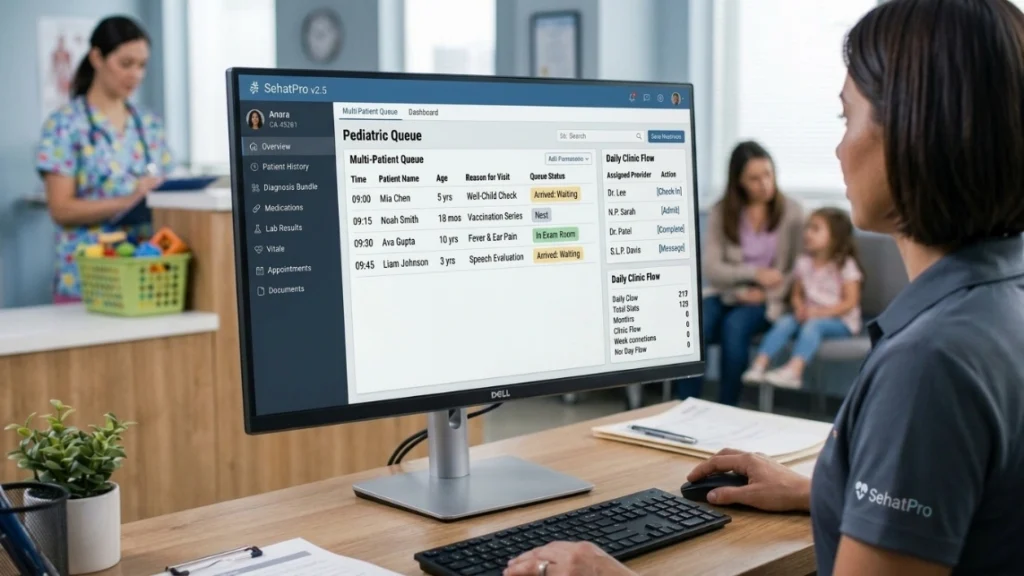
Unlike a dermatology or dental practice where most visits are pre-booked, pediatric clinics deal with genuine unpredictability — a feverish toddler doesn’t wait for a slot. SehatPro’s appointment scheduling and queue management system handles this automatically by blending pre-booked slots with a live token queue, so a mother who booked online at 9 AM and a walk-in emergency at 9:15 both get a clear, visible position — no arguments at the reception counter.
For a pediatrician in Multan running a single clinic, this cuts the daily chaos of overlapping bookings. For a multi-branch practice in Faisalabad, multi-branch clinic support means the front desk at every location sees the same live queue logic, so a family can be redirected to a sister branch with shorter wait times without a phone call to check availability.
The token display also reduces a very specific pediatric problem: anxious children waiting too long in a crowded room. Shorter, more predictable wait times mean fewer meltdowns before the child even sees the doctor — something every pediatric receptionist in Pakistan will recognize immediately.
Is Pediatric Clinic Software Secure Enough for Sensitive Child Health Data?
Child health records — including vaccination status and developmental history — require the same data protection as any medical record, and Pakistani clinics are increasingly expected to demonstrate this to parents and regulators alike.
Parents are understandably protective of their child’s medical information. A pediatric clinic that can’t explain how patient data is stored risks losing trust fast. SehatPro’s data privacy and security infrastructure uses encryption and secure cloud backups, meaning a clinic fire, stolen laptop, or corrupted hard drive in a Larkana clinic doesn’t mean losing a decade of children’s health histories.
For clinics in areas with unreliable internet — common in parts of Toba Tek Singh or Mirpur-AJK — the ProCare plan offers an offline installation option, so patient data entry doesn’t stop during a connectivity gap. Records sync once the connection returns, instead of staff reverting to paper mid-day and creating a reconciliation headache later.
Role-based access is equally important in pediatrics. A receptionist should be able to check a child in and view the vaccination schedule, but shouldn’t necessarily see detailed consultation notes. SehatPro’s role-based access separates what doctors, receptionists, and lab staff can view, keeping sensitive pediatric notes limited to clinical staff only.
What Does Pediatric Clinic Software Cost in Pakistan?
Pricing depends on clinic size and connectivity needs, ranging from a low monthly subscription for a solo practice to a one-time offline installation for clinics with unreliable internet.
Cost is usually the first objection a pediatrician raises — understandably, given tight margins in smaller practices. SehatPro’s CareStart plan begins at PKR 2,999/month, built for solo pediatric practices that need appointment scheduling, EMR, and vaccination tracking without a large upfront investment. Clinics with unstable internet, common in smaller towns like Sahiwal, can opt for the ProCare plan at a one-time PKR 79,999, which includes offline installation. Larger multi-branch pediatric networks — say, a group running clinics across both Lahore and Karachi — typically move to EnterpriseCare, a custom plan built around branch count and staff volume.
Compare that monthly cost against a single missed follow-up that turns into a hospital admission, or the receptionist hours lost searching paper files during peak walk-in hours, and the math tends to favor digital fairly quickly.
Conclusion
A pediatric clinic runs on timing — the right vaccine at the right age, the right follow-up before a small issue becomes a big one. Paper records make that timing a matter of memory. Good pediatric clinic software makes it automatic.
Four things to take away: vaccination tracking should calculate and remind, not just record; a pediatric EMR needs growth trends and allergy flags visible at a glance, not buried in notes; your scheduling system has to handle real walk-in chaos, not just pre-booked slots; and data security isn’t optional when you’re storing children’s health histories.
SehatPro was built inside real Pakistani clinics — from solo pediatric practices in Multan to multi-branch networks in Faisalabad — with exactly these problems in mind.
FAQ
Q1: What is the best pediatric clinic software in Pakistan?
SehatPro is built specifically for Pakistani pediatric clinics, combining vaccination tracking, growth-focused EMR, appointment scheduling, and WhatsApp reminders in one system. It supports Urdu-speaking staff and works in areas with unreliable internet, starting at PKR 2,999/month.
Q2: How much does pediatric clinic software cost in Pakistan?
Pricing typically starts around PKR 2,999/month for a solo practice. Clinics needing offline access can choose a one-time installation plan near PKR 79,999. Multi-branch pediatric networks usually move to a custom enterprise plan based on branch count and staff volume.
Can pediatric clinic software track vaccination schedules automatically?
Yes. Quality vaccination tracking software calculates each child’s remaining immunization schedule based on age and prior doses, then sends automated reminders before a vaccine becomes overdue, rather than relying on staff memory or a paper register.
Is pediatric clinic software difficult for Urdu-speaking clinic staff to learn?
Most receptionists and staff adapt within two to three days when the interface supports Urdu directly, rather than requiring English fluency. SehatPro’s multilingual interface covers Urdu, English, and several other languages used across Pakistani clinics.
Is patient data safe with cloud-based pediatric clinic software?
Reputable systems use encryption and automatic cloud backups, protecting records against device theft, fire, or hardware failure. This matters especially for pediatric clinics storing years of vaccination and growth history that would be difficult to reconstruct from memory alone.
How long does it take to set up pediatric clinic software in a Pakistani clinic?
Basic setup — appointment scheduling and patient registration — can be running within a day. Migrating historical vaccination records from paper files takes longer and depends on how much existing data the clinic chooses to digitize upfront.