Best EMR Software for Gynecologists & OB-GYN Clinics in Pakistan
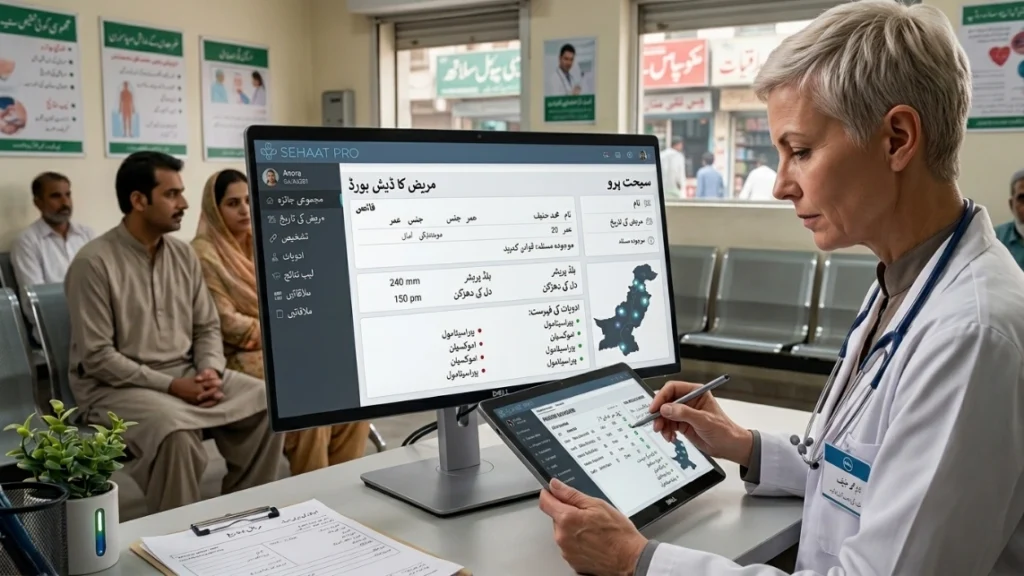
The best gynecology clinic software in Pakistan combines a cloud-based EMR, appointment and token queue management, and WhatsApp reminders in one system. SehatPro is built for Pakistani OB-GYN clinics — it tracks full obstetric history, prints prescriptions in seconds, and works even where internet is unreliable.
Introduction
Every 50 minutes, a woman in Pakistan dies from a pregnancy-related complication, according to UNFPA’s 2024 State of World Population report. Behind many of those numbers sits a quieter, preventable failure: a missed follow-up, a lost antenatal file, a receptionist who couldn’t find last trimester’s blood pressure readings when it mattered. If you run a gynecology clinic software in Pakistan search and land here, you already know the stakes are higher in OB-GYN practice than almost any other specialty.
A gynecologist doesn’t just treat one patient — she tracks a pregnancy across nine months, dozens of visits, and multiple risk markers that must never fall through the cracks. Paper files can’t do that reliably. A register that a receptionist in Multan flips through by hand can’t flag a patient who missed her 32-week scan.
This article walks you through what OB-GYN-specific clinic software should actually do, how it compares to paper-based systems, and how SehatPro handles the realities of running a women’s health practice in Lahore, Karachi, Faisalabad, or a smaller town where internet drops mid-consultation. Let’s start with why gynecology needs a different kind of EMR altogether.
Why Gynecology and Obstetrics Need Purpose-Built Clinic Software
Gynecology practice management isn’t the same as running a general physician’s clinic. You’re tracking pregnancies across trimesters, menstrual histories, contraceptive counseling, and surgical records — all of which need to stay linked to one patient for years, not just one visit.
A general practitioner in Multan might see a patient for a fever and never need her again for six months. A gynecologist in Lahore sees the same obstetric patient every few weeks for nine months, then again for postnatal care, then again years later for a follow-up pregnancy. If her antenatal card is a loose paper file, sixteen visits worth of blood pressure trends, weight gain, and lab results are scattered across a folder that’s easy to misplace during a busy walk-in morning.
This is where SehatPro’s unlimited patient records feature changes the daily routine. Every visit — antenatal check, ultrasound note, delivery record, postnatal visit — sits under one patient profile, searchable in seconds by name or CNIC. A dermatologist in Sialkot might only need last visit’s notes. An OB-GYN in Karachi needs the full nine-month arc, plus history from a previous pregnancy three years ago, pulled up before the patient even sits down.
Pro Tip — SehatPro Insight: Across our 135+ doctors, the clinics that struggle most with obstetric follow-ups are the ones still relying on a physical antenatal card the patient carries herself. If she forgets it or it gets damaged, the clinic has no backup. Centralized EMR records remove that single point of failure entirely.
What Should EMR for Gynecologists Actually Include?
An EMR for gynecologists needs obstetric-specific fields, not a generic medical record template borrowed from general practice. Look for pregnancy timelines, menstrual cycle tracking, ultrasound logging, and delivery outcome fields built into the system from day one.
Most clinic software sold in Pakistan is designed for general practitioners first, with women’s health treated as an afterthought. That’s a problem when your daily work involves tracking gestational age, fetal growth curves, and risk flags that change week to week. Ask any vendor demoing their EMR software Pakistan solution: can it record trimester-wise visits under one continuous pregnancy timeline, or does every visit start a blank form?
The Fields That Actually Matter in EMR Software for Gynecologists
Any true EMR software for gynecologists should include these fields by default, not as an add-on:
- Last menstrual period (LMP) and calculated expected date of delivery
- Gravida/para/abortion (G/P/A) history, visible on every visit
- Trimester-wise vitals — blood pressure, weight, fundal height
- Ultrasound and lab result attachments linked to the pregnancy record
- Delivery outcome and postnatal follow-up scheduling
- Contraceptive counseling and menstrual history for non-obstetric visits
SehatPro’s EMR and patient history module holds all of this under one lifetime record, so a gynecologist in Faisalabad running a multi-branch clinic can pull up a patient’s second pregnancy and instantly see complications flagged during her first — without calling the other branch to fax over paper notes. A study cited by the World Health Organization’s Pakistan office notes that maternal hemorrhage and hypertensive disorders remain the leading causes of maternal death in the country — both conditions where trend data across visits, not a single snapshot, is what catches danger early.
Paper Files vs. SehatPro: What Changes for a Women’s Health Clinic
Paper-based obstetric tracking fails in ways that are easy to underestimate until a critical reading gets missed. A side-by-side comparison makes the daily difference clear for any clinic owner deciding whether to switch.
| Factor | Paper-Based System | SehatPro |
|---|---|---|
| Time to pull a patient’s full history | 5–10 minutes, if the file isn’t misplaced | Under 10 seconds via search |
| Risk of losing antenatal records | High — single physical copy | Low — encrypted cloud backup |
| Missed follow-up visits | No automatic tracking | WhatsApp/SMS reminders sent automatically |
| Staff workload during walk-in rush | Manual token writing, frequent queue disputes | Live queue and token management |
| Prescription legibility | Handwritten, error-prone | Print-ready, standardized format |
| Multi-branch record access | Not possible without physical transfer | Centralized across all branches |
| Monthly cost for a small clinic | “Free” but hidden in staff time and errors | Starts at PKR 2,999/month (CareStart) |
For a solo gynecologist in Sialkot working with two staff members, the paper column isn’t really free — it’s paid for in the twenty minutes a receptionist spends hunting for a file while three patients wait in a crowded room.
How Appointment and Queue Chaos Hurts Women’s Health Clinics Specifically
Double bookings hit OB-GYN clinics harder than most specialties because pregnant patients often wait longest and can least afford to sit in a crowded waiting room for an hour. A predictable queue system isn’t a convenience here — it’s part of patient safety.
Walk-in culture is deeply rooted in Pakistani healthcare. A gynecologist in Karachi might have twelve scheduled antenatal visits and fifteen walk-ins on a Saturday morning. Without a live system, the front desk resolves conflicts by memory and goodwill, which breaks down fast once the waiting room fills up.
SehatPro’s appointment scheduling and queue management system handles this automatically, assigning tokens in real time and letting your Urdu-speaking receptionist manage both booked and walk-in patients from the same screen. Patients see their position, reducing the “am I next?” disputes that eat into staff patience during a busy Friday clinic.
Why This Matters More for High-Risk Pregnancies
A patient flagged as high-risk — gestational diabetes, previous C-section, hypertension — shouldn’t sit in a general queue behind routine walk-ins. Role-based access lets your front desk flag priority patients so they’re seen faster, without a doctor needing to personally intervene every time. This kind of triage is nearly impossible to enforce consistently with a handwritten token system.
Reducing Prescription Errors and Missed Follow-Ups
Handwritten prescriptions remain one of the most common sources of medication errors in Pakistani clinics, particularly for antenatal patients juggling iron, calcium, and folic acid supplements alongside condition-specific medication. Illegible handwriting at a busy pharmacy counter can mean the wrong dose reaches a pregnant patient.
SehatPro’s fast consultation and prescription writing tool lets a gynecologist select from reusable templates — standard antenatal supplement bundles, postpartum care instructions, PCOS management plans — and print a clean, standardized prescription in under a minute. One-click diagnosis bundles mean a routine antenatal visit doesn’t require retyping the same instructions every single time.
Missed follow-ups are the other silent risk. A patient who skips her 28-week glucose screening because nobody reminded her isn’t being careless — she’s often juggling a household, transport costs, and no formal appointment reminder. SehatPro’s automated SMS and WhatsApp reminders for appointments and medicines close that gap without adding work for your staff. Given that Pakistan’s broadband penetration crossed 60.8% by mid-2025 according to the Pakistan Telecommunication Authority’s 2024–25 annual report, WhatsApp has become the most reliable channel to reach patients directly on their phones, even in smaller towns like Toba Tek Singh or Sahiwal.
Data Privacy and Security for Sensitive Women’s Health Records
Gynecological and obstetric records contain some of the most sensitive information a clinic holds — fertility history, pregnancy outcomes, and personal details patients don’t want exposed to unauthorized staff or lost paper files. Security isn’t optional for this specialty; it’s foundational to patient trust.
A patient in a smaller city like Larkana or Mirpur-AJK may be even more cautious about who sees her records than a patient in a large urban hospital, given how word travels in tighter communities. SehatPro’s data privacy and security infrastructure uses encryption and secure cloud backups, so records aren’t sitting in an unlocked drawer or on a shared clinic computer anyone can browse.
Role-based access for doctors, receptionists, and lab staff means your front desk can manage appointments and billing without ever viewing detailed clinical notes — a distinction that matters enormously in gynecology, where patients expect discretion. For clinics connected to a lab via SehatPro’s QuickLab integration, results flow directly into the patient’s record instead of being handed across a counter on a slip of paper that can be misplaced or seen by someone it shouldn’t be.
Setting Up Gynecology Clinic Software: A Practical Checklist
Switching from paper to digital records feels daunting mid-practice, but a phased rollout keeps disruption minimal for both staff and patients. Follow this sequence rather than trying to digitize everything on day one.
- Digitize active obstetric patients first — start with current pregnancies still under active follow-up, not your entire historical archive
- Set up reusable templates — antenatal visit forms, common prescription bundles, discharge instructions
- Train front desk on the queue and token system — this is what staff will use most, every single day
- Enable WhatsApp reminders for upcoming antenatal visits and postnatal checks
- Configure role-based access so sensitive notes are visible only to clinical staff
- Run parallel with paper for one to two weeks — most SehatPro clinics phase out paper entirely within a month
- Review the reporting dashboard weekly to catch missed follow-ups before they become a pattern
For a multi-branch practice — say, a group running clinics in both Islamabad and Rawalpindi — SehatPro’s support for multi-branch clinics centralizes this rollout so every location follows the same setup without duplicating staff training effort.
Choosing the Right Plan for Your OB-GYN Practice Size
A solo gynecologist starting a new practice has different needs from a multi-branch women’s hospital, and pricing should reflect that instead of forcing every clinic into one package. Matching the plan to your patient volume avoids both overpaying and outgrowing your system within a year.
CareStart, at PKR 2,999/month, suits a solo practitioner in a smaller city just getting a digital record system in place. Clinics in areas with unreliable connectivity — parts of interior Sindh or rural Punjab — often move toward ProCare, a one-time PKR 79,999 investment that includes an offline installation option, so a power cut or dropped internet connection during a delivery-day rush doesn’t stop the front desk from working. Larger, multi-branch practices typically move to EnterpriseCare, a custom plan built around the number of branches and staff roles involved.
SehatPro’s patient reports and insights module also scales with plan size, giving a solo doctor a simple monthly view of patient volume and a hospital administrator exportable Excel reports across every branch.
Conclusion
Women’s health in Pakistan runs on continuity — and continuity is exactly what paper files can’t guarantee. A missed antenatal reading, a misplaced obstetric card, or a prescription written illegibly under time pressure isn’t just an inconvenience; in gynecology and obstetrics, it can be the difference between catching a complication early and missing it entirely. Choosing the right gynecology clinic software in Pakistan means picking a system built around pregnancy timelines, not one borrowed from general practice.
The takeaways worth acting on: centralize every patient’s obstetric history in one searchable record, automate follow-up reminders instead of relying on memory, standardize prescriptions to cut errors, and secure sensitive records with role-based access rather than an unlocked filing cabinet.
Ready to see how SehatPro can simplify your clinic? Book a free demo today.
Related reading: Best EHR Systems for Small Practices in Pakistan and How Multi-Branch Clinics in Pakistan Are Going Digital.
FAQ
What is the best gynecology clinic software in Pakistan for a solo practitioner? A: For a solo gynecologist, look for software with obstetric-specific EMR fields, WhatsApp reminders, and affordable entry pricing. SehatPro’s CareStart plan at PKR 2,999/month covers appointment scheduling, prescription printing, and patient records — enough for a single-doctor clinic without hospital-grade overhead.
How much does EMR software for gynecologists cost in Pakistan? A: Pricing typically starts around PKR 2,999/month for entry-level plans and scales up to one-time offline packages near PKR 79,999 for clinics needing connectivity independence. Enterprise multi-branch pricing is usually custom, based on branch count and staff roles.
Is clinic software difficult for Urdu-speaking staff to learn? A: Not if the software supports a native Urdu interface. SehatPro offers a multilingual interface across Urdu, English, Arabic, Sindhi, and 27+ other languages, so receptionists and staff can work in the language they’re most comfortable with, cutting training time significantly.
How secure are patient records in cloud-based women’s health clinic software? A: Reputable systems use encryption and automated cloud backups, which protect records better than an unlocked physical file cabinet. SehatPro’s data privacy and security framework restricts access by staff role, so sensitive gynecological notes stay visible only to clinical personnel.
How long does it take to set up obstetrics practice management software? A: Most solo clinics complete setup and staff training within one to two weeks of running the system alongside existing paper files. Multi-branch practices take slightly longer to standardize workflows across locations, but SehatPro’s team supports phased rollouts to minimize disruption.
Does gynecology clinic software work in areas with poor internet connectivity? A: Yes, if the vendor offers an offline mode. SehatPro’s ProCare plan includes an offline installation option specifically for clinics in areas with unreliable internet, ensuring the front desk and doctor can keep working through connectivity drops.