Best Clinic Management Software for Dentists in Pakistan
Pakistan has roughly one doctor for every 1,300 people — well short of the World Health Organization’s recommended ratio of 1:1,000, while the minimum suggested by the World Health Organisation (WHO) for developing nations is 1:1,000. For a dentist in Lahore or Multan running a full chair from 9 a.m. to 8 p.m., that shortage shows up as overbooked afternoons, a waiting room full of walk-ins, and a register full of handwritten notes nobody can read by day three. Finding the best dental clinic software in Pakistan — one dentists actually trust, not an imported system built for a different kind of practice — isn’t a luxury anymore. It’s the difference between a clinic that runs and one that survives on chaos.
Why Do Dental Clinics in Pakistan Need Dedicated Clinic Management Software?
Dentistry runs on repeat visits, staged treatment plans, and precise before-and-after records — a general prescription pad and a diary can’t hold that. You need software built around treatment stages, not single-visit consultations.
A general physician’s clinic in Islamabad might see a patient once for a fever and never again for months. A dental clinic in Sialkot sees the same patient for a scaling appointment, then a filling two weeks later, then a crown fitting a month after that — and every visit depends on what happened in the last one. If that history lives in a paper file cabinet, someone has to physically pull the folder before the patient sits in the chair. If it’s scattered across a diary and a WhatsApp group with the assistant, details get missed — which tooth, which shade of composite, which sitting number for a root canal.
This is where general-purpose clinic software falls short and dental-specific workflows matter. A pediatric dentist in Islamabad treating a nervous child needs the last visit’s notes pulled up in seconds, not five minutes into a search. A prosthodontist in Karachi fitting a denture over multiple sittings needs each stage logged against the same patient file, not four separate paper slips.
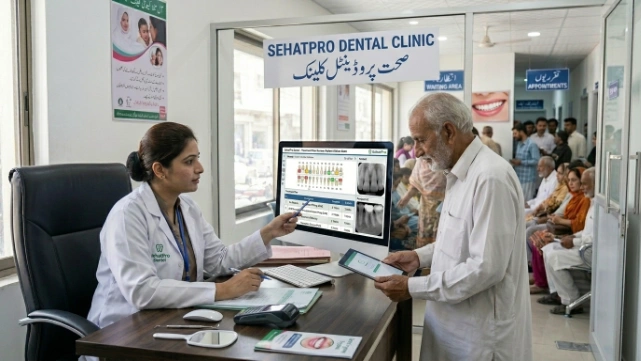
SehatPro’s unlimited patient records system keeps a lifetime dental history against every patient — procedure by procedure, sitting by sitting — accessible the moment they check in, whether they were last seen in your Faisalabad branch or your Lahore one. That single change removes the single biggest source of wasted chair time in a Pakistani dental practice: rebuilding a patient’s story from memory.
What Should Dental Clinic Software in Pakistan Actually Do?
At minimum, dental clinic software in Pakistan needs to handle scheduling, patient records, prescriptions, reminders, and reporting — and it needs to keep working when the internet doesn’t. Anything less just digitizes the same chaos on a screen.
Think about a typical Tuesday for a general dentist in Multan. Six scheduled appointments, four walk-ins who heard about you from a neighbor, one patient calling to ask if their crown has arrived from the lab, and a receptionist juggling all of it on a single landline. Software that only handles bookings and ignores everything else around it — the queue, the records, the follow-up — solves a fraction of the actual problem.
“Best Dental Clinic Software: The Non-Negotiable Core Features”
A dental practice in Pakistan should expect, at minimum:
- Appointment scheduling with live queue management, so walk-ins and bookings sit in the same visible line instead of two competing systems
- Dentist EMR software that stores tooth-by-tooth history, treatment stages, and attached images
- Print-ready prescriptions with your clinic letterhead, not handwriting an assistant has to decipher later
- Multilingual interface, because your front-desk staff may be far more comfortable working in Urdu than English
- Offline resilience, because Multan, Larkana, and Sahiwal don’t always have dependable broadband
What Gets Ignored — Until It Costs You
Clinics often skip evaluating reporting and reminders until they’ve already lost revenue to no-shows and can’t explain where a slow month came from. SehatPro’s patient reports and insights module exports daily and monthly numbers to Excel, so you can see patterns — a spike in extractions before Eid, a dip in scaling appointments during monsoon season — instead of guessing.
Dentist EMR Software: Turning X-Rays, Treatment Plans, and Prescriptions Into One Record
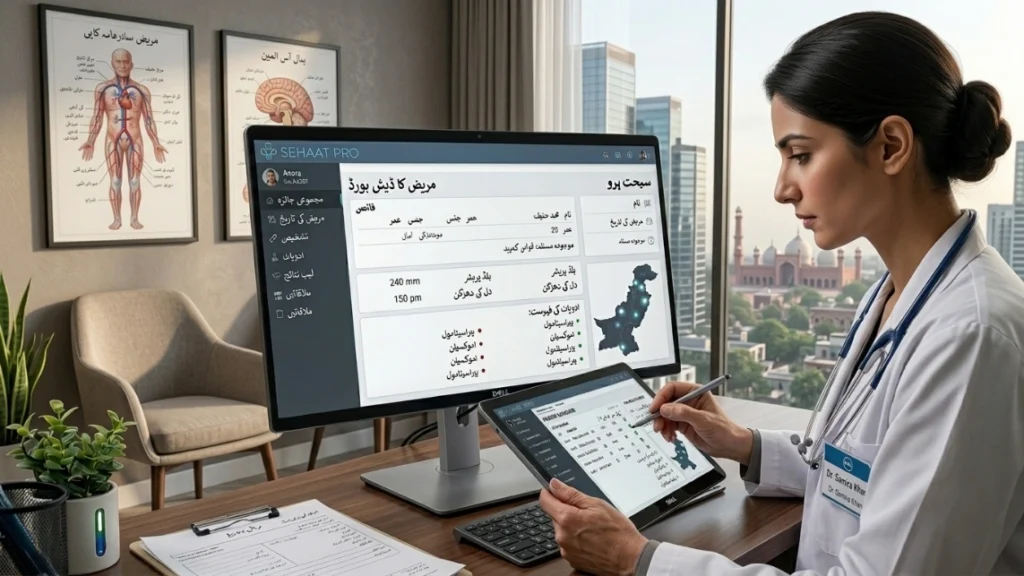
A dentist EMR is only useful if it holds everything a treatment plan actually needs — charting, notes, images, and prescriptions — in one patient file that any authorized staff member can open in seconds. Fragmented records slow down every single sitting.
Consider a cardiologist in Karachi versus a dentist in the same city. The cardiologist’s notes are largely narrative — symptoms, ECG readings, medication changes. A dentist’s notes are spatial and procedural: which tooth, which surface, which material, which sitting number of a three-stage root canal, and what the patient’s pain response was under anesthesia. Generic EMR templates built for physicians rarely capture this well, which is why dentists in Pakistan often still default to paper odontograms even after buying software.
Chairside Speed Matters More Than Feature Count
An assistant charting between patients doesn’t have time to click through six menus. SehatPro’s fast consultation and prescription writing workflow uses one-click diagnosis bundles and reusable templates — so a routine scaling-and-polishing note, or a standard post-extraction prescription, gets logged in seconds rather than typed fresh every time.
Records That Travel With the Patient
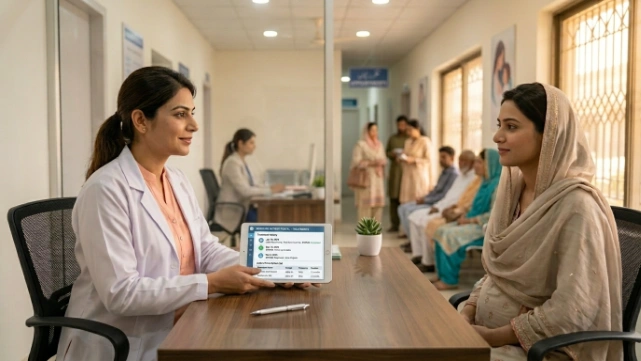
A gynecologist in Lahore rarely needs a patient’s history from a different clinic. A dentist frequently does — a patient walks in from Toba Tek Singh mid-treatment because they relocated for work, and you need to know exactly where their root canal was left off. With records stored on the cloud rather than a single clinic’s paper cabinet, that history is available the moment they’re checked in, provided your clinic runs on the same connected system across branches.
Pro Tip — SehatPro Insight: Across the 135+ doctors on SehatPro, the clinics that struggle most in month one aren’t the ones with the least tech-savvy staff — they’re the ones that try to migrate every old paper record on day one. Start with active patients only. Backfill historical files gradually over the first month, and your team adapts twice as fast.
Paper Files vs. Dental Practice Management Software: What Actually Changes
Moving off paper isn’t just about looking modern — it changes measurable outcomes: time per patient, error rate, and how much your staff can actually retain. Here’s what shifts when a Pakistani dental clinic switches.
| Factor | Paper-Based Dental Clinic | SehatPro Dental Practice Management |
|---|---|---|
| Time to pull a returning patient’s file | 3–5 minutes, longer if misfiled | Under 10 seconds via search |
| Prescription errors from handwriting | Common — especially with dosage and drug names | Eliminated with print-ready templates |
| Missed follow-ups / no-shows | No systematic tracking | Automated SMS/WhatsApp reminders |
| Staff workload during peak walk-in hours | High — manual queue and register entries | Reduced — live token queue auto-updates |
| Multi-branch record access | Not possible; each branch is siloed | Centralized, accessible from any branch |
| Data loss risk (fire, flood, misplacement) | High — single physical copy | Low — encrypted cloud backups |
| Monthly reporting for tax/compliance | Manual compilation, hours of work | Exportable to Excel in minutes |
The comparison isn’t close on any single row, but the cumulative effect is what actually matters — hours per week returned to patient care instead of paperwork.
How Do You Manage Walk-In Patients and Multi-Chair Scheduling Without Chaos?
Walk-in culture is the reality of Pakistani dentistry, and software that assumes every patient books ahead will fail on day one. You need a live queue that treats walk-ins and appointments as one system, not two.
A general physician in Multan might comfortably run an appointment-only clinic. A dentist rarely can — a cracked tooth, a dislodged filling, or sudden pain doesn’t wait for a scheduled slot, and turning away a walk-in in a competitive market means losing that patient permanently. The clinics that manage this well aren’t the ones that eliminate walk-ins; they’re the ones that absorb them without collapsing the day’s schedule.
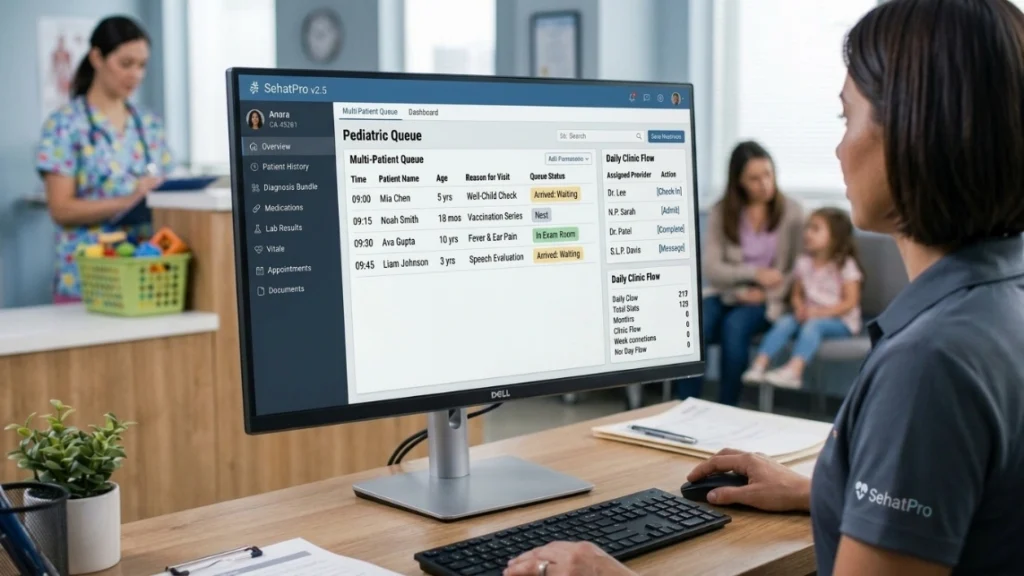
This is where SehatPro’s appointment scheduling and queue management system handles this automatically — booked patients and walk-ins share one live token queue, visible on-screen at the front desk and, in multi-chair clinics, synced across each operatory. A dermatologist in Sialkot running a single-chair practice needs a simple version of this. A multi-branch orthodontic chain in Faisalabad with four chairs running simultaneously needs the same core system scaled up, with each chair’s queue managed independently but reported centrally.
For a clinic with two or three dentists working different chairs at once, the token system prevents the classic Pakistani clinic problem: two patients told “aap ka number agla hai” at the same time, because two different staff members were managing the queue on paper independently.
Do WhatsApp and SMS Reminders Actually Reduce No-Shows for Dental Patients?
Yes — and the evidence is strong. Text message reminders have been shown to cut no-show rates by roughly 38% in controlled studies, with a broader review of multiple trials finding average reductions near 41%.
Dental treatment plans depend on patients showing up for sequenced visits. A missed root canal follow-up doesn’t just cost you the appointment slot — it risks the treatment outcome itself. A randomized study from Imperial College London found <cite index=”12-1″>no-show rates were 38% lower among patients who received a text message appointment reminder</cite> compared with those who received none. A broader systematic review across multiple healthcare settings found reminder systems produced <cite index=”15-1″>an average of 41% reduction in missed appointment rates and 34% increase in clinic attendance rates</cite> across the studies reviewed.
Pakistan’s connectivity has caught up enough to make this practical almost everywhere. By late 2025, the country had crossed <cite index=”25-1″>200 million telecom subscribers and 150 million broadband connections, with telecom coverage exceeding 92% and broadband penetration crossing 60%</cite>, according to the Pakistan Telecommunication Authority’s annual report. That means a WhatsApp reminder reaches a patient in Larkana or Mirpur-AJK nearly as reliably as one in Karachi.
SehatPro’s automated SMS and WhatsApp reminders send follow-up nudges for the specific cadence dentistry needs — a 48-hour reminder before a scheduled crown fitting, a same-day nudge for a scaling appointment, and post-extraction care instructions sent automatically in Urdu or English depending on the patient’s preference. For a pediatric dental practice in Islamabad, where parents juggle school pickup schedules against appointment times, this alone measurably reduces empty chair time.
Managing Multi-Branch Dental Chains and Role-Based Staff Access
If you run more than one location, your software needs to centralize patient records while still giving each branch its own operational independence. Without that, multi-branch growth just multiplies your paperwork problem.
A single-dentist clinic in Sahiwal has simple needs. A dental chain with branches in Lahore, Faisalabad, and Karachi has a fundamentally different problem: a patient who started orthodontic treatment in one city may walk into another branch mid-treatment, and the receiving dentist needs the full history immediately — not a phone call to the original branch’s receptionist.
Role-Based Access Protects Both Patients and Staff
Not every staff member needs to see everything. A receptionist should manage scheduling and basic patient details. A lab technician connected through QuickLab integration needs access to test and imaging orders, not full treatment notes. A dentist needs full clinical access. SehatPro’s support for multi-branch clinics builds this separation in by default, with role-based permissions that keep sensitive clinical decisions with clinicians while still letting front-desk staff run day-to-day operations smoothly.
One Owner, One View, Every Branch
For the clinic owner or practice manager, centralized reporting matters as much as centralized records. Instead of calling each branch manager for a monthly summary, SehatPro’s patient reports and insights consolidate revenue, patient volume, and treatment-type breakdowns across every branch into one exportable view — useful when deciding whether it’s time to open a fourth chair in Faisalabad or add a second dentist in Karachi.
Choosing the Right Clinic Software for Dentists: Pricing and What to Check
Price alone shouldn’t decide your software — but cost-sensitivity is real for Pakistani clinics, and the right plan depends on your patient volume, branch count, and internet reliability. Match the plan to how your clinic actually operates, not to the most expensive tier.
Cost is consistently the top objection dentists raise before adopting clinic software — and it’s a fair concern. A solo dental practitioner in Toba Tek Singh doesn’t need the same plan as a five-branch chain in Karachi. This is why tiered, transparent pricing matters more than feature lists alone.
Step-by-Step: Evaluating Clinic Software for Your Dental Practice
- Count your active patient volume — a low-volume solo practice may only need CareStart at PKR 2,999/month; a busy multi-chair clinic needs a higher tier
- Check your internet reliability honestly — if your area has frequent outages, prioritize an offline-capable plan like ProCare (PKR 79,999 one-time)
- Confirm Urdu-language support for your front desk — your receptionist’s comfort with the interface determines adoption speed
- Ask about data security specifics, not just marketing language — encryption standards, backup frequency, and who can access patient data
- Test the prescription and EMR workflow chairside, not just in a demo — speed under real patient load is what matters
- Confirm multi-branch and role-based access if you’re planning to expand, even if you’re single-branch today
Data privacy deserves particular attention in dentistry, where treatment records include imaging and long-term histories. SehatPro’s data privacy and security framework uses encrypted cloud backups, so a hardware failure at your clinic — or a fire, which remains a real risk for paper-based practices — doesn’t mean losing years of patient history.
Conclusion
Your clinic’s paperwork shouldn’t be the reason a patient waits twenty extra minutes for a filling they scheduled a week ago. The clinics that get the most out of dental clinic software Pakistan-wide aren’t the ones with the fanciest features — they’re the ones that matched the software to how they actually work: walk-ins alongside bookings, Urdu-speaking staff, and connectivity that isn’t always guaranteed.
Four things to act on: get your active patient records off paper first, not everything at once. Turn on automated reminders before your next ortho or root-canal cohort starts missing follow-ups. Give your front desk a live queue instead of a shared diary. And pick a pricing tier that matches your actual patient volume, not the biggest package available.
Ready to see how SehatPro can simplify your clinic? Book a free demo today.
Related reading: How EMR Software Is Changing Patient Records for Small Clinics in Pakistan and Multi-Branch Clinic Management: A Practical Guide for Growing Pakistani Healthcare Chains.
FAQ
What is the best dental clinic software in Pakistan for a small, single-chair practice?
For a solo dentist, look for software with simple scheduling, a live walk-in queue, and print-ready prescriptions without a steep learning curve. SehatPro’s CareStart plan (PKR 2,999/month) covers appointment handling, basic EMR, and reminders — built for exactly this kind of clinic without unnecessary multi-branch features.
How much does dental clinic software Pakistan clinics use typically cost?
Pricing usually ranges from around PKR 2,999/month for basic plans to one-time offline packages near PKR 79,999 for clinics needing full independence from internet connectivity. Enterprise pricing for multi-branch chains is usually custom, based on branch count and patient volume.
Does dentist EMR software work well in areas with unreliable internet?
It can, if the platform offers an offline installation option. Cloud-only systems struggle during outages common in smaller cities and rural areas. Look for a plan built specifically for intermittent connectivity, so patient records and prescriptions remain accessible even during a power or internet disruption.
Is clinic software for dentists difficult for Urdu-speaking staff to learn?
Not if the interface itself is available in Urdu. Software built only in English creates a real adoption barrier for receptionists and assistants more comfortable working in local languages. A multilingual interface — Urdu, English, and others — removes this friction almost entirely within the first week of use.
How secure is patient data in cloud-based dental practice management software?
Reputable platforms use encryption both in transit and at rest, along with automated cloud backups, so data isn’t lost to hardware failure, theft, or fire. Ask any vendor directly about their backup frequency and who within the clinic has access to sensitive treatment records before signing up.
How long does it take to set up dental clinic software Pakistan clinics can start using immediately? Most cloud-based systems can be set up within a day, with staff training typically completed within the first week of daily use. Full migration of historical paper records takes longer and is best done gradually, starting with active patients rather than the entire archive at once.