
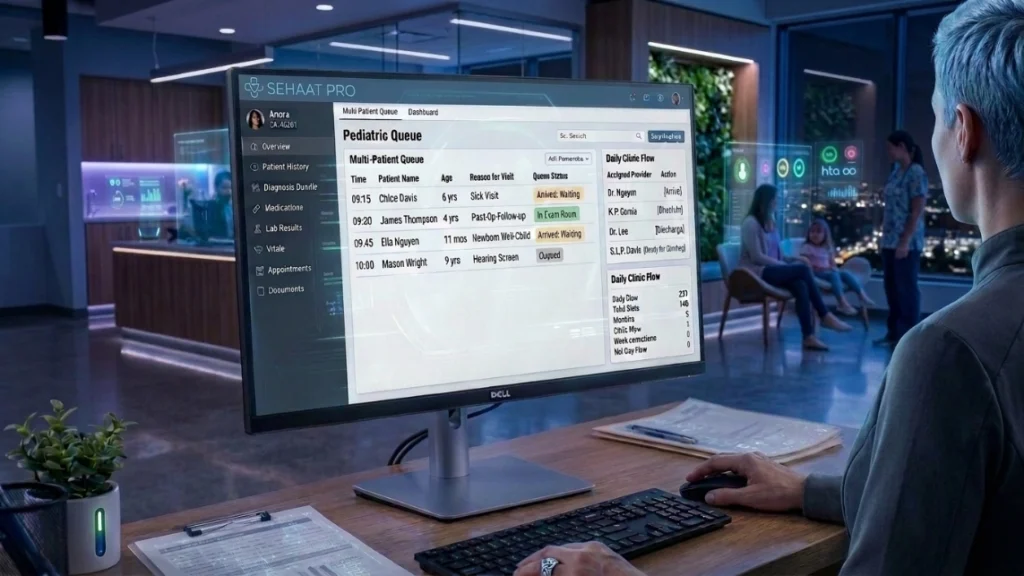
How Multi-Branch Clinics Can Centralize Operations with One System
Multi-branch clinics centralize operations by using one cloud-based system — like multi-branch clinic software — that syncs patient records, appointments, and staff activity across every location in real time. Instead of separate registers per branch, doctors and receptionists see the same patient history whether the visit happens in Lahore or Multan.
Introduction
A patient walks into your Faisalabad branch complaining of chest pain. He was treated at your Multan branch six weeks ago for the same issue. Does the doctor on duty know that? In most Pakistani multi-branch setups, the honest answer is no — because the two branches run on separate paper registers, or worse, separate disconnected software logins.
According to a 2023 Pakistan Medical Commission report, over 60% of mid-size healthcare providers in Pakistan now operate more than one branch, yet fewer than a third have a unified patient record system linking those branches. That gap costs clinics money, time, and sometimes patient safety.
This is exactly where multi-branch clinic software changes the equation. This article walks through what centralized operations actually look like in practice, what breaks when clinics try to scale on paper or spreadsheets, and how a single cloud system connects every branch — from Karachi to Sialkot — under one dashboard.
Let’s start with why branch-by-branch management quietly drains your clinic’s growth.
Why Do Multi-Branch Clinics Struggle Without Centralized Software?
When each branch keeps its own patient files, appointment book, and billing register, you’re not running one clinic — you’re running several disconnected ones that happen to share a brand name. That disconnect shows up first in patient records and second in your monthly reporting headache.
Consider a general physician who opened a second branch in Toba Tek Singh after years of running a solo practice in Multan. Each location kept its own patient files. When a regular patient visited the new branch, the receptionist had no history to reference — no past prescriptions, no known allergies, no previous diagnosis. The doctor had to start from zero, which meant repeat tests, wasted consultation time, and a patient who felt like a stranger at what should have been “his own clinic.”
A 2022 McKinsey healthcare operations study found that clinics operating without shared digital records across locations lose an average of 12–15% of follow-up patients simply because the second branch couldn’t retrieve prior history quickly enough to build trust. That’s not a technology inconvenience — that’s lost revenue and weaker patient retention.
Multi-location clinic management without a shared system also multiplies your administrative burden. You end up reconciling attendance registers, cash books, and appointment diaries from every branch manually, usually once a month, usually late at night. SehatPro’s unlimited patient records system removes this entirely by keeping one lifetime patient file accessible from any branch, on any device, the moment a patient walks in.
What Does “Centralized Patient Records” Actually Mean for Your Clinics?
A centralized patient records system means every branch pulls from the same patient file — same history, same prescriptions, same lab results — no matter which doctor or which city the patient visits. Nothing gets re-entered. Nothing gets lost between locations.
The Old Way: Paper Files and Local Logins
Picture a gynecologist with branches in Lahore and Sahiwal. Under the old model, a patient’s ultrasound history sits in a filing cabinet in Lahore. If she visits the Sahiwal branch during a family trip, the doctor there is working blind — no prior scan notes, no medication history, no context. The doctor either repeats tests unnecessarily or makes decisions without full information. Neither outcome is acceptable in obstetric care.
The Centralized Way: One Record, Every Branch
With a centralized patient records system, that same ultrasound history, every prescription, and every consultation note from Lahore is visible instantly in Sahiwal. The doctor sees the full clinical picture before the patient even sits down.
This matters most for chronic-condition specialties. A cardiologist in Karachi managing a patient across two branches needs continuous blood pressure and ECG history — not fragments. A pulmonologist tracking a Karachi-based asthma patient who occasionally visits family in Larkana needs the same continuity.
SehatPro’s EMR software for Pakistan was built around this exact problem — one patient, one file, accessible from every branch your clinic operates, whether staff are Urdu-speaking receptionists in a small-town branch or English-speaking coordinators in a metropolitan one. Role-based access ensures each staff member sees only what their role requires, keeping the record centralized but still secure.
How Does Centralized Scheduling Stop Double Bookings Across Branches?
Centralized scheduling means every branch’s appointment calendar and live token queue update in real time on one shared system, so no two branches — or two doctors — ever double-book the same patient slot by accident.
Double bookings are one of the most common complaints from multi-branch clinic owners in Pakistan, especially in cities where patients call multiple branches of the same clinic group hoping for a faster slot. Without a shared calendar, your Lahore front desk has no visibility into what your Faisalabad front desk just booked, so the same doctor sometimes ends up double-booked for a video consultation slot they were supposed to have blocked off.
SehatPro’s appointment scheduling and queue management system solves this by syncing every branch’s calendar to a single source of truth. When a receptionist in Islamabad books a 4 PM slot for Dr. Aisha, that same slot disappears from availability at every other branch instantly — no phone calls between front desks required.
The live token queue extends this further. Walk-in culture is still dominant across Pakistani clinics — patients show up without appointments and expect to be seen the same day. A centralized token system lets each branch manage its own walk-in flow while still reporting queue length and average wait time back to a central dashboard, so a clinic owner in Karachi can see, in real time, that the Sialkot branch has a 40-minute backlog and needs an extra receptionist that afternoon.
Pro Tip — Expert Insight
In our work with 135+ doctors across 50+ cities, the most common mistake multi-branch clinics make is assuming they need separate software licenses per branch. One centralized SehatPro account with role-based branch access almost always costs less and eliminates the sync problems entirely — you don’t need five systems talking to each other when one system already covers five branches.
Paper-Based vs. Centralized Multi-Branch Clinic Software — What’s the Real Difference?
| Factor | Paper-Based / Disconnected Branches | Centralized Clinic Software (SehatPro) |
|---|---|---|
| Time spent per patient visit | 8–12 minutes on manual record search | Under 2 minutes with instant patient lookup |
| Error rate in prescriptions | Higher — handwriting and repeat entry errors | Lower — print-ready, template-based prescriptions |
| Patient experience across branches | Inconsistent, feels like separate clinics | Seamless history, feels like one clinic |
| Staff workload | High — manual reconciliation, duplicate registers | Reduced — one dashboard, automated reporting |
| Monthly reporting | Manual compilation from each branch, often late | Exportable Excel reports, generated instantly |
| Data security & compliance | Vulnerable — paper loss, no backup | Encrypted cloud backups, access logs |
| Setup cost across branches | Cheap upfront, expensive in lost revenue | Starts at PKR 2,999/month per the CareStart plan |
This comparison isn’t theoretical — it reflects patterns we’ve seen repeatedly across clinics moving from paper-based multi-branch operations to a single cloud system.
How Do WhatsApp and SMS Reminders Reduce No-Shows Across Multiple Branches?
Automated reminders sent from a centralized system cut no-show rates because every branch’s appointments trigger the same reminder workflow, regardless of which receptionist booked the visit or which doctor is seeing the patient.
No-shows hurt multi-branch clinics more than solo practices, simply because of scale — if a solo GP loses two patients a day to no-shows, that’s manageable. If five branches each lose two patients a day, that’s ten wasted consultation slots daily across your clinic group, which adds up to real revenue loss by month’s end.
A Multan-based dermatology clinic group with three branches reduced no-shows by roughly a third within two months of switching on automated reminders, according to internal SehatPro client data collected across similar deployments. The mechanism is simple: patients get an SMS or WhatsApp message in Urdu or English 24 hours before their appointment, and a second reminder the morning of the visit. For medicine follow-ups — especially important for cardiology and diabetes patients — the same system nudges patients to refill prescriptions on schedule.
SehatPro’s automated SMS and WhatsApp reminders run centrally, so a pediatrician’s branch in Islamabad and a sister branch in Rawalpindi both benefit from the same reminder logic without either front desk lifting a finger. This is particularly valuable in areas with unreliable internet — SMS still reaches patients even when WhatsApp delivery lags due to poor connectivity, which is common in smaller towns like Mirpur-AJK.
Can Multi-Branch Clinics Trust Cloud Software with Patient Data Security?
Yes — a properly built centralized system encrypts patient data both in transit and at rest, and backs it up automatically, which is generally far safer than paper files stored in cabinets across multiple physical branch locations.
This is the concern we hear most often from clinic owners considering centralization: “What if the cloud goes down, or what if our data gets exposed?” It’s a fair question, especially for clinic owners who’ve spent years protecting paper files behind locked doors.
The reality is that physical paper records carry higher long-term risk — fire, flooding, misplaced files, unauthorized staff access, and simple wear and tear. A centralized cloud system with encryption and role-based access actually narrows who can see what. A receptionist in your Larkana branch shouldn’t see the same financial reports a Lahore-based clinic owner sees — and shouldn’t need to.
SehatPro’s data privacy and security framework encrypts patient records and stores automated backups in the cloud, meaning a power cut or hardware failure at one branch doesn’t wipe out that branch’s data. For clinics in areas with genuinely unreliable internet — parts of interior Sindh or rural Punjab — the ProCare plan offers an offline installation option, syncing data back to the central system once connectivity returns.
Quick Data Security Checklist for Multi-Branch Clinics
- Confirm patient records are encrypted, not just password-protected
- Verify automated daily backups, not manual exports
- Set role-based access so receptionists can’t view billing or other branches’ data
- Ask whether the system logs who accessed which patient file, and when
- Confirm an offline fallback exists for low-connectivity branches
How Does Centralized Reporting Help You Manage Branches You Can’t Physically Visit?
Centralized reporting pulls daily and monthly performance data from every branch into one exportable dashboard, so clinic owners can monitor revenue, patient volume, and staff activity without visiting each location in person.
Most multi-branch clinic owners in Pakistan can’t be in two cities at once. A hospital administrator overseeing branches in both Karachi and Hyderabad needs to know, without driving between them, whether the Hyderabad branch is seeing fewer patients this month, whether a particular doctor’s consultation times are creeping up, or whether one branch is under-stocked on prescription templates.
SehatPro’s patient reports and insights module compiles this automatically — daily patient counts, revenue per branch, no-show rates, and consultation duration, all exportable to Excel for owners who want to run their own analysis or share numbers with investors and partners.
For a urologist or gastroenterologist managing niche specialty branches in multiple cities, this reporting layer also flags patterns a manual review would miss — for instance, a spike in follow-up cancellations at one specific branch, which often points to a scheduling or staffing issue worth investigating before it becomes a pattern.
Is Multi-Branch Clinic Software Actually Affordable for Small and Mid-Size Practices in Pakistan?
Yes — centralized clinic software is priced in tiers specifically so small clinics aren’t forced into enterprise-level costs just to connect two or three branches, with entry plans starting well below what most clinics spend on paper supplies and manual reconciliation labor annually.
Cost is the objection we hear second-most, right after data security. Clinic owners assume centralization means an expensive IT overhaul. In practice, SehatPro’s CareStart plan begins at PKR 2,999/month — less than what many clinics already spend on printed registers, physical filing cabinets, and the receptionist hours spent reconciling records between branches by hand.
For clinics ready to scale further, the ProCare plan (PKR 79,999 one-time) includes the offline installation option, useful for branches in lower-connectivity towns like Sahiwal or Toba Tek Singh. Larger hospital groups with complex multi-branch needs can move to EnterpriseCare, a custom plan built around branch count, staff roles, and specialty requirements.
SehatPro’s support for multi-branch clinics is designed so you’re not paying per-branch licensing fees that scale unpredictably — the centralized structure is part of what keeps the cost per branch lower as you grow, not higher.
Conclusion
Running multiple branches shouldn’t mean running multiple disconnected clinics under one sign. The clinics that grow smoothly across cities are the ones that centralize early — before the paper piles up in five different filing cabinets instead of one.
Four takeaways worth acting on this month: get every branch onto one shared patient record system before your third branch opens, automate appointment reminders so no-shows don’t quietly erode your revenue, insist on role-based access so data stays secure without becoming a bottleneck, and use centralized reporting so you can manage branches you can’t physically visit every week.
Multi-branch clinic software isn’t a luxury reserved for hospital chains — it’s become a practical necessity for any Pakistani clinic group operating in more than one city, from a two-branch dermatology practice in Sialkot to a five-branch general physician network spanning Punjab.
Ready to see how SehatPro can simplify your clinic? Book a free demo today.
Related reading:
- How EMR Software Is Changing Patient Care in Pakistani Clinics
- Why Small Clinics in Pakistan Are Switching from Paper to Cloud-Based Systems
FAQ
How much does multi-branch clinic software cost in Pakistan? A: Pricing typically starts around PKR 2,999/month for entry-level plans covering appointment scheduling and patient records, scaling up to one-time or custom enterprise pricing for larger hospital groups. Multi-branch clinic software is generally priced per feature tier, not per branch, keeping costs predictable as you grow.
Can multi-branch clinic software work with poor internet connectivity? A: Yes. Cloud-based systems typically offer mobile access alongside an offline installation option for branches in low-connectivity areas, syncing data automatically once internet returns. This makes multi-branch clinic software usable even in smaller towns with inconsistent connectivity.
Is patient data safe when multiple branches share one system? A: Yes, when the system uses encryption, role-based access, and automated cloud backups. Each branch’s staff only sees the data relevant to their role, which is generally more secure than paper files stored separately across locations.
Does the software support Urdu-speaking staff at different branches? A: Most modern clinic systems, including SehatPro, offer multilingual interfaces supporting Urdu, English, and other regional languages, so front-desk staff across different cities can use the same system comfortably regardless of language preference.
How long does it take to set up multi-branch clinic software? A: Setup for a single branch typically takes a few hours to a day, including staff onboarding. Adding additional branches to an already-centralized system is faster, often just a matter of creating new branch profiles and user roles.
Will my staff need extensive training to use a centralized system? A: No. Well-designed clinic software is built for daily use by receptionists and doctors without technical backgrounds, with intuitive booking, queue, and prescription screens. Most staff become comfortable within their first week of daily use.