Why Every Modern Clinic Needs a Live Queue & Token System
A clinic queue management system organizes walk-in and appointment patients into a live, numbered token sequence, visible on a screen or the patient’s phone. It replaces first-come chaos with a transparent order, reduces patient waiting time, prevents double bookings, and gives receptionists a clear, real-time view of who’s next — without shouting names across a crowded waiting room.
Introduction
At Shalamar Hospital in Lahore, researchers tracked 105 patient visits through the outpatient gynecology clinic and found an average wait of just over 45 minutes — with some patients waiting nearly twice that. Their own conclusion: implement staggered appointments and a token system to fix it. That single recommendation captures a problem playing out in clinics from Multan to Mirpur every single day.
You know the scene. Ten patients arrive at 10 AM because “the doctor said morning.” Your receptionist is juggling a phone call, a walk-in, and a register that three people are trying to read upside down. Nobody knows who’s next. Tempers rise. The doctor gets interrupted mid-consultation to settle an argument about turn order.
A clinic queue management system fixes this at the root — not by asking patients to behave differently, but by giving your front desk a tool that tracks order automatically, in real time, whether the patient booked online or walked in five minutes ago.
This article walks through what a live token system actually does, how it fits into a Pakistani clinic’s daily rhythm, and what to look for before you buy one.
What Does a Clinic Queue Management System Actually Do?
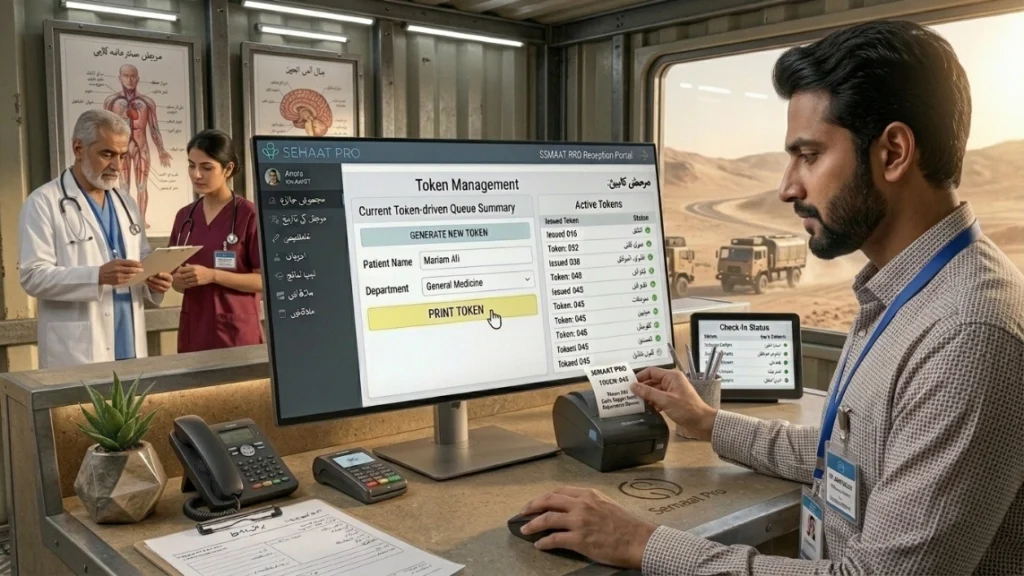
A queue management system assigns every patient a live token the moment they check in, then displays the current number being served on a screen, tablet, or WhatsApp update — so nobody needs to ask “kitna number chal raha hai” every ten minutes.
Under the hood, it’s doing three jobs at once. First, it merges your appointment list and your walk-in line into a single ordered queue, so a patient who booked for 11 AM doesn’t get pushed behind six walk-ins who arrived first. Second, it timestamps every stage of the visit — check-in, vitals, consultation, prescription — which is exactly the breakdown the Shalamar Hospital study used to find where time was actually being lost. Third, it frees your receptionist from manually calling names, which matters more than it sounds in a clinic where the waiting room is standing-room-only by 10 AM.
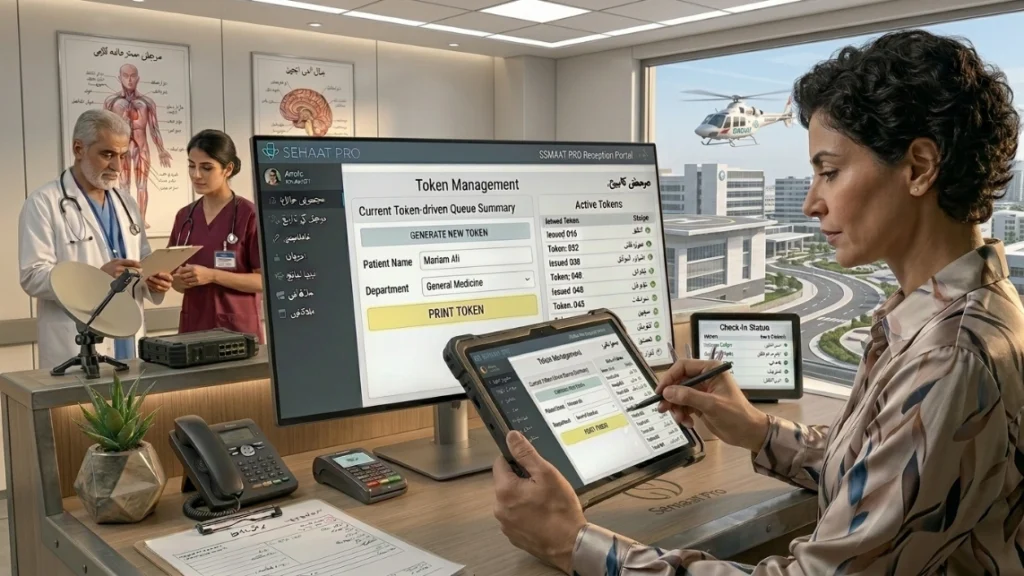
In SehatPro, this lives inside the same screen as appointment scheduling and queue management, so a general physician in Multan sees appointments and walk-ins on one live board instead of switching between a diary and a token register. A pediatrician in Islamabad running two consultation rooms can split the queue by room without maintaining two separate paper lists. And because the interface works in Urdu as well as English, your front desk staff doesn’t need English fluency to run it correctly from day one.
Why Do Pakistani Clinics Struggle With Patient Flow More Than Most?
Pakistani clinics deal with a walk-in culture that most off-the-shelf international software simply wasn’t built for — patients arrive without appointments, expect to be seen the same day, and often bring extended family along, all of which paper registers and rigid scheduling tools handle badly.
Consider a typical Saturday at a general practitioner’s clinic in Faisalabad. Appointments are booked for 40 patients, but another 25 walk in because it’s the weekend and people are off work. The paper register fills two pages. Patients start comparing arrival times out loud. The receptionist, who is also answering the clinic phone, has no reliable way to say who’s actually next — because “next” depends on both the register and memory.
This is compounded by three local realities:
Unstable internet in smaller cities and towns. A queue system that freezes when the connection drops for two minutes is worse than no system at all — it erodes staff trust immediately. This is precisely why SehatPro’s ProCare plan includes an offline installation option, so clinics in areas with inconsistent connectivity in places like Sahiwal or Toba Tek Singh keep running the queue locally, syncing to the cloud once the connection returns.
Urdu-speaking front desk staff. Software built for a Western clinic assumes English-fluent administrative staff. That assumption doesn’t hold in most Pakistani clinics, where receptionists are skilled at patient handling but may be more comfortable working in Urdu.
Joint-family patient visits. A single token often represents three or four people — the patient, a parent, and someone assisting an elderly relative. A good queue system needs to display token numbers large enough and clearly enough that an entire waiting room can track their turn without repeatedly asking staff.
The Multi-Branch Complication
For clinics with more than one location — a dermatologist running branches in Sialkot and Lahore, for instance — an unlinked queue means a patient calling to ask about wait times gets a guess, not an answer. SehatPro’s support for multi-branch clinics keeps each branch’s queue live and visible from a central dashboard, so front-desk staff — or the doctor, from home — can see exactly how backed up any location is at any moment.
How Does a Token System Actually Reduce Patient Waiting Time?
A live token system reduces waiting time by eliminating the two biggest sources of delay in a manual queue: patients arriving early to “hold their place,” and staff spending time resolving disputes about turn order instead of processing patients.
When patients know their token number and can track it — on a waiting room screen or a WhatsApp update — they stop clustering at the front desk asking for updates. That alone gives your receptionist back meaningful time during peak hours. The Shalamar Hospital study found that the longest single delay in the entire patient journey, roughly 20 minutes, happened before history-taking and examination even began — a stage almost entirely dependent on how smoothly patients are called and moved into the room. A live queue directly targets that bottleneck.
There’s a second, quieter benefit: predictability. When a token system shows “Token 14 is being served, you are Token 19,” a patient can step out for tea, pray, or take a call, instead of standing in a doorway for fear of missing their turn. That’s a small thing that changes how a clinic feels to sit in.
Reminders compound this effect before the patient even arrives. A systematic review of appointment-reminder studies published in the Pan African Medical Journal found an average 41% reduction in missed-appointment rates and a 34% increase in attendance where automated reminders were used. Fewer no-shows means fewer empty slots disrupting your day’s schedule — and fewer reshuffled queues. SehatPro’s automated SMS and WhatsApp reminders send this automatically, timed ahead of the appointment, in the patient’s preferred language.
Expert Insight — From SehatPro’s Experience Across 135+ Doctors The clinics that see the biggest drop in waiting-room complaints aren’t always the busiest ones — they’re the ones that stopped letting walk-ins and appointments live in two separate systems. The single most common mistake we see is a clinic buying queue-display hardware before fixing the underlying scheduling logic. A screen showing token numbers doesn’t help if the numbers behind it were assigned inconsistently. Fix the queue logic first; the display is just the visible part.
Paper Register vs. Live Queue System: What Actually Changes?
Moving from a paper token register to a live digital queue changes more than speed — it changes error rates, staff workload, and how prepared you are if a health department or insurance panel ever asks for records.
| Factor | Paper-Based Queue | SehatPro Live Queue System |
|---|---|---|
| Time to check in a patient | 2–4 minutes, manual writing | Under 30 seconds, tap to check in |
| Risk of duplicate/lost tokens | High — torn pages, illegible handwriting | Near zero — system-generated, timestamped |
| Walk-in vs. appointment conflicts | Frequent disputes, staff mediates manually | Automatically merged into one live order |
| Patient visibility into wait | None — must keep asking staff | Live screen + WhatsApp/SMS updates |
| Staff workload during peak hours | High — constant name-calling, register management | Lower — system calls next token automatically |
| Data for reporting | Manual counting, hours of work | One-click exportable reports |
| Multi-branch visibility | Not possible without phone calls | Live dashboard across all branches |
| Compliance/audit readiness | Weak — paper can be lost or altered | Strong — timestamped, backed up, encrypted |
What About Data Privacy and Losing Patient Records?
Clinics moving off paper worry most about two things: losing patient history if a system fails, and whether digital records are actually more private than a locked filing cabinet — and both concerns are addressable with the right setup.
A paper file cabinet feels safe because it’s physical, but it’s also one office fire, one flood, or one misplaced folder away from years of patient history disappearing. Digital records carry a different risk profile: they need encryption, access control, and reliable backups, but done correctly, they’re dramatically harder to lose. SehatPro stores every patient’s history under unlimited, lifetime patient records, backed up automatically to the cloud, with encrypted, access-controlled data privacy so a receptionist can check in a patient without being able to view sensitive diagnosis notes meant only for the treating doctor.
This matters specifically because Pakistan’s internet access is still uneven. Nationwide, internet penetration stood at 45.7% at the start of 2025, with roughly 116 million users, meaning a meaningful share of your patients — and possibly your own clinic location — deal with inconsistent connectivity. A cloud system that can’t function offline isn’t realistic for every clinic in the country. That’s the specific gap SehatPro’s ProCare offline installation plan is built to close, syncing records the moment connectivity returns rather than losing data in the gap.
Role-based access solves the second half of the privacy question. Your receptionist needs to manage the queue and confirm appointments — not read consultation notes. Your lab staff need test orders — not full medical history. Setting this up correctly from day one avoids the awkward conversation later about who can see what.
Will My Staff Actually Be Able to Use This Without Extensive Training?
The staff who resist new clinic software almost never resist because they can’t learn it — they resist because past systems were built in English, assumed fast internet, and required more clicks than the paper method they already knew by heart.
A queue and token system designed for a Pakistani clinic needs to clear a much lower bar than most software reviews assume: can a receptionist who has never used a computer beyond WhatsApp check a patient in during a busy Monday morning without calling for help? SehatPro’s interface runs in Urdu, English, Arabic, Sindhi, and 27+ other languages, specifically so that staff comfort isn’t a barrier to adoption.
Here’s a realistic first-week rollout checklist we recommend to new clinics:
- Day 1: Set up doctor profiles, consultation rooms, and working hours in the system.
- Day 2: Import or manually enter existing patient records — SehatPro’s team assists with bulk imports where paper records exist.
- Day 3: Run the token queue for appointments only, keeping walk-ins on paper as a backup.
- Day 4–5: Merge walk-ins into the live queue once staff are comfortable with check-in and calling next-token flows.
- End of Week 1: Pull your first exportable report from patient reports and insights to review how many patients were seen, average time per consultation, and no-show rate.
Clinics that follow a staged rollout like this — rather than switching everything at once on a Monday morning — see far less staff pushback, because nobody is learning five new workflows simultaneously during a live patient rush.
How Does This Connect to Prescriptions, EMR, and the Rest of the Consultation?
A queue system that doesn’t talk to your EMR and prescription tools just moves the chaos from the waiting room into the consultation room — the real gain comes when check-in, consultation, and prescription writing share the same patient record automatically.
When a patient’s token is called in SehatPro, the doctor opens the consultation screen already populated with that patient’s full history — previous visits, past prescriptions, allergies, lab results from connected labs via QuickLab integration. There’s no re-asking questions the patient already answered last visit, which is exactly the kind of delay the Shalamar Hospital study flagged as the longest bottleneck in the entire pathway. From there, fast consultation and print-ready prescription writing, along with one-click diagnosis bundles for common conditions, lets a cardiologist in Karachi or a dermatologist in Sialkot move from consultation to a legible, printed prescription in under a minute — instead of the handwritten notes that cause pharmacy call-backs and dosage confusion.
This is where a queue system stops being a waiting-room gadget and becomes what it should be: the front door to a clinic that runs on one connected system instead of five disconnected habits.
Conclusion
A crowded waiting room doesn’t have to mean a chaotic one. The clinics that fix this fastest aren’t the ones with the most expensive equipment — they’re the ones that stop treating check-in, queue order, and consultation as three separate problems. A clinic queue management system brings walk-ins and appointments into one live order, cuts the time patients spend wondering when they’ll be seen, and gives your front desk a tool built for how Pakistani clinics actually operate — Urdu interface, offline capability, and all.
Three things to act on this week: audit how much time your staff currently spends resolving queue disputes, check whether your reminder system (if you have one) is actually reducing no-shows or just sending texts nobody reads, and walk through your patient check-in process as if you were a first-time patient — note every point of confusion.
Ready to see how SehatPro can simplify your clinic? Book a free demo today.
Related reading: How EMR Software Cuts Prescription Errors in Pakistani Clinics and Multi-Branch Clinic Management: Keeping Every Location in Sync.
FAQ
How much does a clinic queue management system cost in Pakistan?
Pricing depends on clinic size and features. SehatPro’s CareStart plan begins at PKR 2,999/month and includes appointment scheduling and live queue management, with higher tiers up to ProCare (PKR 79,999 one-time) for offline installation and larger clinics needing custom EnterpriseCare arrangements.
Is a clinic queue management system difficult for non-technical staff to learn?
Not if it’s built for real clinic workflows. SehatPro’s interface works in Urdu, English, and 27+ other languages, and most receptionists learn the basic check-in and queue-calling flow within a single day of guided use.
Can a token system work if my clinic has unreliable internet?
Yes. SehatPro’s ProCare plan includes an offline installation option that runs locally and syncs to the cloud once connectivity returns, which matters given that many Pakistani towns still face inconsistent broadband access.
Does a queue system reduce patient waiting time or just organize the line?
Both. A study at Shalamar Hospital, Lahore found average outpatient wait times of roughly 45 minutes and specifically recommended a token system to reduce them, since organized order eliminates the delays caused by disputed turns and duplicate check-ins.
Is patient data safe in a cloud-based queue and clinic management system?
Reputable systems use encryption, role-based access, and automated backups. SehatPro restricts sensitive medical notes to treating doctors while giving receptionists only the access needed to manage scheduling and check-in.
How is a token system different from just numbering patients on paper?
A digital clinic queue management system automatically merges walk-ins with appointments, timestamps each stage of the visit, displays live updates to patients, and generates reports — none of which a paper register can do without significant manual effort.